
For most HGV drivers in England, the core legal limits are: no more than 9 hours driving per day (extendable to 10 hours twice a week), 56 hours in any single week, and 90 hours across any two consecutive weeks. A 45-minute break is required after every 4.5 hours at the wheel. These are the assimilated rules — what used to be called EU rules — and they govern the majority of goods vehicle drivers on UK roads today.

GB domestic rules, which apply to lighter vehicles and exempt operations, set a different ceiling: up to 10 hours driving per day, with a maximum 11-hour duty period for company drivers. GOV.UK’s drivers’ hours pages and DVSA guidance are the two sources you should have ready at any roadside check.
Which rule set applies to you?
- Assimilated rules: goods vehicles over 3.5 tonnes maximum permissible mass, driving in the UK or to/from an EU country
- GB domestic rules: most goods vehicles exempt from assimilated rules (typically under 3.5 tonnes, certain local operations)
- AETR rules: journeys to or through non-EU countries (Norway, Switzerland, Turkey and others)
From 1 July 2026, assimilated rules will extend to some light goods vehicles over 2.5 tonnes for certain international operations. If your fleet includes vans in that weight band doing cross-border work, check the updated GOV.UK assimilated rules guidance now.
Table of Contents
- 1. How to tell which rule set applies to your journey
- 2. At-a-glance numeric limits for drivers’ hours
- 3. Breaks and rest periods explained, with timeline examples
- 4. When a tachograph is required and how to keep lawful records
- 5. How the Working Time Directive interacts with drivers’ hours
- 6. Common exemptions and special operational cases
- 7. What enforcement officers check and the likely penalties
- 8. Daily and weekly compliance checklist
- 9. Where to read the rules and who to contact for authoritative help
- Key takeaways
- The compliance routine that actually protects you
- Authoritative links and downloadable templates
1. How to tell which rule set applies to your journey
The single most important question before any shift is: which legal regime governs today’s driving? Get this wrong and every limit, record, and break you apply could be the wrong one.
The threshold for assimilated rules is a maximum permissible mass above 3.5 tonnes, whether you are driving in the UK or crossing into EU territory. Cabotage operations and international haulage fall squarely under assimilated rules. A local delivery van under 3.5 tonnes doing purely domestic work will typically fall under GB domestic rules instead, where written weekly record sheets are acceptable rather than a tachograph.
AETR rules cover journeys that pass through or terminate in non-EU third countries. The practical difference from assimilated rules is narrow for most drivers, but the paperwork requirements and some rest provisions differ, so it is worth checking the GOV.UK AETR guidance if your routes include Norway or Switzerland.
For passenger vehicles, buses and coaches have their own parallel structure: assimilated rules for scheduled services above certain thresholds, GB domestic rules for exempt operations.
Pro Tip: If you do even a short period of driving under assimilated rules on any given day, the entire day falls within the assimilated framework — including all rest and recording obligations. One cross-border collection in the morning does not let you revert to domestic rules for the afternoon run.
2. At-a-glance numeric limits for drivers’ hours
The table below covers the core limits under both rule sets. These are the figures an enforcement officer will check against your records.
| Limit | Assimilated rules | GB domestic rules |
|---|---|---|
| Daily driving | 9 hours (10 hours twice per week) | 10 hours |
| Daily duty (company drivers) | Not separately capped | 11 hours |
| Weekly driving | 56 hours | No weekly driving cap |
| Fortnightly driving | 90 hours | No fortnightly cap |
| Break after driving | 45 minutes after 4.5 hours (may split: 15 min then 30 min) | 30 minutes after 4.5 hours |
| Daily rest (regular) | 11 hours | 10 hours |
| Daily rest (reduced) | 9 hours (up to 3 times between weekly rests) | Not applicable |
| Weekly rest (regular) | a long rest period | 24 hours |
| Weekly rest (reduced) | a shorter rest period requiring compensatory rest | Not applicable |
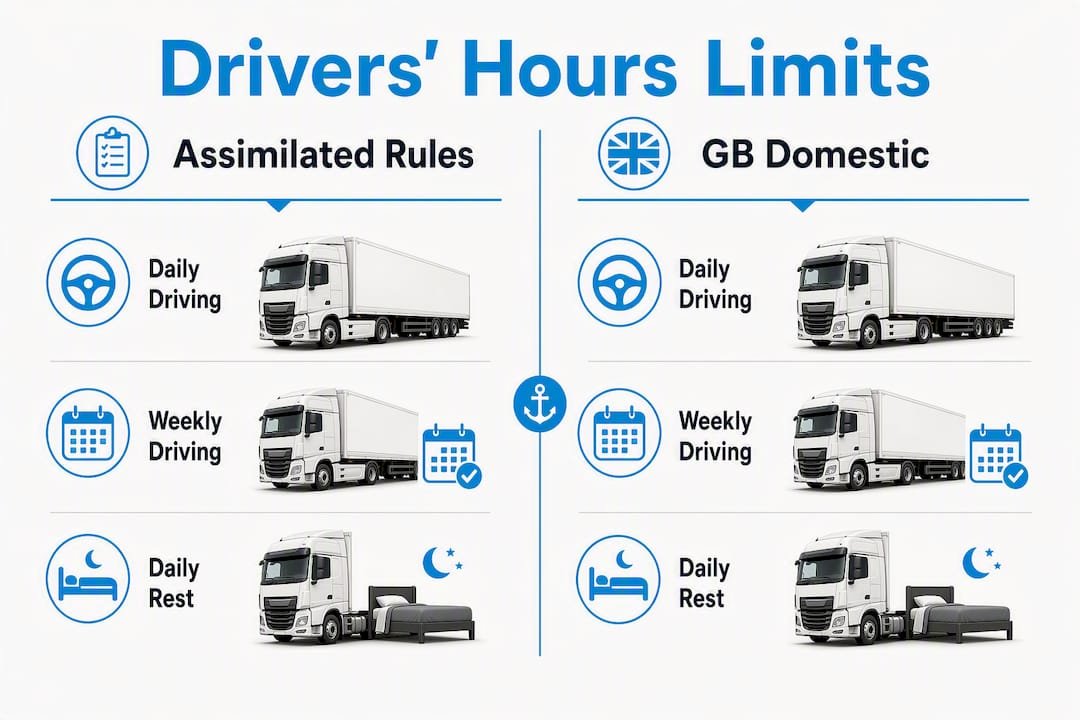
Sources: GOV.UK assimilated rules; GOV.UK GB domestic rules
A typical compliant assimilated-rules week might look like four days at 9 hours and two days at 10 hours, totalling exactly 56 hours. The fortnightly 90-hour cap then limits the following week to no more than 34 hours if you hit 56 in week one.
Exemptions and reduced rest provisions can alter these numbers in specific circumstances. Multi-manning, ferry crossings with bunk facilities, and certain emergency operations all carry their own modifications — covered in section 7 below.
3. Breaks and rest periods explained, with timeline examples
The 4.5-hour rule and split breaks
Under assimilated rules, you must not drive for more than 4.5 consecutive hours without taking a break of at least 45 minutes. That break can be split into two parts: a 15-minute segment first, then a 30-minute segment. The sequence is fixed by law.
The order matters critically. Taking the 30-minute break first and the 15-minute break second invalidates the split entirely. At a roadside inspection, this is a straightforward technical breach that an officer will spot immediately on the tachograph trace.
A compliant morning might look like this: drive 09:00–11:15 (2 hours 15 minutes), take a 15-minute break, drive 11:30–13:30 (2 hours), take a 30-minute break, then resume driving from 14:00. The 4.5-hour driving block is satisfied and the split break is correctly sequenced.
A non-compliant version of the same morning: drive 09:00–13:30 (4.5 hours), take a 30-minute break, drive 14:00–14:15, take a 15-minute break. The split is in the wrong order and the 4.5-hour block was not interrupted — two separate breaches on one tachograph card.
Pro Tip: Record the exact start and end time of each break segment on your tachograph or record sheet. “Break 11:15–11:30, break 13:30–14:00” is what an officer needs to see. Vague entries like “break approx. 45 min” invite further scrutiny.
Daily rest
Regular daily rest under assimilated rules is 11 consecutive hours. This can be reduced to 9 hours, but only up to three times between any two weekly rest periods — and no compensatory rest is required for reduced daily rests. For ferry or train journeys where a driver has access to a bunk or couchette, the rest may be interrupted up to twice, provided the total rest still reaches 11 hours.
Weekly rest
Regular weekly rest is 45 consecutive hours. A reduced weekly rest of 24 hours is permitted, but the shortfall must be compensated in full before the end of the third week following the reduced rest, attached to a rest period of at least 9 hours. Weekly rest must begin no later than after six 24-hour periods from the end of the previous weekly rest.
4. When a tachograph is required and how to keep lawful records
Tachographs are mandatory wherever assimilated or AETR rules apply. For most goods vehicles over 3.5 tonnes, that means a calibrated digital tachograph recording driving time, other work, periods of availability, and rest. Analogue tachographs are still legal in older vehicles but are increasingly rare; digital units with a driver smart card are the standard across most modern fleets.
Under GB domestic rules, drivers exempt from assimilated rules may use written weekly record sheets instead of a tachograph. Many operators choose to standardise on digital tachographs across their entire fleet regardless, because it simplifies audits and removes the risk of a driver inadvertently crossing into assimilated-rules territory without the right recording equipment.
What your records must show
Whether you are using a tachograph card or a written record sheet, the following must be captured:
- Driving time: every period at the wheel, recorded continuously
- Other work: loading, unloading, vehicle checks, admin — anything that is not driving, rest, or a period of availability
- Periods of availability (POA): time when you are waiting but not required to work (e.g. waiting for loading to finish when the duration was known in advance)
- Breaks and rest: exact start and end times, clearly distinguished from other work
Transport managers should note that duty time and driving time are distinct metrics under GB domestic rules. Driving may stop at 10 hours, but the 11-hour daily duty cap counts all other work too. A driver who drives for 9 hours and then spends 3 hours on admin has breached the duty limit, even though the driving limit was not reached.
At a roadside check, you should be able to produce: your current tachograph card or record sheet, records for the previous 28 days (or the current week plus the previous 15 days for analogue charts), and your driver’s licence.
5. How the Working Time Directive interacts with drivers’ hours
Drivers’ hours rules and working-time law run in parallel, and both apply simultaneously. The Road Transport Working Time Directive sets a maximum average working week of 48 hours, which can be extended to 60 hours in any single week provided the average over the reference period (typically 17 weeks) does not exceed 48 hours. There is no opt-out available for mobile workers in road transport — unlike the general Working Time Regulations.
The 6-hour trigger is the practical constraint most drivers encounter. Under working-time rules, you must not work more than 6 consecutive hours without a break, regardless of how much of that time was spent driving. A driver doing 5 hours of driving followed by 1.5 hours of loading has hit the 6-hour mark and needs a break under working-time law, even if the 4.5-hour driving break was taken earlier.
Employers must keep records of working time for all mobile workers and must not schedule shifts that breach the average weekly limit. Where a driver’s schedule looks compliant on driving hours alone but pushes total working time above 60 hours in a single week, the schedule needs revision before it runs.
The interaction matters most for same-day delivery operations where multi-drop runs combine significant driving with substantial loading and unloading time. A shift that looks fine on the tachograph can still breach working-time rules once all the non-driving work is counted.
6. Common exemptions and special operational cases
Not every vehicle or operation falls neatly under the standard rule sets. The main exemptions and derogations worth knowing:
- Local operations and national derogations: — some operations wholly within a defined radius may qualify for national derogations under assimilated rules. These are narrowly defined and must be confirmed against the current GOV.UK guidance — do not assume a derogation applies without checking.
- Buses and coaches: — passenger vehicles have parallel rule sets. Private driving (not for hire or reward) is not subject to GB domestic drivers’ hours rules at all. Scheduled services above certain thresholds fall under assimilated rules; others under GB domestic.
When relying on any exemption at a roadside check, carry documentary evidence: an incident report for emergencies, a written authorisation from the operator for derogations, or a route plan showing the operation falls within the exempt scope. An officer who cannot verify an exemption on the spot may treat the driver as non-compliant.
7. What enforcement officers check and the likely penalties
DVSA enforcement is graduated but can move quickly from a verbal warning to a prohibition notice if records are missing or rest periods are clearly inadequate. Understanding what officers look for lets you prepare properly.
At a roadside check, an officer will typically examine: tachograph charts or driver card data for the current day and recent history, weekly record sheets for domestic-only drivers, evidence of breaks and rest periods, duty time recording, and the driver’s licence and CPC card.
DVSA enforcement outcomes range from:
- Verbal warning: minor or first-time technical breaches
- Offence rectification notice: requires the driver or operator to address a specific issue
- Fixed penalty and licence points: for more serious or repeated breaches
- Prohibition notice: vehicle cannot move until the breach is rectified (e.g. a driver who has not taken adequate rest)
- Vehicle immobilisation: serious safety risk; release charges apply
- Prosecution: for deliberate or persistent non-compliance, with operator licence implications
If you are stopped, cooperate fully, present your records calmly, and note the officer’s name and reference number. Do not argue about the interpretation of limits at the roadside — that is a matter for a formal appeal. If a prohibition notice is issued, the vehicle stays put until the officer is satisfied the breach is resolved.
Operators face the greatest long-term risk: serious or repeated breaches can trigger a DVSA investigation and a public inquiry before the Traffic Commissioner, putting the operator licence itself at risk.
8. Daily and weekly compliance checklist
A short, consistent routine before and after each shift catches most common breaches before they become enforcement issues.
Driver daily checklist (pre-start)
- Insert your driver card and confirm the tachograph is recording correctly
- Check your remaining driving time from the previous day and week
- Confirm your last rest period met the minimum (11 hours regular, or 9 hours reduced if applicable)
- Plan your break points: mark where the 4.5-hour driving limit falls on your route
- Note your planned finish time and check it fits within the daily duty limit
Driver daily checklist (post-shift)
- Confirm all activities are correctly recorded: driving, other work, POA, breaks
- Remove your driver card and store it securely
- Flag any reduced rest periods to your transport manager immediately
Transport manager weekly checklist
- Download and review all driver card data from the previous week
- Check for any reduced daily or weekly rests and confirm compensatory rest is scheduled
- Verify no driver has exceeded 56 hours in the week or 90 hours across the fortnight
- Cross-check working-time totals against the 48-hour average and 60-hour single-week cap
- Confirm record sheets are complete for any domestic-only drivers
Pro Tip: Build a simple spreadsheet that auto-calculates each driver’s rolling fortnightly total. It takes 20 minutes to set up and immediately flags anyone approaching the 90-hour limit before the week ends, not after.
A worked example of the checklist catching a breach: a driver records a 30-minute break followed by a 15-minute break and marks both as a single 45-minute split break. The checklist review spots the reversed sequence. The transport manager corrects the record and briefs the driver before the next shift, rather than discovering the breach at a roadside inspection.
9. Where to read the rules and who to contact for authoritative help
Bookmark these pages and carry the relevant ones on your device for roadside checks:
- GOV.UK drivers’ hours overview: the starting point for all rule sets, with links to goods vehicles, buses and coaches, and exemptions
GOV.UK also provides downloadable weekly record sheet templates for GB domestic drivers. Search “drivers’ hours weekly record sheet” on GOV.UK to find the current version. Print a supply and keep them in the cab if your operation does not use a tachograph.
For transport managers needing operational guidance on choosing a reliable courier partner that already operates within these compliance frameworks, Frphaulage provides same-day and haulage services across the UK with signed proof of delivery on every job.
Key takeaways
Under UK drivers’ hours rules, the rule set that applies to your vehicle determines every limit, break, and record-keeping obligation — getting that first decision right is the foundation of compliance.
| Point | Details |
|---|---|
| Identify your rule set first | Assimilated rules apply above 3.5 tonnes; GB domestic rules apply to most exempt lighter vehicles. |
| Core assimilated limits | 9 hours daily (10 hours twice weekly), 56 hours weekly, 90 hours per fortnight. |
| Split break sequence is fixed | Under assimilated rules, the break must be 15 minutes then 30 minutes — never reversed. |
| Tachograph mandatory for assimilated rules | Digital tachograph required; GB domestic drivers may use written weekly record sheets. |
| Check GOV.UK before July 2026 | Assimilated rules extend to some LGVs over 2.5 tonnes for international operations from 1 July 2026. |
The compliance routine that actually protects you
Most drivers’ hours breaches are not deliberate. They happen because a driver misjudges a rolling fortnightly total, takes a split break in the wrong order, or forgets that a single cross-border collection has brought the whole day under assimilated rules. The rules are not especially complicated once you know which set applies — the problem is consistency.
What actually works in practice is treating the pre-start tachograph check as non-negotiable, the same way a pilot runs a pre-flight checklist. Not because an officer might be watching, but because the alternative is discovering a breach at 14:00 on a Thursday when you are 200 miles from base and the vehicle cannot legally move. That is a far more expensive problem than two minutes of record-checking at the start of a shift.
The July 2026 change to assimilated rules for some LGVs is a genuine operational risk for fleets running vans on international routes. Managers who assume “it’s just a van, domestic rules apply” without checking the updated weight thresholds will find themselves with drivers who have no tachograph and no compliant records for a journey that now requires both.
Authoritative links and downloadable templates
- Drivers’ hours overview — GOV.UK
- Assimilated and AETR rules (goods vehicles) — GOV.UK
- GB domestic rules (goods vehicles) — GOV.UK
- DVSA roadside vehicle checks — GOV.UK
- Working Time Directive for road transport — EUR-Lex
- Simplified EU drivers’ hours guidance PDF — GOV.UK

If your business needs a haulage or courier partner that operates within these compliance frameworks as standard, Frphaulage’s same-day services cover urgent collections across the UK with 60–120 minute response times, 24/7/365, and signed proof of delivery on every shipment.
This article provides general information about UK drivers’ hours rules and is not legal advice. Rules change — always verify current limits and requirements against the official GOV.UK guidance or consult a qualified transport consultant before making compliance decisions.