For most UK businesses, the best cargo insurance is a full-value goods-in-transit (GIT) policy, either per shipment or as an annual programme, matched precisely to your maximum load value. Carrier liability alone will not protect you: it is calculated by weight, not replacement cost, and the gap between what a carrier pays and what your goods are actually worth can be substantial.
The providers and brokers worth contacting first:
- Specialist brokers (Marsh UK, Aon UK, Arthur J. Gallagher UK, WTW UK) for complex programmes, bespoke wording, and market access
- Marine and GIT underwriters (AXA XL, AIG UK, Zurich UK, Aviva) for direct or broker-placed annual policies
- Per-shipment platforms (Flexport and similar) for ad-hoc or same-day movements
- Third-party parcel insurers for smaller consignments where declared value fees from carriers are disproportionate
Your immediate next step: calculate your maximum single-load replacement value today, then request the full policy wording and a certificate of insurance (COI) from at least two markets before committing.
Table of Contents
- Which UK cargo insurance providers and brokers are worth comparing?
- What types of cargo insurance policy are available, and which fits your operation?
- How do you choose the right cargo insurance provider or policy?
- What does the claims process look like, and what mistakes cost businesses money?
- How we selected and compared providers
- Practical guidance for same-day courier and haulage operations
- Key takeaways
- Why cargo cover is the operational detail most businesses get wrong
- Frphaulage: insured same-day transport with full documentation support
- Useful sources and where to request policy wording
Which UK cargo insurance providers and brokers are worth comparing?
The table below covers the main UK-available insurers, brokers, and markets. Note that several providers listed (Progressive, OOIDA, Sentry, Great American, State Farm, biBERK) are primarily US-market participants; they appear here for completeness and may be accessible via London market brokers for specific cross-border or multinational programmes. UK businesses should treat them as secondary options.
| Provider | Best for | Policy type | Geographic scope | Distribution channel |
|---|---|---|---|---|
| Aviva (UK) | Established shippers and business fleets | GIT / annual | UK-focused | Direct / broker |
| AXA XL (UK) | Importers/exporters needing marine-to-door cover | Marine cargo / GIT / annual | Worldwide | Broker / direct |
| AIG UK | Large shippers with complex cross-border programmes | Marine cargo / inland marine / annual | Worldwide | Broker |
| Zurich UK | UK businesses wanting established insurer support | GIT / marine cargo / annual | UK + worldwide | Broker / direct |
| Marsh UK | Complex programmes needing wholesale market access | Bespoke placement | Worldwide | Broker |
| Aon UK | Businesses needing market comparison and claims advocacy | Bespoke placement | Worldwide | Broker |
| Arthur J. Gallagher UK | SME shippers and hauliers | GIT / motor truck cargo / annual | UK + EU | Broker |
| WTW UK | Corporate shippers with global trade lanes | Marine cargo / annual programme | Worldwide | Broker |
| The Hartford | Specialist programme capacity (multinational) | Motor truck cargo / inland marine | Worldwide (select) | Broker |
| Progressive | US-centric or cross-border operations | Motor truck cargo | US / cross-border | Broker (US primary) |
| OOIDA Truck Insurance | Owner-operators and specialist hauliers | Truck cargo | US / select | Broker (US primary) |
| Sentry | Niche cargo risks via London market | Inland marine / cargo | Select markets | Broker |
| Great American | Specialty capacity via broker access | Cargo / specialty | Select markets | Broker |
| State Farm / biBERK | Smaller shippers with packaged commercial policies | Packaged commercial | US primary | Direct (US primary) |
Broker vs insurer vs MGA: which channel suits you?
- Direct insurer — (Aviva, AXA XL, Zurich): faster for standard GIT needs; policy wording is the insurer’s own form
For hauliers and couriers, Arthur J. Gallagher UK and Aviva are the most practical starting points. For importers and exporters with ocean or air freight, AXA XL and AIG UK carry the marine underwriting depth you need. For high-volume annual programmes, Marsh UK or Aon UK will access the broadest market.
What types of cargo insurance policy are available, and which fits your operation?
The right policy form depends on your mode of transport, commodity, and shipment frequency. Here is the short answer: hauliers and couriers should look at motor truck cargo or GIT policies; importers and exporters need marine cargo; businesses with unpredictable shipment volumes should consider per-shipment cover alongside an annual programme.
All-risk vs named perils
All-risk policies cover any physical loss or damage not specifically excluded. They are the standard for most commercial cargo and GIT programmes and give the broadest protection. Named-perils policies only pay for losses caused by a listed event (fire, collision, theft) and are cheaper but leave significant gaps. For most UK businesses moving goods regularly, all-risk is the correct starting point.
Per-shipment vs annual programmes
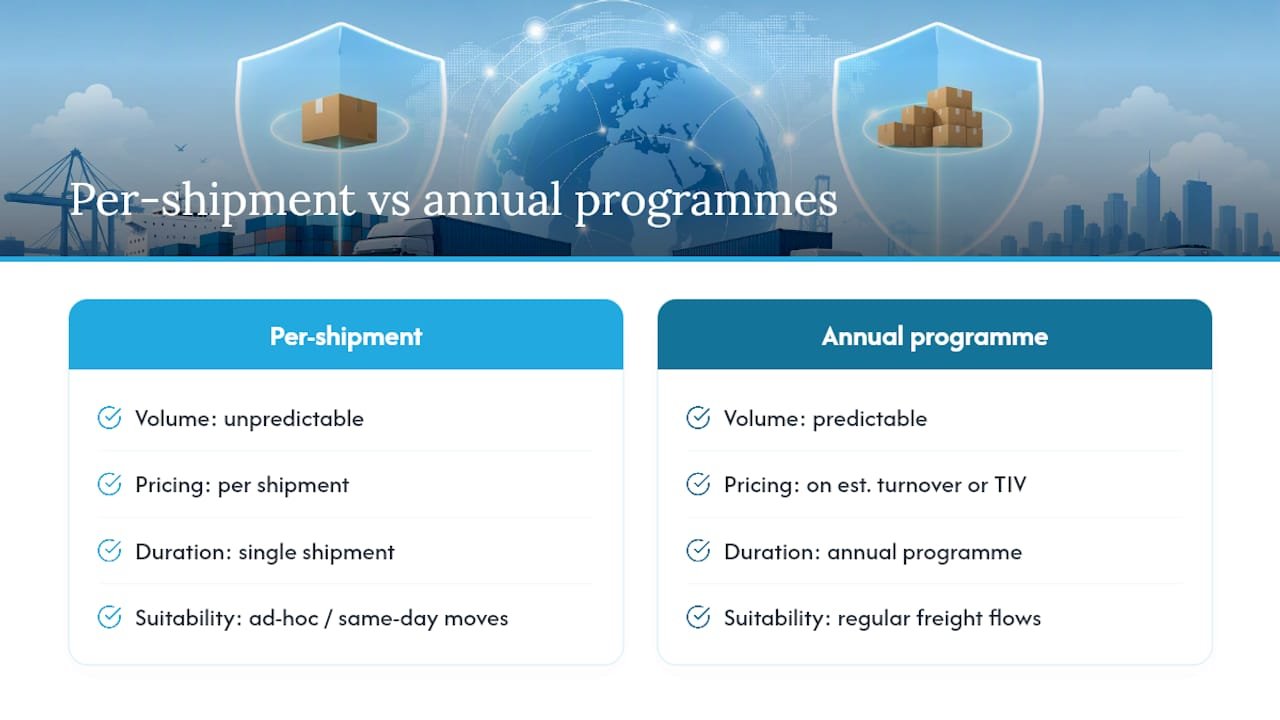
Markets offer both per-shipment and annual cargo insurance. Per-shipment cover is ideal for ad-hoc or same-day movements where you cannot predict volume. Annual programmes suit businesses with consistent freight flows; they are priced on estimated annual turnover or total insured value and typically offer lower per-shipment cost at volume.
Motor truck cargo vs marine cargo
Motor truck cargo covers goods in road vehicles. Marine cargo extends to ocean, air, and multimodal shipments, typically on a warehouse-to-warehouse basis. If your goods cross a port or airport, marine cargo is the correct form. If you are a UK haulier moving domestic freight, a GIT or motor truck cargo policy is the standard product.
Endorsements worth asking about
- Temperature control (reefer and pharmaceutical loads)
- Theft from unattended vehicle (a common sub-limit trigger)
- Employee dishonesty
- Loading and unloading extension
- Temporary storage extension (GIT policies often exclude warehouse storage unless endorsed)
GIT cover typically applies while goods are in vehicles in transit and may not extend to storage periods. Confirm the exact trigger wording before binding.
Declared value vs full-value insurance
Declared value is the carrier’s liability cap, not an insurance policy. When you declare a shipment value with a carrier, you are setting the maximum the carrier will pay under their own liability terms, and they charge an incremental fee for higher declared amounts. This is not the same as buying independent cargo insurance.
Third-party shipping insurance typically costs less per £100 of coverage than carrier declared value fees and usually processes claims faster, because the insurer’s only job is to pay claims, not to defend its own liability position.
The practical rule: calculate today’s replacement cost of your goods, not the original purchase price. Compare that to the worst-case carrier liability recovery (weight multiplied by the carrier’s per-kilo or per-pound liability rate). The difference is your coverage gap. Fill it with a cargo or GIT policy.
Pro Tip: Always request the full policy schedule and clause wording, not just the marketing summary. The schedule lists every sub-limit and endorsement; the marketing summary does not. If a broker cannot provide the wording before you bind, treat that as a red flag.
How do you choose the right cargo insurance provider or policy?
The single most important decision is matching your policy limit to your maximum load value and confirming that the theft and temperature sub-limits are adequate for your commodity. Everything else is secondary.
Step-by-step checklist:
- Document your maximum load value: the highest replacement-cost load you will ever move in a single vehicle or shipment; this sets your minimum limit requirement
- List your lanes and modes: domestic UK, UK to EU, worldwide ocean or air; the mode determines the policy form (GIT, motor truck cargo, or marine cargo)
- Identify your commodity risk: electronics, food, pharmaceuticals, and alcohol each carry specific exclusion and sub-limit risks
- Request full policy wording from at least two markets: compare sub-limits line by line, not just the headline limit and premium
- Check the deductible structure: per-occurrence vs aggregate; confirm whether the deductible applies to theft separately
- Test the claims process: ask how claims are notified, what documentation is required, and what the target response time is
- Confirm COI turnaround: for same-day and urgent jobs, the speed of certificate issuance matters as much as the premium
Questions to ask your insurer or broker:
- What is the theft-from-unattended-vehicle sub-limit, and what security conditions apply?
- Does the policy cover loading and unloading, or only goods in motion?
- Is temporary storage covered, and for how long?
- What is the claims notification deadline, and is it calendar days or business days?
- Who is the claims contact, and what is the target acknowledgement time?
Red flags that should disqualify a market:
- Refusal to provide full policy wording before binding
- Theft sub-limit below your typical single-load value
- No named claims contact or unclear dispute resolution process
- Exclusion of your primary commodity without an available endorsement
What does the claims process look like, and what mistakes cost businesses money?
A typical cargo or GIT claim follows this sequence: notify the insurer within the deadline stated in the policy (often 7–14 days of discovery), submit a formal claim with supporting documents, allow the insurer to appoint a loss adjuster if the value warrants it, and receive a settlement offer.
Documents you must preserve from the moment of loss:
- Signed proof of delivery (POD) or note of non-delivery
- Bill of lading or consignment note
- Photographs of damaged goods and packaging, taken before any movement
- Temperature logs for reefer or pharmaceutical loads
- Salvage notes if goods are partially recoverable
- Any correspondence with the carrier about the incident
Common mistakes that reduce or deny settlements:
- Assuming carrier liability covers the full replacement value (it almost never does)
- Failing to photograph damage before goods are moved or repackaged
- Missing the notification deadline stated in the policy
- Not preserving packaging (insurers use packaging condition to assess whether exclusions apply)
- Accepting a carrier’s settlement without notifying the cargo insurer first (subrogation rights may be affected)
- Relying on the marketing summary rather than the policy wording when assessing whether a loss is covered
Timeline expectations vary by insurer and claim complexity. Straightforward claims with complete documentation can settle within a few weeks. Complex or high-value claims involving a loss adjuster typically take longer. Ask your broker for the insurer’s published claims service standards before binding.
How we selected and compared providers
The shortlist and comparison above were built on five criteria: policy wording breadth and sub-limit transparency, market appetite by mode and commodity, claims service reputation and COI turnaround speed, financial strength of the underwriting entity, and accessibility for UK businesses (direct or via broker).
Primary sources used:
- Published policy wordings and product pages from AXA XL, Arthur J. Gallagher UK, and Flexport
- Industry guidance from Logrock, ParcelPath, LTL.Delivery, and ShippingCalculators.net
- Publicly available broker capability statements from Marsh UK, Aon UK, WTW UK, and Gallagher UK
Limitations to disclose: policy wordings for most providers are not publicly available in full; the comparison reflects publicly stated product features and broker capability summaries. Sub-limits, deductibles, and premium rates are indicative and will vary on submission. Readers should request full policy wordings and COIs directly from providers or brokers before making a purchasing decision.
The publisher (Frphaulage) is a courier and haulage operator, not an insurer or broker. This article is general information, not professional insurance advice. Confirm current policy terms with a regulated UK insurance broker or the insurer directly.
Practical guidance for same-day courier and haulage operations
For same-day and urgent jobs, the fastest sensible route is either a per-shipment cargo policy issued before collection or confirmation that your annual commercial GIT policy explicitly covers same-day movements at the load value you are carrying. Do not assume a standard business contents add-on covers a £30,000 electronics consignment moving at short notice.
Operational checklist for logistics and operations teams:
- Before booking: confirm the load’s replacement value and check it against your current GIT policy limit and any per-item sub-limits
- At pickup: photograph goods and packaging before loading; record seal numbers if applicable; obtain a signed consignment note
- During transit: use live tracking and confirm secure parking procedures for any overnight or multi-leg movements
- At delivery: obtain a signed POD; note any visible damage on the POD before the driver leaves
- For COI requests: ask your broker for a template COI that can be issued within the hour for urgent jobs; most established brokers can do this for annual policyholders
Sample contract clause to include in customer agreements:
When choosing a courier partner, check whether they can provide a COI on request and whether their GIT policy covers your commodity and load value. Our guide on how to choose a same-day courier covers the operational features to look for.
Pro Tip: Signed POD, photographs at pickup, and seal records are not just good practice; they are the evidence base for any cargo claim. Build them into every job sheet as a non-negotiable step, not an optional extra.

Key takeaways
The most reliable cargo insurance for UK businesses is a full-value GIT or marine cargo policy with sub-limits checked against your actual commodity and maximum load value, placed through a specialist broker for anything beyond a standard domestic programme.
| Point | Details |
|---|---|
| Match limit to max load value | Set your policy limit at the highest single-load replacement cost you will ever move, not an average. |
| Check sub-limits before binding | Theft, temperature, and contamination sub-limits can reduce payouts far below the headline limit. |
| Third-party insurance beats declared value | Independent cargo insurance typically costs less and settles faster than carrier declared value fees. |
| Document evidence at every pickup | Photographs, signed POD, and seal records are essential for any claim; build them into every job sheet. |
| Frphaulage provides insured same-day transport | Frphaulage offers signed POD and COI support on same-day and haulage jobs across the UK. |
Why cargo cover is the operational detail most businesses get wrong
There is a gap between how cargo insurance is sold and how it actually performs at claim time, and most logistics managers only discover it after a loss. The marketing pitch is simple: pay a premium, get covered. The reality is that the policy wording contains a set of conditions, sub-limits, and notification requirements that can reduce a £100,000 claim to a fraction of that figure if you have not read them carefully.
The most common error is not choosing the wrong insurer. It is choosing the right insurer but binding on a policy with a theft sub-limit that does not match the load value, or missing the notification deadline because nobody in the operations team knew it existed. These are procedural failures, not insurance failures, and they are entirely avoidable.
Brokers are underused by SME hauliers and couriers. The instinct is to go direct to save on fees, but for anything beyond a standard domestic GIT programme, a broker’s ability to negotiate wording, access specialist markets, and advocate at claim time is worth more than the commission saving. The best cargo insurance is not the cheapest policy; it is the one that pays out when you need it to, on the terms you expected.
Frphaulage: insured same-day transport with full documentation support
Sorting out cargo insurance is one part of the equation. The other is choosing a transport partner whose operational standards actually support a claim if something goes wrong.
Frphaulage runs insured same-day and next-day courier and haulage services across the UK, with collection available within 60–120 minutes of your call, 24/7/365. Every job comes with a signed proof of delivery, live tracking, and documented handover, giving you the evidence base a cargo insurer will ask for. For high-value or sensitive loads, Frphaulage’s vetted driver network and secure vehicle standards reduce the underwriting risk that drives premiums up.
Frphaulage is not an insurer or broker. Policy purchase stays with your insurer or broker, and you should always verify that your GIT or cargo policy covers the specific load and lane before booking. What Frphaulage does is make the documentation side straightforward: COI requests, signed PODs, and job records are available on request for every movement.
If you need an insured, same-day movement with full proof of delivery, book a same-day courier job or review the full service options at Frphaulage services.
Useful sources and where to request policy wording
When requesting policy wording and COIs, ask specifically for: warehouse-to-warehouse wording (for marine cargo), the theft-from-unattended-vehicle sub-limit and security conditions, refrigerated/temperature wording if applicable, and the named claims contact with target response times.
Primary sources used in this article:
- Goods In Transit Insurance | AXA UK
- Cargo Insurance Companies: 2026 Providers Guide
- What Does Declared Value Mean? Complete 2026 Shipping Guide | ParcelPath
- Declared value vs full‑value shipment insurance | LTL.Delivery
- Declared Value vs Shipping Insurance | ShippingCalculators.net
- Goods in transit | AJG UK
- Flexport cargo insurance product page