If you need to move a heavy or palletised load to a site with no forklift and no loading dock, a tail lift delivery is an appropriate solution. Book a same-day tail-lift courier, confirm the pallet weight and access conditions before you call, and request a signed Proof of Delivery. That is the short answer. Everything below helps you get it right first time.
Before you book, run through three quick checks: confirm the pallet weight (within standard weight bands commonly used by operators: lighter pallets are suited to standard tail lift and pallet truck; medium weights may require lift assist; heavier weights usually need a forklift at both ends), verify the ground surface is stable and level, and measure the rear door aperture of the receiving site to confirm the vehicle can get close enough to lower the platform safely.
- Weight band: standard tail lift typically covers lighter pallets; heavier pallets may require lift assist; the heaviest usually need a forklift.
- Surface: flat, firm ground only. Gravel, steep slopes and soft ground cause failed lifts.
- Access: confirm vehicle reversing space, overhead clearance and any width restrictions before the driver departs.
- Next step: call or book online, give weight, dimensions and access photos, and confirm POD requirements at the same time.
Key takeaways
Same-day tail lift delivery is the right choice when the load exceeds manual handling limits and neither end of the journey has a forklift or dock. The weight band, surface condition and platform dimensions are the three variables that determine whether the job succeeds or fails.
| Point | Details |
|---|---|
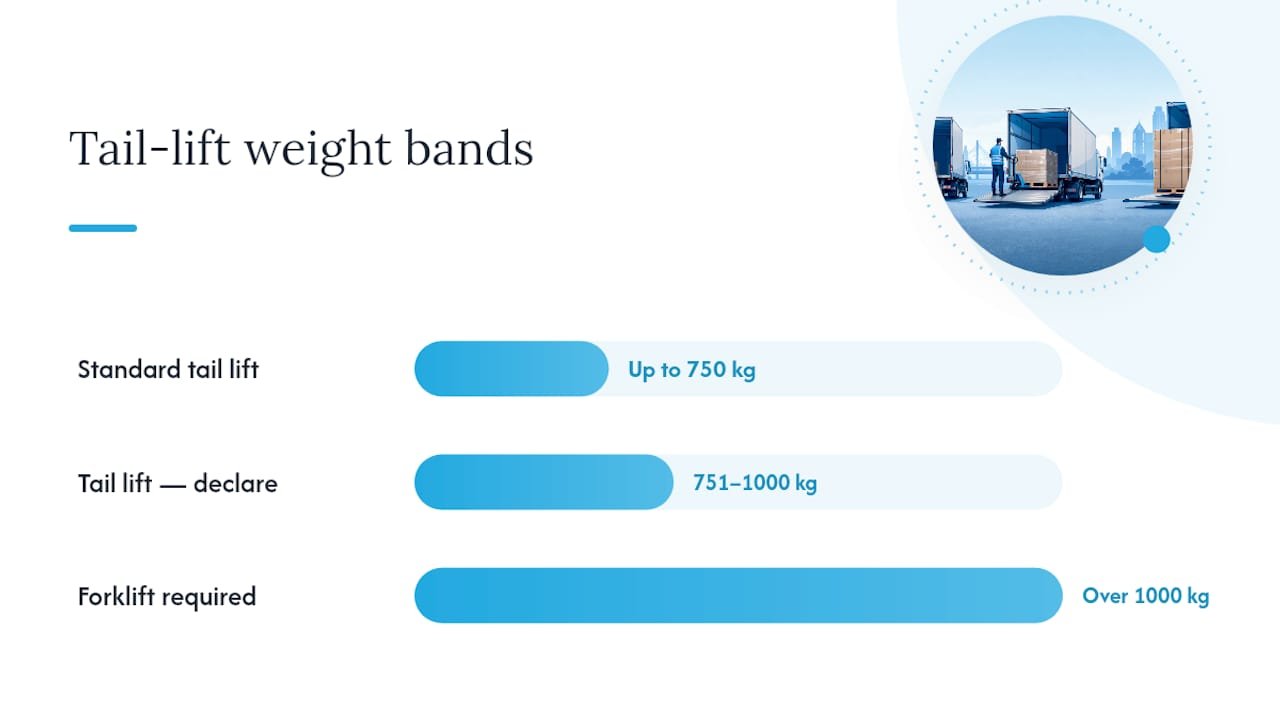
| Weight thresholds | Up to 750 kg: standard tail lift; 751–1,000 kg: lift assist; over 1,000 kg: forklift required at both ends. |
| Surface and access | Stable, level ground is mandatory. Gravel, slopes and narrow access must be declared at booking. |
| Platform dimensions | Check platform width and depth against pallet size, not just weight. Overhang creates a tipping risk. |
| Preparation prevents failure | Weigh the pallet, photograph the access, brief the recipient and confirm POD requirements before the driver departs. |
| Frphaulage | Offers 60–120 minute same-day collection, signed POD and vetted fleet coverage across the UK, 24/7/365. |
Table of Contents
- What is tail lift delivery and how does it work?
- When should you choose tail lift transport?
- Which vehicle and tail lift type is right for your load?
- Weight, size and platform limits to check before booking
- When is a forklift or loading bay still required?
- How does same-day tail lift delivery work end to end?
- What drives the cost of a same-day tail lift job?
- Safety, load securement and compliance: what operations teams must check
- Shipper checklist: what to prepare before the driver arrives
- How Frphaulage handles same-day tail lift deliveries
- How to choose a same-day tail lift provider: criteria and red flags
- Which tail lift type is better for fragile or very heavy loads?
- The detail most coordinators overlook when booking urgent lifts
- Frphaulage: same-day tail lift collection across the UK
- Sources
What is tail lift delivery and how does it work?
A tail lift (also called a liftgate in North America or a tailgate lift in some UK freight circles) is a powered platform mounted at the rear of a delivery vehicle. The driver operates it hydraulically or electrically to raise and lower loads between ground level and the vehicle bed, removing the need for a forklift or a loading dock at either end of the journey.
According to Bär Cargolift, a leading German manufacturer, tail lifts increase handling efficiency, improve operator ergonomics and allow deliveries to sites where fixed lifting equipment simply does not exist. The standard for safe use and design is EN 1756-1, which most reputable manufacturers and fleet operators reference when specifying equipment.
Wikipedia’s tail lift entry notes that standard models typically handle up to around 2,500 kg, while heavy-duty variants exceed that figure. Capacity is always model-dependent, so checking the specific vehicle’s rated limit before booking is not optional.
Why businesses use tail lift transport:
- Removes the need for a forklift or dock at the delivery address.
- Supports single-operator jobs, reducing labour costs at both ends.
- Reduces manual handling risk for heavy appliances, pallets and equipment.
- Enables residential and kerbside pallet drops that would otherwise be impossible.
- Speeds up same-day urgent jobs by removing the dependency on site equipment.
Pro Tip: When booking, always state “tail lift required” explicitly. Some freight platforms treat it as an optional add-on rather than a default, and omitting it from the booking note is one of the most common causes of a failed collection.
When should you choose tail lift transport?
The decision is simpler than most coordinators expect. If the collection or delivery site has no forklift, no dock leveller and no mechanical handling equipment, a tail lift is the practical default for anything heavier than a courier parcel.
Typical use cases where tail lift delivery is the right choice:
- White goods and large appliances delivered to residential addresses.
- Single-pallet drops to retail units, offices or light industrial sites without a dock.
- Furniture deliveries requiring a single driver with no manual handling team.
- Manufacturing components going to a site that has a forklift at one end but not the other.
- Urgent same-day jobs where arranging a forklift would add hours to the timeline.
Weight is the clearest decision variable. Palletline’s guidance places practical weight thresholds for operational decisions: standard tail lifts are generally used for lighter pallets; medium weights require lift assist; and the heaviest loads need a forklift at collection and delivery. These thresholds are widely used by UK logistics teams as a quick internal rule.
Access and surface conditions can override weight entirely. A 400 kg pallet on a steep gravel driveway is a failed delivery waiting to happen. A pallet truck cannot operate safely on loose or uneven ground, and a tail lift platform lowered onto a slope creates a tipping risk. Narrow entrances, low overhead cables and parked vehicles blocking the reversing path are all worth photographing and declaring at the time of booking.
Which vehicle and tail lift type is right for your load?
Not all tail lifts are the same, and the wrong combination of vehicle and lift type can mean the platform is too small, the capacity too low or the approach angle wrong for the site. Knowing the main families saves time when you are briefing a carrier.
The four main lift types:
- Cantilever (tuck-under): the platform folds under the vehicle floor when not in use. Common on Luton vans and curtainsiders used for white goods and furniture. Good for urban deliveries where ground clearance and parking space are limited.
- Column lift (railgate): the platform travels vertically on two columns mounted at the vehicle’s rear. Steadier vertical motion makes it better suited to fragile or stacked goods. Often found on larger rigids.
- Slider: the platform slides out from beneath the vehicle body before lowering. Suits heavier loads and vehicles with higher bed heights, such as 18T and 26T rigids.
- Tuck-under (variant): similar to cantilever but with a slightly different fold mechanism; used interchangeably with cantilever in many UK fleet descriptions.
The Van Man Company’s glossary explains that cantilever designs are particularly common on Luton vans used for appliance deliveries, precisely because the fold-under mechanism keeps the platform out of the way during transit without adding significant vehicle length.
Matching vehicle class to lift type:
- Luton and curtainside vans: cantilever or tuck-under, typically rated up to 500–750 kg.
- 7.5T rigids: column or cantilever, with higher platform capacities.
- 12T–26T rigids: slider or column lifts, suited to heavier palletised freight.
Pro Tip: Before confirming a booking, ask the carrier for the platform dimensions (width and depth) and the vehicle’s rear door aperture. A platform that is narrower than your pallet is a safety issue, not just an inconvenience.
When checking vehicle fit, three measurements matter: platform width relative to pallet width, vehicle bed height relative to the receiving surface, and the approach angle from the road to the drop-off point. A vehicle that cannot get within two metres of the door may render the tail lift useless regardless of its rated capacity.
Weight, size and platform limits to check before booking
Capacity figures on tail lifts refer to the maximum load the platform can safely carry, not the maximum load the vehicle can transport. These are different numbers, and confusing them causes problems.
Wikipedia’s summary confirms that standard models typically handle up to around 2,500 kg, but entry-level van-mounted lifts are rated considerably lower. Eurosender’s guidance notes that small vans with tail lifts commonly handle around 700 kg, which aligns with the 750 kg threshold used by pallet networks as the upper limit for a standard tail lift and pallet truck combination.
QFM Logistics’ operational guide (an Australian operator, cited here for its practical operational detail) places typical platform weight ranges at 500–1,000 kg and identifies overweight loads, unsuitable ground and unstable pallets as the most common causes of failed lifts.
Capacity decision matrix:
| Load weight | Recommended approach | Notes |
|---|---|---|
| Up to 750 kg | Standard tail lift + pallet truck | Suitable for most van and 7.5T vehicles |
| 751–1,000 kg | Tail lift + lift assist | Declare at booking; carrier arranges |
| Over 1,000 kg | Forklift at collection and delivery | Tail lift alone is insufficient |
Platform size matters as much as weight. A standard euro pallet fits most platforms, but an oversized pallet or a load with significant overhang creates a tipping risk even when the weight is within limits. Platform depth (front to back) is the dimension most often overlooked. If your pallet is 1,200 mm deep and the platform is only 900 mm, part of the load is unsupported during travel.
When a pallet is borderline, the practical options are: split the load across two pallets, request a vehicle with a higher-capacity slider or column lift, or arrange lift assist. Declaring the exact dimensions at booking costs nothing; a failed collection costs the surcharge, the delay and the re-book fee.
When is a forklift or loading bay still required?
A tail lift handles a lot, but it does not handle everything. The clearest rule: if the load exceeds the vehicle’s platform rating, a forklift is not optional.
Situations where a forklift or dock is still required:
- Pallet weight over 1,000 kg at either the collection or delivery address.
- Loads that are physically unstable and cannot be safely placed on a moving platform.
- Oversized pallets where significant overhang would create a tipping risk.
- Sites with a dock leveller already in place, where using the dock is faster and safer.
- Multi-pallet loads being moved simultaneously rather than one at a time.
The responsibility for providing a forklift at the collection address rests with the shipper. At the delivery address, it rests with the recipient. Neither the driver nor the carrier is obligated to arrange mechanical handling equipment that was not declared at booking. If you book a tail-lift vehicle and the pallet turns out to be 1,200 kg, the driver is within their rights to refuse the lift on safety grounds. That means a failed collection, a wasted vehicle movement and a surcharge.
Palletline’s guidance is direct on this point: over 1,000 kg requires a forklift at both collection and delivery. Booking a tail-lift vehicle for a load in that range is the single most common booking error in pallet logistics.
Pro Tip: *Weigh the pallet before you call. If you do not have a floor scale, use the supplier’s despatch note weight.
How does same-day tail lift delivery work end to end?
The workflow is straightforward once you know what information the carrier needs and where the handoffs happen.
Step 1: Booking
Give the carrier the pallet weight, dimensions (length × width × height), collection and delivery postcodes, access photos or notes, a contact name and mobile number at both ends, and your preferred collection window. For same-day jobs, urgency changes vehicle allocation: a dedicated vehicle is dispatched rather than a shared load, which is why FRP Haulage can offer collection windows of 60–120 minutes from the point of booking.
Step 2: Collection
The driver arrives, inspects the load and operates the tail lift. The shipper is responsible for placing the pallet onto the platform (or onto the vehicle bed once the platform is raised). The driver operates the lift; they do not typically load the pallet themselves unless lift assist has been pre-arranged. Have the pallet ready at the collection point, banded and stable, before the vehicle arrives.
Step 3: Transit
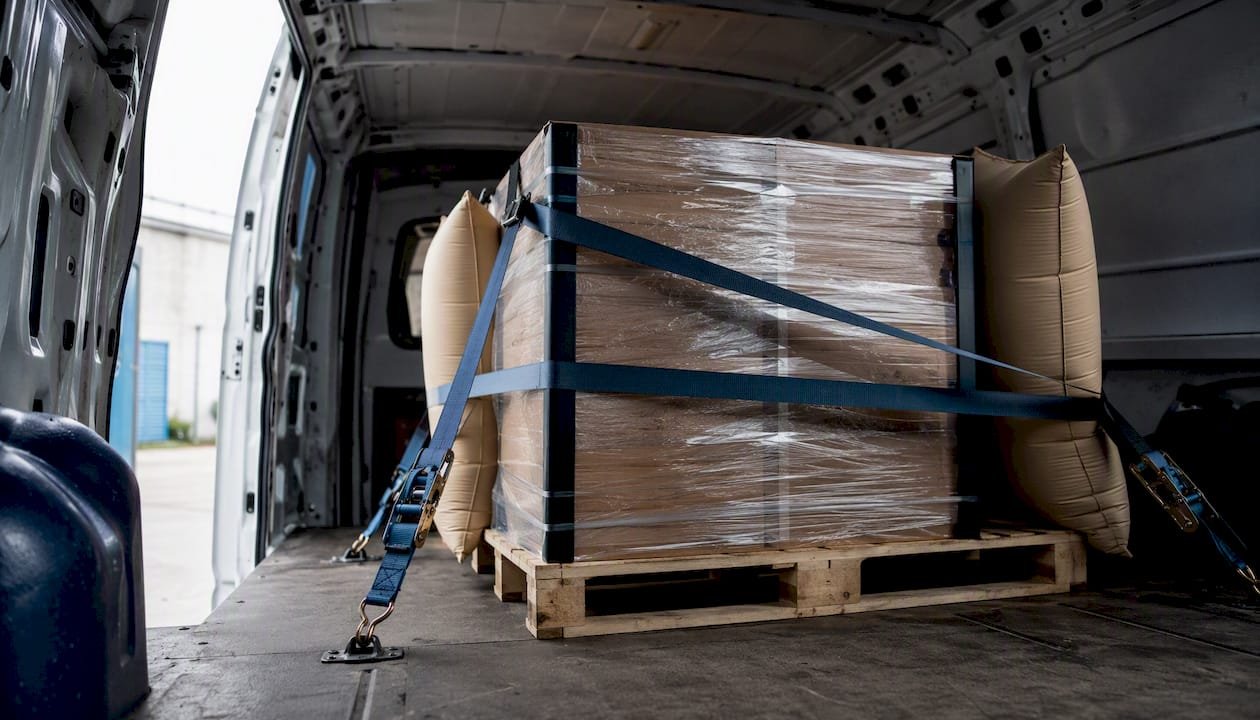
The load is secured inside the vehicle for transit. For fragile or high-value goods, load securement during transit is a shared responsibility: the carrier secures the load, but the shipper must pack and band it in a way that survives road movement. Proper cargo securement practices reduce damage claims and protect both parties.
Step 4: Unloading and proof of delivery
At the delivery address, the driver lowers the pallet to ground level. The recipient (or the driver, if lift assist was booked) moves it to the final position. A signed Proof of Delivery is issued. If the recipient is absent and authority to leave has been granted, the driver records this. Failed deliveries trigger a re-book; the carrier should notify you within the agreed window.
Eurosender notes that tail-lift service is typically offered as a surchargeable add-on, which means same-day tail-lift collection carries a modest premium over a standard same-day job. That premium is almost always cheaper than a failed collection and re-book.
Pro Tip: Brief the recipient before the vehicle departs. A driver who arrives at an empty site with no authority to leave and no contact number will not wait indefinitely. That is a failed delivery, and the re-book cost falls on the shipper.
What drives the cost of a same-day tail lift job?
Pricing for tail lift transport is not a flat rate. Several variables compound, and understanding them helps you budget accurately and avoid unexpected surcharges.
Primary cost drivers:
- Weight: the single largest variable. Heavier pallets require larger vehicles with higher-capacity lifts.
- Dimensions: cubic size affects vehicle selection even when weight is low. A light but bulky load may require a larger vehicle.
- Distance: same-day dedicated vehicles are priced per mile or per zone, not by pallet network rates.
- Urgency: a 60-minute collection window costs more than a two-hour window, which costs more than a scheduled next-day slot.
- Vehicle type: a Luton van is cheaper than a 7.5T rigid; a 7.5T rigid is cheaper than an 18T curtainsider.
- Access difficulty: narrow roads, restricted hours, permit zones and sites requiring a second person all add to the quote.
- Lift assist: pre-arranged assistance at collection or delivery is a separate line item.
Common surcharges to watch for:
- Failed or aborted collection attempts (driver attends but cannot load).
- Waiting time beyond the agreed window (typically charged per 15 or 30 minutes).
- Out-of-hours bookings (evenings, weekends, bank holidays).
- Oversized pallet surcharge where dimensions exceed standard euro pallet.
- Residential delivery fee for addresses without commercial access.
To get an accurate quote, give the carrier: exact weight (not estimated), pallet dimensions including height, photographs of the collection and delivery access, and a clear note on whether a pallet truck is available at the delivery address. Vague bookings produce vague quotes and, more often than not, surcharges on the day.
Safety, load securement and compliance: what operations teams must check
Safety on a tail lift job is a shared responsibility. The driver operates the lift; the shipper prepares the load. Both sides have obligations, and a failure on either side can result in injury, a refused lift or a damaged shipment.
Key safety checks before collection:
- Pallet is stable, evenly loaded and banded or stretch-wrapped securely.
- No loose items that could shift during platform travel.
- Ground at the collection point is firm, level and free of obstacles.
- The driver has clear space to reverse the vehicle and deploy the platform.
- Any site hazards (low cables, uneven kerbs, restricted access) are declared at booking.
The relevant standard for tail lift design and safe use is EN 1756-1, referenced by manufacturers including Bär Cargolift. In the UK, tail lifts fitted to commercial vehicles are also subject to LOLER (Lifting Operations and Lifting Equipment Regulations 1998), which requires that lifting equipment is thoroughly examined at regular intervals by a competent person. As a shipper, you are not responsible for the carrier’s LOLER compliance, but choosing a carrier who can confirm their equipment is in examination schedule is a reasonable due diligence step.
Palletline’s guidance is explicit that pallet trucks require stable, even ground to operate safely. Gravel surfaces, steep slopes and soft ground are not suitable. If the delivery address has any of these conditions, declare them at booking so the carrier can assess whether the job is feasible or whether an alternative approach is needed.
For transit, proper cargo securement means the load must not shift during braking or cornering. Stretch wrap alone is rarely sufficient for a pallet in a curtainsider; load bars, straps or dunnage bags are the standard approach for anything that cannot be blocked by adjacent freight.
Shipper checklist: what to prepare before the driver arrives
Running through this list before the collection window saves time, prevents surcharges and reduces the chance of a failed lift.
Documentation and data:
- Accurate pallet weight (from scales or verified despatch note).
- Pallet dimensions: length, width and height including packaging.
- Delivery address, postcode and recipient contact name and mobile number.
- Any special instructions (fragile, this way up, temperature-sensitive).
Pallet condition:
- Pallet is in good condition with no broken boards or protruding nails.
- Load is evenly distributed and does not overhang the pallet edges significantly.
- Stretch wrap or banding is tight and covers the full height of the load.
- Labels are visible and securely attached.
Site preparation:
- Clear path from the vehicle’s parking position to the drop-off point.
- Firm, level surface at the collection point for the pallet truck and platform.
- Space for the vehicle to reverse safely (check overhead clearance too).
- Photographs of the access taken and sent to the carrier at booking.
On the day:
- Be present or have a representative available at the agreed collection time.
- Contact the recipient to confirm they will be available and the access is clear.
- Confirm POD requirements: signed receipt, photograph, or authority to leave.
- Have the pallet at the collection point before the driver arrives, not in a warehouse aisle.
QFM Logistics’ guide lists incorrect booking (missing tail-lift declaration), overweight loads and unstable pallets as the three most common causes of failed tail-lift deliveries. All three are preventable at the preparation stage.
How Frphaulage handles same-day tail lift deliveries
Frphaulage operates same-day courier services across the UK with a personal fleet and a vetted partner network, which means coverage does not depend on a single depot or region. For tail-lift jobs, the key operational details are:
Core service features:
- Collection within 60–120 minutes of booking for urgent same-day requests, available 24/7/365.
- Dedicated vehicle dispatch for time-critical loads, rather than consolidating with other freight.
- Signed Proof of Delivery for every shipment, with real-time tracking available.
- Vetted partner network covering national routes where the personal fleet does not reach.
- Out-of-hours capability for evening, weekend and bank holiday collections.
Handling edge cases:
- Lift assist for pallets in the 751–1,000 kg range can be arranged at booking.
- Access problems declared at booking are assessed before vehicle dispatch, not on arrival.
- Multi-drop tail-lift routes are available for businesses with regional distribution requirements.
When you call or book online, give the weight, dimensions, access photos and your preferred collection window. The team confirms vehicle type and lift capacity before dispatch, so there are no surprises at the collection point. For logistics coordinators who need a reliable same-day courier with documented proof of delivery, Frphaulage’s combination of personal fleet and vetted partners is a practical answer to the coverage gap that single-depot operators cannot fill.
How to choose a same-day tail lift provider: criteria and red flags
The market for tail lift courier services in the UK ranges from large pallet networks to specialist same-day operators. The right choice depends on urgency, weight, access and how much accountability you need when something goes wrong.
Evaluation criteria:
- Capacity confirmation: the provider should confirm the vehicle’s platform rating before dispatch, not after.
- Collection SLA: a credible same-day operator states a collection window in minutes, not “as soon as possible.”
- Proof of delivery: signed POD is non-negotiable for any business shipment. Electronic or paper, it must be available.
- Insurance: ask for the carrier’s goods-in-transit insurance limit. For high-value loads, confirm it covers the full replacement value.
- Transparent surcharges: a reputable provider lists surcharges (waiting time, failed attempt, out-of-hours) before you confirm the booking.
- Coverage: confirm the provider can reach both the collection and delivery postcode with a tail-lift vehicle, not just a standard van.
- Customer service hours: for same-day jobs, you need a contact who can answer the phone during the delivery window, not just during office hours.
Red flags:
- No confirmed collection window given at booking.
- Weight limits described as “up to about” without a specific figure.
- No mention of POD or tracking.
- No contingency offered for access problems.
- Insurance information not available on request.
Questions to ask before you confirm:
- What is the platform’s rated capacity for this vehicle?
- What is the collection window from the point of booking?
- How do you handle a failed delivery attempt?
- What surcharges apply if the driver has to wait or return?
- Can you provide lift assist if the pallet is over 750 kg?
For a more detailed framework on choosing a same-day courier, the criteria above map directly onto the questions a procurement team should include in any RFQ or phone briefing.
Which tail lift type is better for fragile or very heavy loads?
This is a question most booking guides skip, but the answer matters when you are moving something that cannot be replaced easily.
The lift family determines how the platform moves, not just how much it can carry. Column and slider lifts travel vertically with minimal lateral movement, which makes them the better choice for heavy palletised loads where stability during the lift cycle is the priority. Bär Cargolift’s manufacturer guidance confirms that column and slider designs are favoured for high-capacity applications and vehicles with significant bed height.
Railgate lifts (a variant of the column design) produce a particularly steady vertical motion, which is why they appear on vehicles carrying fragile stacked goods, glass, or equipment that cannot tolerate tilting. Cantilever lifts, by contrast, describe a slight arc as the platform lowers, which is fine for robust pallets but less ideal for anything that could topple.
Matching lift type to load:
- Fragile, stacked or top-heavy goods: column or railgate lift on a rigid vehicle.
- Heavy pallets (750 kg+): slider or column lift with confirmed capacity rating.
- White goods, appliances, furniture: cantilever on a Luton van, which is the standard for this category.
- Mixed loads or multi-drop routes: confirm lift type with the carrier based on the heaviest single item.
Platform size is the other variable that capacity figures do not capture. A lift rated at 1,500 kg on a platform that is only 900 mm deep cannot safely carry a 1,200 mm pallet, regardless of weight. For fragile goods, above-bed travel (where the platform rises above the vehicle floor to allow loading from a raised dock) is a feature worth asking about specifically.
Pro Tip: When booking for fragile or high-value loads, specify the load type explicitly: “fragile, stacked, palletised, glass panels” rather than just “pallet.” That single detail lets the carrier assign the correct lift and vehicle combination rather than defaulting to whatever is available.
The detail most coordinators overlook when booking urgent lifts
The operational reality of same-day tail lift bookings is that most failures happen in the 20 minutes before collection, not during transit. A pallet that is not at the collection point, a recipient who does not answer the phone, or an access photo that was never sent: these are the moments that convert a smooth job into a surcharge and a re-book.
When you call to book an urgent lift, the information that matters most is weight, pallet dimensions, a photograph of the access at both ends, your preferred collection window, and a direct mobile number for the contact at each address. That is the complete briefing. Everything else is secondary.
One practical step that most guides omit: schedule a brief inspection window after delivery for fragile or high-value loads. Ask the recipient to check the goods before signing the POD and to photograph any visible damage before the driver leaves. A signed POD without a damage note makes a subsequent claim significantly harder to pursue. Two minutes at the point of delivery can save weeks of dispute.
Frphaulage: same-day tail lift collection across the UK
Frphaulage is built for exactly the situation this article describes: a heavy or palletised load, a site without a forklift, and a timeline that does not allow for next-day options.
The service runs 24/7/365 with collection windows of 60–120 minutes from the point of booking. Every shipment comes with a signed Proof of Delivery, and the combination of a personal fleet and a vetted partner network means coverage across England, Wales, Scotland and Northern Ireland without the gaps that single-depot operators leave. For pallets in the 751–1,000 kg range, lift assist can be arranged at booking. For urgent loads, a dedicated vehicle is dispatched rather than consolidated with other freight.
To book, visit the FRP Haulage services page, call directly, or use the live chat. Give weight, dimensions and access details when you make contact, and the team confirms vehicle type and collection window before dispatch. If you want to compare service levels before committing, the same-day courier guide walks through the criteria in detail.
Sources
- Tail lift — Wikipedia
- What is a tail lift? German manufacturer Bär Cargolift
- Tail lift delivery with vetted couriers — Eurosender
- What is a tail‑lift delivery? Tailgate & liftgate — QFM Logistics