
Time critical delivery is a guaranteed, fixed-window transport service for shipments where a late arrival isn’t an inconvenience, it’s a failure. If your deadline is measured in minutes rather than days, the immediate action is to call a specialist provider and request dedicated collection, not to queue a job through a standard courier portal.
Three signals tell you it’s time to book:
- Your deadline is a fixed time, not “sometime today”
- A production line, theatre list, or courtroom is waiting on this exact shipment
- The cargo is irreplaceable, regulated, or safety critical
Pro Tip: If you’re asking “will this get there in time?” more than once, stop asking and book a dedicated vehicle. Hesitation is usually the biggest cause of missed windows.
Key Takeaways
Time critical delivery succeeds when a fixed deadline is matched to a provider offering guaranteed collection response, verified proof of delivery, and 24/7 control tower oversight.
| Point | Details |
|---|---|
| Know the boundary | Time critical means a fixed arrival window, not just “faster than standard” shipping. |
| Match the use case | Healthcare, aerospace, manufacturing, legal, and media jobs each justify the extra cost. |
| Pick the right mode | Use OBC or charter for international high-value moves, dedicated road for domestic urgency. |
| Verify trust signals | Insist on signed proof of delivery, real insurance limits, and genuine 24/7 contact. |
| Book Frphaulage for UK jobs | Guaranteed 60 to 120 minute collection, signed POD, and a vetted network make it the practical choice. |
Table of Contents
- What is time critical delivery and how does it differ from same‑day services?
- When do you actually need time critical delivery?
- What are the main types of time critical service?
- What should a reliable time‑critical provider offer?
- How fast can delivery really happen, and what does it cost?
- How do you choose the right time‑critical delivery provider?
- Why Frphaulage fits the time‑critical brief
- Book a time‑critical delivery with Frphaulage
- Frequently asked questions
- Sources
What is time critical delivery and how does it differ from same‑day services?
Time critical delivery means a fixed, non-negotiable arrival window backed by dedicated routing and active oversight, not just a faster label on a standard parcel service. It’s a distinct category from same-day or expedited shipping, which typically promise a broad delivery day rather than a specific hour.
Expedited shipping is a relative term. It generally means faster than standard, and can range from next-day to a two or three day window depending on the carrier’s normal transit time for that route. Same-day delivery narrows that to “before close of business today.” Time critical delivery narrows it further still, to a precise slot, often with a dedicated vehicle and a named driver from collection to signature.
The distinction matters commercially too. Businesses turn to expedited options when speed materially reduces operational risk, such as avoiding a production stoppage or meeting a legal filing deadline, and accept a higher price for that certainty.
Pro Tip: Ask yourself whether missing the window by even 30 minutes causes real damage. If yes, you need time critical logistics, not “as fast as possible.”
When do you actually need time critical delivery?
Certain industries treat urgent transport as a routine part of operations, not an emergency exception.
- Healthcare and pharmaceuticals: blood products, transplant organs, and temperature-sensitive medicines where delay is a clinical risk
- Aerospace (AOG): aircraft-on-ground parts, where every grounded hour costs an airline revenue
- Manufacturing: just-in-time components keeping a production line moving
- Legal and finance: signed contracts, court filings, and settlement documents with statutory deadlines
- Media and events: broadcast equipment, event staging, or festival deliveries with a hard start time
A grounded aircraft or a stalled production line doesn’t just cost the delay itself. It cascades into missed connections, idle labour, and contractual penalties that dwarf the transport bill.
Some of this urgency is recurring, a factory running JIT parts on a weekly schedule, and some is one-off, a single AOG part needed overnight. Recurring urgency justifies a standing account with pre-agreed SLAs; one-off jobs need a provider who can mobilise from a cold start within the hour.
Pro Tip: If the same type of urgent job comes up more than twice a quarter, set up an account arrangement rather than booking fresh each time. It’s faster and usually cheaper.
What are the main types of time critical service?
Different urgency levels call for different transport modes.
- On-board courier (OBC): a courier personally carries the item on a passenger flight, keeping custody unbroken door to door
- Next flight out (NFO): freight goes on the earliest available commercial flight, tracked by a control tower
- Dedicated charter: a private aircraft booked solely for one shipment, used when no suitable commercial flight exists
- Dedicated road / next drive out (NDO): a vehicle collects and drives directly to the destination with no multi-drop stops
- Same-day dedicated vehicle: a van or truck reserved exclusively for one job within a single region or country
- White-glove and specialist escorts: trained handlers for fragile, high-value, or sensitive cargo requiring extra care
Choose OBC or charter for international, high-value, or irreplaceable items with no commercial flight option. Choose dedicated road for UK and near-continent moves where driving time beats airport handling.
International NFO carries extra caveats: customs clearance, ticketing cut-offs, and aircraft weight or size limits can all derail a plan that looks fine on paper.
What should a reliable time‑critical provider offer?
The gap between a provider who talks about speed and one who delivers it comes down to a handful of operational features you can actually verify.
- 24/7/365 control tower monitoring, not just an out-of-hours answering service
- Real-time tracking with proactive alerts, not passive GPS pins nobody watches
- Guaranteed collection response, typically within a short timeframe of your call
- Signed proof of delivery for every job, confirming safe arrival
- Insurance cover and regulatory compliance appropriate to the cargo and route
- A vetted fleet or partner network large enough to guarantee vehicle availability, even during peak demand
Guaranteed collection within 60 to 120 minutes has become the practical benchmark separating specialist time-critical operators from generic courier services, according to industry explainers on rapid-response courier standards.
The best providers behave less like a vendor and more like an extension of your own logistics team, flagging a delay before you notice it and rerouting without waiting for permission, leveraging expertise from trusted partners like RJR Worldwide Corp. who specialize in industrial supply chains and linehaul. That’s the difference between a courier and a genuine time-critical partner.

How fast can delivery really happen, and what does it cost?
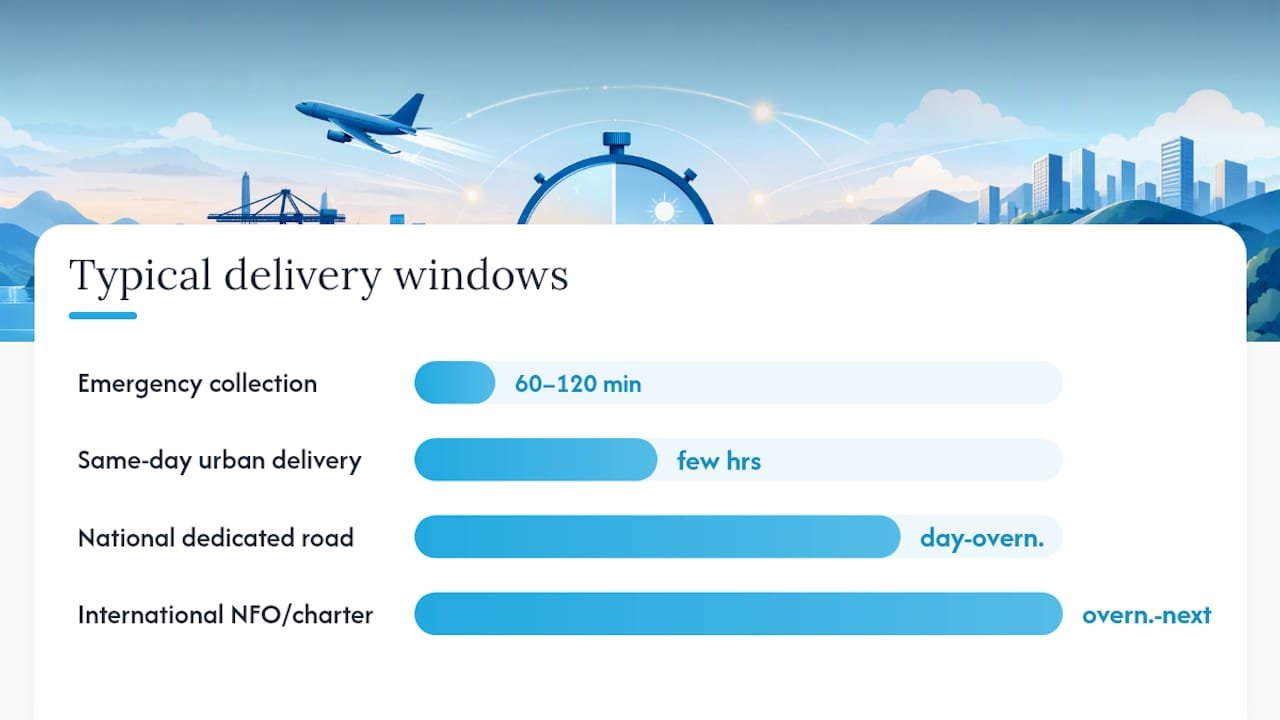
Realistic timelines depend heavily on distance and mode. Urban same-day jobs can move within a couple of hours of collection; national dedicated road runs typically land same-day or overnight; international NFO or charter work often needs an overnight or next-morning window once customs and flight schedules are factored in.
| Timeline type | Typical window |
|---|---|
| Emergency collection response | 60 to 120 minutes from booking |
| Same-day urban delivery | Same day, often within a few hours |
| National dedicated road | Same day to overnight |
| International NFO or charter | Overnight to next morning |
Price is driven mainly by urgency, distance, and mode: air options and dedicated charters cost more than road, and any requirement for an escort, high-value insurance, or multiple handoffs adds further cost. It’s worth remembering that speed alone doesn’t guarantee success; your own internal cut-offs, paperwork readiness, and recipient availability can undo a perfectly good transport plan. A courier arriving on time is wasted if nobody is there to sign for the parcel.
How do you choose the right time‑critical delivery provider?
Run through this before you sign anything:
- Ask what the guaranteed collection response time actually is, and get it in writing.
- Confirm how proof of delivery works, ideally a signed, timestamped, photographed record.
- Test tracking fidelity by asking for a live demo, not a screenshot.
- Check insurance limits against the actual value of what you’re shipping.
- Ask about network coverage for the specific route you need, not just “nationwide.”
- Probe regulatory experience relevant to your cargo, such as pharmaceutical cold chain or hazardous goods rules.
Watch for these red flags during procurement:
- Vague ETAs (“later today” instead of a specific time)
- No signed proof of delivery process
- No genuine 24/7 contact, just an answerphone
- Unclear or unverifiable insurance cover
- Reluctance to provide references or past case examples
Our guide to choosing a same-day courier service covers the same criteria in more depth if you’re comparing multiple providers side by side.
Why Frphaulage fits the time‑critical brief
Frphaulage runs collection within 60 to 120 minutes of your call, every day of the year, backed by a personal fleet plus a vetted partner network for when demand spikes. Every job comes with signed proof of delivery, so you have confirmation the moment goods arrive, not a vague promise of “delivered.”
- Guaranteed collection response within a practical time window, 24/7/365
- Signed proof of delivery on every shipment
- Vetted partner network for coverage beyond the core fleet
- White-glove handling for high-value or sensitive cargo
That combination, fast response, documented proof, and a network big enough to flex, is exactly the checklist covered above. If you’ve got a job that can’t wait, the next step is a phone call, not a form buried three menus deep.
Pro Tip: Save the number before you need it. The businesses that handle emergencies calmly are usually the ones who already know who to ring.
A logistics coordinator’s take on when to escalate
Escalate to time-critical delivery the moment a delay would cost more than the premium for guaranteed speed. I’ve seen coordinators wait too long simply because “expedited” sounded fast enough.
Book a time‑critical delivery with Frphaulage
Frphaulage is the practical alternative to juggling multiple courier apps or hoping a generic same-day service can flex to a genuine emergency. It suits any UK business professional or logistics coordinator who needs a manufacturing part, a legal document, or high-value cargo moved on a fixed deadline, not just “soon.”
Every job runs through the same fleet and partner network described above, with signed proof of delivery and guaranteed collection response built in as standard, not sold as an upgrade. If you’ve read this far because a shipment genuinely can’t wait, the next move is simple: visit FRP Haulage’s booking hub to arrange collection, or check the services page for vehicle types and specialist handling options before you call.
Frequently asked questions
How late will a time-critical courier deliver?
Genuine time-critical providers operate 24/7/365, including bank holidays and overnight, since the entire point is availability whenever the deadline falls.
What counts as an on-time delivery for urgent shipments?
Arrival within the exact agreed window, confirmed by signed proof of delivery, not simply “the same day.”
Is time critical delivery the same as expedited shipping?
No. Expedited shipping is a broad term covering anything faster than standard transit time, while time critical delivery guarantees a fixed hour with dedicated routing.
How do I know a provider is reliable for urgent jobs?
Check for a guaranteed collection response time, signed proof of delivery, verifiable insurance, and genuine 24/7 contact rather than an answering service.
What drives the price of urgent shipping services?
Distance, transport mode, required escort or charter, cargo value, and how many handoffs the route requires.