
A delivery time window is the block of time, agreed in advance, during which a courier or carrier commits to collecting or dropping off a shipment. Get the length wrong and you pay for it twice: too narrow, and you burn routing budget forcing drivers into rigid slots; too wide, and customers stop trusting the promise at all. The single practical move is this: offer realistic windows, then let a soft-window penalty system absorb the odd delay rather than treating every miss as a hard failure.
Three things back that recommendation up. First, first-attempt delivery rate (FADR) improves measurably when customers pick their own slot rather than guessing when they’ll be home, according to Locus’s analysis of delivery time windows. Second, route optimisation tools such as Google’s Route Optimization API build soft windows in as standard, applying a penalty cost instead of blocking a delivery outright when a slot is tight. Third, at Frphaulage we treat the same principle as operational fact: a short collection promise only works because it’s backed by a vetted partner network and signed proof of delivery, not because the number sounds impressive on a website.
Before you set a single slot, know this:
- A window is only as good as the buffer built around it, not the number printed on the booking screen.
- Hard windows suit high-value or attended deliveries; soft windows suit everything where a 20 minute slip costs nothing but a little routing efficiency.
- Compliance rate and FADR matter more than average delivery speed when you’re judging whether your window policy is actually working.
Key Takeaways
Reliable delivery time windows depend on pairing a realistic promise with a soft-window penalty system, measured continuously through FADR and on-window compliance rather than assumed from the booking screen.
| Point | Details |
|---|---|
| Define the window type first | Decide hard versus soft before setting length; hard windows suit high-value or attended drops, soft suits general parcel runs. |
| Track FADR and compliance rate | Baseline both for two to four weeks before changing policy, then re-measure after each adjustment. |
| Tune penalties, don’t just enforce | A correctly priced penalty usually beats a rigid hard window on total routing cost. |
| Prevent detention with pre-booking | Book return slots at the same time as the original delivery and monitor free-time expiry daily. |
| Frphaulage models the operational fit | Its 60 to 120 minute collection window, signed proof of delivery and vetted partner network show a soft-window promise built for audit, not just speed. |
Table of Contents
- Delivery time windows explained: pickup, drop-off, hard and soft
- Why delivery time windows pay off: the metrics that prove it
- Hard windows vs soft windows: choosing the right policy
- Scheduling and routing tactics that hold windows without wrecking cost
- Time-slot management systems: what to look for before you buy
- How to audit and improve on-window compliance
- Avoiding detention, demurrage and other avoidable charges
- FRP Haulage in practice: what a realistic window promise looks like
- What the data actually tells you to prioritise
- Book a courier that treats your window as a promise, not a guess
- Sources
Delivery time windows explained: pickup, drop-off, hard and soft
A pickup window is the slot in which a courier commits to collecting goods from origin; a drop-off window is the slot promised to the receiving party. They’re rarely the same length. Pickup windows for same-day urgent freight often run 30 to 60 minutes because the sender needs certainty for staffing and dock access. Drop-off windows for scheduled home or business deliveries typically stretch to multiple hours, matching what large retailers like Amazon commonly show customers for scheduled slots.
The distinction that actually changes how a scheduler behaves is hard versus soft.
- Hard windows are non-negotiable constraints in the routing engine. If a vehicle can’t reach the stop inside the window, the system either reroutes at cost or drops the stop entirely.
- Soft windows carry a start and end time plus a penalty cost for arriving early or late. The optimiser weighs that penalty against the cost of skipping or rescheduling, and usually chooses whichever is cheaper.
- Time window encoding in a scheduler typically stores both a hard boundary (the absolute limit) and a soft boundary (the preferred limit), so the system has room to negotiate before it breaches a contract term.
Google’s own developer documentation for its Route Optimization API demonstrates exactly this behaviour: a shipment with a soft start and end time accrues a cost per minute of deviation, and the optimiser will accept that cost rather than leave a stop unserved. That’s a deliberate design choice, not a workaround.
Statistic callout: Academic modelling of attended home deliveries shows that offering short customer-chosen windows raises routing cost, but flexible approaches to window length can recover much of that cost while keeping the convenience customers want.
Why delivery time windows pay off: the metrics that prove it
Time windows exist because failed attempts are expensive and annoying for everyone involved. A driver who arrives to an empty address has wasted a slot that could have served another customer, and the redelivery attempt costs money on top of the original job. Windows fix the coordination problem: the customer knows roughly when to be available, and dispatch knows roughly how to sequence the route.
Four numbers tell you whether your window strategy is actually delivering that benefit:
- First-attempt delivery rate (FADR): the share of deliveries completed successfully on the first visit. This is the headline number, according to Locus’s glossary on delivery time windows, because every failed attempt adds cost and delay to everything scheduled after it.
- On-window compliance rate: the percentage of deliveries completed inside the promised window, regardless of whether they succeeded on the first try.
- Cost per delivery: the fully loaded cost including fuel, driver time and any penalty or redelivery charges.
- Failed-attempt cost: the specific cost of a missed delivery, covering the redelivery run and any customer service overhead.
Statistic callout: Route density (stops completed per hour of driving) tends to fall when window commitments narrow, because vehicles spend more time waiting for a slot to open than actually delivering, a trade-off documented in Köhler et al.’s modelling of attended home deliveries.
Set a baseline before you change anything. Track FADR and compliance rate for two to four weeks under your current policy, then adjust window length or penalty structure and measure again. Short-term targets should focus on compliance rate stability; long-term targets should chase FADR upward without letting cost per delivery creep past what the improved conversion or retention is worth.
Hard windows vs soft windows: choosing the right policy
Narrow hard windows feel like good customer service until you look at the routing bill. Every vehicle locked to a 30 minute slot has to sit idle or double back if traffic runs against it, and that dead time doesn’t disappear, it gets billed to somewhere else in the operation. Köhler et al.’s research on attended home deliveries found that short customer windows consistently raise routing cost compared with wider or flexible alternatives.

Soft windows solve most of that without abandoning the promise. The optimiser accepts a known penalty for a small deviation instead of forcing a reroute or a skipped stop, which is precisely the mechanism Google’s Route Optimization API applies through its softStartTime and softEndTime parameters. A tuned penalty, set correctly, will usually beat a rigid hard window on total cost.
Rules of thumb that hold up across most operations:
- Same-day urgent freight: 30 to 60 minute hard windows, because the sender or receiver is often standing by and the cargo has genuine time sensitivity.
- White-glove or high-value cargo: 60 to 90 minute soft windows with a low penalty threshold, because the receiving party needs confidence but the goods rarely justify skipping a stop over a 20 minute slip.
- General parcel and multi-drop runs: two to four hour soft windows, matching the pattern most large retailers already train customers to expect.
Pro Tip: Run your penalty cost as a genuine number, not a placeholder. If the penalty is set too low, the optimiser will happily blow through every soft window; set too high, it behaves like a hard window and you lose the flexibility you built it for.
Scheduling and routing tactics that hold windows without wrecking cost
Meeting a promised window reliably comes down to how the route is built before the driver ever leaves the depot, not how hard they push once they’re on the road.
- Cluster nearby slots together. Grouping deliveries in the same postcode area into adjacent windows cuts drive time between stops and gives the optimiser more room to absorb a delay without breaching the next commitment.
- Build buffer time into the schedule, not into the window. A 10 minute buffer between stops protects the promise to the customer without making the quoted window itself vaguer.
- Tune penalty cost against skip cost. If skipping a stop costs less than the accumulated penalty for lateness, the optimiser will skip it, and that’s rarely the outcome you want for a scheduled business account. Review that ratio regularly rather than setting it once and forgetting it.
- Push real-time ETA updates to the customer or receiving dock. A short notification an hour before arrival does more for perceived reliability than a narrower window ever will.
A tuned penalty cost in an optimiser very often produces lower total cost than a strict window policy that forces skipped shipments or long driver wait times. The saving isn’t in the window length. It’s in how gracefully the system handles the moments the window nearly breaks.
Dynamic routing matters here because static routes, planned the night before and never touched again, can’t respond to a traffic incident or a late pickup upstream. A dynamic system reshuffles the remaining stops in real time, protecting the windows still ahead even if one earlier stop has already gone sideways. Combine that with driver communication tools that flag a likely miss 20 minutes before it happens, and you turn a broken promise into a proactive phone call instead of a customer complaint.
Time-slot management systems: what to look for before you buy
A slot-booking system is only useful if it enforces the rules you actually operate by, not just the ones that look good on a sales demo.
The core features worth checking for:
- Slot generation and capacity caps, so the system won’t overbook a window beyond what your fleet can physically serve.
- Lead-time settings, controlling how far in advance a customer or account manager can book or amend a slot.
- Buffer rules, automatically spacing bookings so back-to-back slots don’t assume zero drive time between stops.
- Rescheduling and cancellation workflows that customers can use themselves, which keeps slot data accurate without tying up a phone line.
Integration points matter as much as the features themselves. The system needs to talk to your checkout or booking flow, your transport management system (TMS), the driver’s mobile app, and any carrier APIs you rely on for multi-partner jobs, plus a notification layer that pushes updates without manual intervention. Feature documentation from booking platforms such as Booked Scheduler shows how far these systems have standardised around calendar sync and capacity limits as baseline expectations.
Set operational rules alongside the software: a firm cut-off time for same-day bookings, a clear cancellation policy that doesn’t punish genuine last-minute changes, and a minimum lead time that reflects your actual dispatch capability rather than an aspirational one. A same-day courier selection guide is worth reading if you’re comparing providers on exactly these operational commitments.
How to audit and improve on-window compliance
Compliance rate isn’t a number you check once a quarter. It needs a daily and weekly rhythm, or the small failures compound before anyone notices.
- Build a daily dashboard tracking on-window rate, FADR and any exceptions flagged by drivers or dispatch, reviewed at the start of each shift.
- Investigate every missed window individually. Pull the timestamp data (GPS ping, POD signature time, driver check-in) rather than relying on a driver’s verbal account.
- Require timestamp evidence for disputed charges. If a customer or carrier disputes a delivery time, the audit trail needs to settle it without argument.
- Feed root causes back into planning. A pattern of misses on one route usually points to a capacity problem, not a driver problem, and the fix is a schedule change, not a warning letter.
- Close the loop with corrective action. That might mean carrier coaching for a specific partner, adjusted buffer times on a congested route, or a capacity increase during a known peak.
Statistic callout: Practitioner guidance on freight accessorial charges consistently finds that daily monitoring of free-time expiry catches most avoidable charge events before they escalate, a principle that applies just as directly to missed delivery windows as it does to container detention.
Avoiding detention, demurrage and other avoidable charges
Detention and demurrage aren’t the same thing, and mixing them up costs money. Detention is the fee charged when equipment (a trailer, a container) sits beyond its free time at your own site, waiting to be unloaded or returned. Demurrage is the fee charged by the carrier or terminal when the same equipment sits idle at their location because you haven’t collected or returned it in time. Both are entirely preventable with the right booking discipline, according to Global CFS’s guidance on avoiding detention and demurrage.
A short checklist prevents most of these charges outright:
- Pre-book the return or empty-collection slot at the same time you book the original delivery, not after the fact.
- Have paperwork, including the Bill of Lading, staged and ready before the driver arrives, so loading or unloading isn’t held up by admin.
- Flag free-time expiry at fixed checkpoints (day two and day four is a workable rule for container moves) so nobody discovers the clock has run out on day six.
- Keep timestamped evidence of every collection and drop-off, because that’s what settles a disputed accessorial invoice without a drawn-out argument.
FRP Haulage in practice: what a realistic window promise looks like
Frphaulage’s operating model is a working example of most of the principles above. A 60 to 120 minute collection window, offered 24 hours a day, 365 days a year, only holds up because it’s built on a personal fleet plus a vetted partner network, giving dispatch enough capacity to absorb sudden demand without quietly widening the promise behind the scenes.
What makes that promise auditable rather than just a marketing line:
- Every job generates a signed Proof of Delivery, giving both sender and receiver a timestamped record that settles any dispute about when a delivery actually happened.
- The partner network is vetted rather than open, which keeps compliance rate consistent across regions instead of varying by whichever subcontractor picked up the job that day.
- Multi-drop and scheduled business account runs follow the same soft-window logic as any well-run optimiser: a small deviation is managed, not treated as a failure.
Readers arranging their own bookings can see this checklist applied directly in FRP Haulage’s guide to choosing a same-day courier service.
What the data actually tells you to prioritise
Most advice on delivery windows still treats window length as the main lever, and that’s the wrong place to look. The research consistently points somewhere else: the penalty structure behind the window matters more than the window itself. A three-hour soft window with a well-tuned penalty will outperform a one-hour hard window with none, on both cost and compliance.
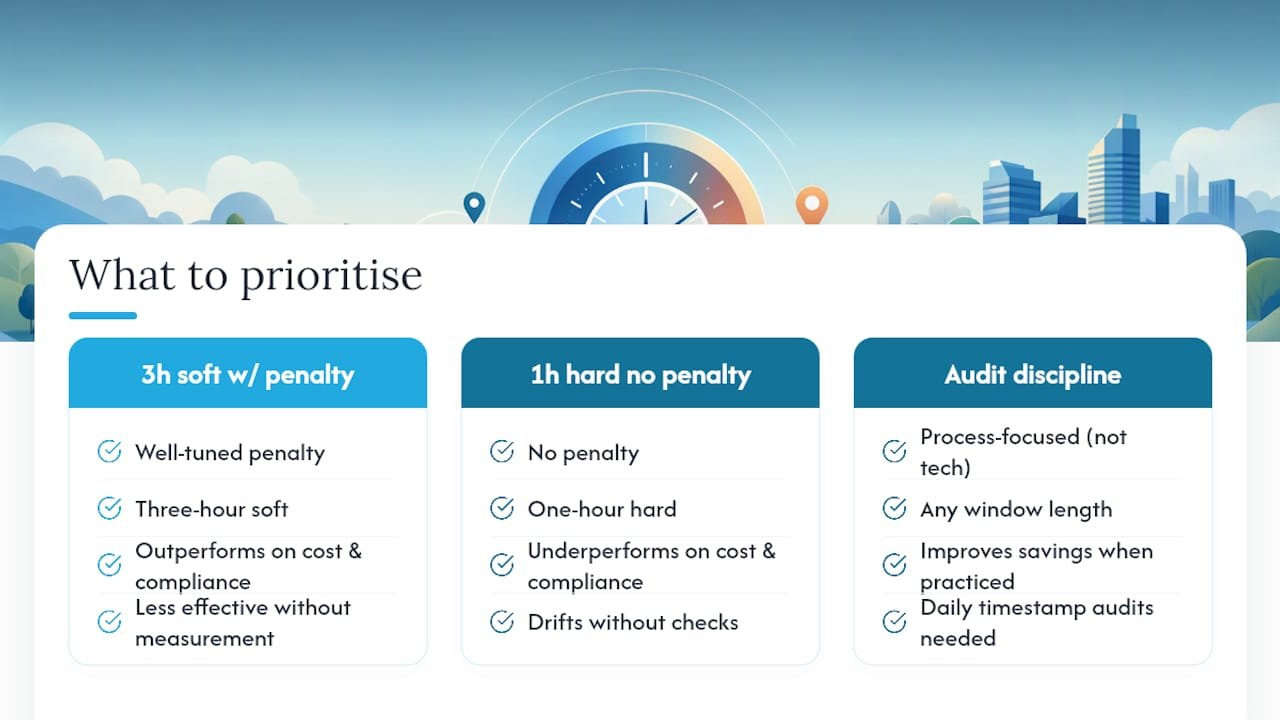
The conventional wisdom also underrates audit discipline. Plenty of operations set a compliance target and never build the daily habit of checking timestamp evidence against it, so the number drifts for months before anyone notices. That’s a process failure, not a technology one, and no amount of routing software fixes it on its own.
If you take one thing from this away, prioritise measurement before you touch window length or penalty settings. You cannot tune what you haven’t baselined, and most of the cost savings in this area come from small, evidenced corrections rather than a wholesale redesign of the booking policy.
Book a courier that treats your window as a promise, not a guess
Most businesses choosing between couriers end up comparing quoted speed against quoted price, and miss the part that actually determines whether a delivery lands on time: how the provider handles the moments a window nearly breaks. Frphaulage builds its entire same-day and next-day service around that exact problem, with a 60 to 120 minute rapid collection promise backed by a personal fleet and a vetted partner network, so a delay upstream doesn’t automatically become a missed window downstream.
Every job, whether it’s a single urgent parcel, a multi-drop regional run, or a scheduled business account, comes with a signed Proof of Delivery, giving you the timestamped evidence this article has argued you need to audit compliance and settle any dispute without a drawn-out argument. That’s available 24 hours a day, 365 days a year, not just during standard office hours.
If you’re weighing up providers for an urgent shipment or a recurring delivery schedule, read how to choose a same-day courier service and then get a quote for your next collection directly from Frphaulage.
Sources
The claims and figures above draw on a small set of primary sources worth reading directly if you’re building or revising a window policy:
- Flexible time window management for attended home deliveries (Köhler et al.)
- What is a Delivery Time Window? Definition and Benefits of It — Locus
- How to avoid detention and demurrage fees — Global CFS