Goods in transit cover, for urgent same-day and next-day logistics, is the courier service and operational safeguards that collect, protect and confirm handover of critical shipments. It is a service commitment, not an insurance policy. If a production line has stopped, an event is hours away, or a patient-critical part is sitting on a shelf 200 miles from where it needs to be. That is the moment to call a provider, not fill out a form.
Common triggers for calling immediately include:
- A manufacturing line down, waiting on one missing component
- An event or installation with a fixed, non-negotiable start time
- Medical or laboratory samples with a narrow viability window
- Contractual penalty clauses tied to a delivery deadline
Whichever provider you choose should confirm collection fast and hand back a signed proof of delivery with full tracking, so you have a defensible record the moment the job closes.
Key Takeaways
Time-critical shipments need a courier with a stated collection SLA, evidence-grade proof of delivery, and 24/7 availability, not vague promises of speed.
| Point | Details |
|---|---|
| Call early, not late | Decision latency, not distance, is usually what pushes a job into emergency-priced territory. |
| Insist on evidence-grade ePOD | GPS, timestamp, photo and signature together settle disputes far faster than paper POD alone. |
| Match urgency to actual risk | Reserve same-day pricing for genuine production, medical or event deadlines, not general nervousness. |
| Know the service limits | Hazardous goods, oversized loads, and undeclared high-value items need flagging at booking. |
| Frphaulage fits this exact need | 60 to 120 minute UK collection, 24/7/365, personal fleet plus vetted network, signed POD on every job. |
Table of Contents
- What does goods in transit cover actually include?
- How does tracking and ePOD cut disputes and speed up payment?
- When should you choose same-day versus next-day cover?
- What should you check before booking a provider?
- How do you prepare a shipment for rapid collection?
- Why FRP Haulage is built for this exact call
- What kinds of loss or damage does this kind of cover address?
- What limits should you expect on this kind of service?
- What’s the process if something goes wrong with a shipment?
- What drives the cost of this kind of service?
- What legal and regulatory points matter here?
- How does this compare with other cargo insurance types?
- Why governance, not just speed, controls your freight costs
- Ready to book same-day cover for a critical shipment?
- Sources
What does goods in transit cover actually include?
Strip away the jargon and this service does four things: collect the goods, keep them secure and monitored while they move, protect them from the practical risks of handling and transit, and confirm the drop-off in a way you can prove later. That last part is where most disputes with clients or suppliers get settled before they start.
The confirmation piece usually comes in one of two forms:
- Paper POD — a signed delivery note, photographed or scanned, useful but easy to lose and slow to reconcile against an invoice.
- Electronic proof of delivery (ePOD) — a digital record captured at the point of handover, typically timestamped and geotagged.
An evidence-grade ePOD record goes further still, linking the order reference, GPS coordinates, photo and item-level confirmation into one auditable trail rather than a loose stack of documents.
There are practical limits worth knowing before you call. Oversized loads, hazardous materials, and anything needing specialist handling (temperature control, ADR classification) sit outside a standard same-day run and need to be flagged at booking, not discovered at collection.
Pro Tip: Photograph the item before collection, not just at delivery. If a dispute ever arises about the condition goods left in, that single photo often settles it in seconds.
How does tracking and ePOD cut disputes and speed up payment?
A weak proof-of-delivery process costs you twice: once in the time spent chasing evidence when a client queries a delivery, and again in the days an invoice sits unpaid while someone tracks down a signature. Fix the evidence trail and both problems shrink.
A genuinely defensible delivery record links together:
- The order or job reference number
- Timestamped GPS coordinates at collection and drop-off
- A photo of the handover
- A named signature or item-level confirmation
This is what separates a basic “delivered” tick box from something insurers, finance teams and clients will actually accept without argument.
Pairing ePOD with e-invoicing removes the manual handoff between “it arrived” and “send the invoice,” and that gap is where most reconciliation delays live. Providers who combine the two report same-day invoicing becoming standard practice rather than the exception, because the delivery event itself triggers billing instead of waiting for someone to chase paperwork. For a business running multiple urgent shipments a week, that difference compounds fast into working capital you actually get to use.
When should you choose same-day versus next-day cover?
Not every urgent job needs the fastest possible option, and paying for a same-day dash when next-day would suffice can unnecessarily increase margin costs. The decision comes down to what happens if the delivery is late, not how important the goods feel.
- Production stop — a missing part halting a line justifies same-day, full stop. Every hour of downtime usually costs more than the premium for rapid collection.
- Perishable or medical shipments — samples, blood products, or time-sensitive pharmaceuticals need same-day cover with a tight collection window, often under two hours from the call.
- Event logistics — staging, signage, or catering equipment tied to a fixed start time sits in same-day territory the closer you get to the date; a week out, next-day is usually fine.
- AOG (aircraft-on-ground) and critical spares — these almost always demand the fastest ground option available, and sometimes escalate beyond ground transport entirely.
For genuine same-day need, expect a rapid collection SLA within a short, clearly stated time window from your call, with round-the-clock availability behind it. Providers built for time-critical work maintain the capacity to respond within minutes or hours precisely because disruption doesn’t wait for office hours.
Weigh the premium against the actual cost of delay. If a late delivery costs you a five-figure contract penalty, a same-day surcharge is trivial by comparison. If the downside is mild inconvenience, next-day or a scheduled slot protects your margin without adding real risk. Only escalate beyond ground expedite, an air charter or an on-board courier, when ground transit time genuinely cannot meet the deadline regardless of provider.
What should you check before booking a provider?
You have minutes on the phone, not hours, to work out whether a provider can actually deliver. A short, sharp checklist beats a long tender process when the clock is running.
Confirm these before you commit:
- Collection SLA — will they state a real window (ideally 60 to 120 minutes), or hedge with “as soon as possible”?
- Fleet structure — do they run their own vehicles, use a vetted partner network, or both? A hybrid model usually copes better with sudden multi-drop or regional demand.
- Proof of delivery — is signed POD standard on every job, or an optional extra?
- Tracking visibility — can you see the vehicle’s progress in real time, or only find out after the fact?
On the operational trust side, push for evidence-grade ePOD as standard, not a premium add-on, plus a stated exception-handling process for when something goes wrong mid-route. Retained documentation matters too. Ask how long delivery records stay accessible; 30 days is not the same as two years when a dispute surfaces late.
Commercially, get clarity on the pricing model (flat job rate versus mileage-banded), whether invoicing integrates with ePOD for faster reconciliation, how liability for goods in transit is actually handled, and how quickly they can confirm a booking once you call. A provider who can answer all of this in under five minutes on the phone is telling you something about how they run the rest of the job too.
Pro Tip: Ask for a written SLA confirmation by text or email before the driver leaves. It costs nothing and gives you a timestamped record if the collection window slips.
For a deeper walk-through of vendor selection, see this guide on choosing a same-day courier service.
How do you prepare a shipment for rapid collection?
Getting a mission-critical shipment ready properly is what turns a 90-minute collection window into an actual 90-minute collection, rather than 90 minutes plus 20 spent hunting for paperwork.
- Label clearly — order reference, SKU details, recipient contact number, and any handling notes (fragile, this way up, temperature-sensitive) visible on the outside.
- Gather documentation — PO number, any required authorisation or export paperwork, and photos of the item’s condition before it leaves your premises.
- Stage the goods — leave them somewhere the driver can access without a site tour, and name who is meeting them at both ends.
- Confirm the handover protocol — will the driver need ID checked, a specific loading bay, or a signature from a named individual only?
Get these four right and most collection delays disappear before the van arrives.
Why FRP Haulage is built for this exact call
Frphaulage runs same-day and next-day courier and haulage services across the UK, and the entire operation is built around one number: a rapid collection SLA of 60 to 120 minutes from your call, 24 hours a day, 365 days a year. That’s not a marketing line, it’s the operational commitment behind every job booked, whether it’s a single urgent parcel or a multi-drop regional run.
What sets the setup apart in practice:
- A personal fleet backed by a vetted partner network, so capacity doesn’t collapse the moment demand spikes
- Signed proof of delivery on every shipment, giving you the evidence trail this article has been arguing for throughout
- Handling suited to manufacturing components, essential documents, and high-value cargo alike
- Client feedback that consistently points to communication and professionalism as the standout, not just speed
If you’re weighing up whether a provider can genuinely back a same-day promise with proof, that combination of fleet resilience and documented delivery is the practical test to apply.
| Point | Details |
|---|---|
| Collection speed | Expect a stated SLA, ideally 60 to 120 minutes, not a vague “soon”. |
| Evidence over paperwork | Evidence-grade ePOD beats paper POD for disputes and faster invoicing. |
| Match urgency to cost | Reserve same-day for genuine production, medical or event deadlines. |
| Provider you can rely on | Frphaulage offers 60 to 120 minute UK collection, 24/7/365, with signed POD on every job. |
What kinds of loss or damage does this kind of cover address?
When people search for goods in transit cover, they’re often really asking what happens if something goes wrong during that window between collection and delivery. In the operational sense this article covers, the answer is about process, not payout.
A well-run same-day or next-day service is designed to prevent three recurring problems: theft during handling or at unattended stops, accidental damage from poor loading or rough handling, and outright loss where a parcel or pallet goes astray between drops. The safeguard against all three is the same, tight chain of custody. Secure loading practices, minimal handling touchpoints, and a driver accountable for a defined manifest all reduce the chance of any of these happening in the first place.
When something does go wrong, the value of a signed POD and photo evidence becomes obvious immediately. A photograph taken at collection proves the condition goods left in; a signature and timestamp at delivery proves who received what, and when. Together, they turn “it went missing somewhere” into a traceable, narrow window you can actually investigate, rather than a shrug.

This is distinct from a goods-in-transit insurance policy, which is a separate financial product covering the monetary value of loss. What Frphaulage and similar operators provide is the operational discipline, secure handling, tracking, and documented handover, that prevents these losses happening and gives you the evidence to resolve them fast when they do.
What limits should you expect on this kind of service?
Every operational courier and haulage service has boundaries, and knowing them before you book saves an awkward conversation at the collection point. The most common one is size and weight. Same-day networks are optimised for parcels, pallets, and vehicle-loadable freight, not abnormal loads needing specialist plant or escort vehicles.
Hazardous goods are another firm line. Anything requiring ADR classification, temperature-controlled transport outside standard ranges, or specific handling certification needs to be declared at booking, because not every vehicle in a fleet or partner network is equipped or licensed for it.
Geographic and timing limits matter too. A 60 to 120 minute collection SLA assumes a reasonable radius from available vehicles; extremely remote pickup points can extend that window, and providers should say so upfront rather than let it become a surprise. Out-of-hours collections at 3am are usually achievable with a 24/7 operation, but access restrictions at the collection or delivery address (site security, loading bay hours) can still cause delays that have nothing to do with the courier.
Finally, expect limits on undeclared value. If a shipment carries unusually high value or fragility, flag it at booking so appropriate handling, and appropriate care during loading and transit, can be arranged. Providers can’t protect against a risk they don’t know about.
What’s the process if something goes wrong with a shipment?
If a shipment is damaged, delayed, or doesn’t arrive as expected, the process for resolving it starts with the evidence trail built during the job itself, which is exactly why proof of delivery matters so much upfront.
The first step is straightforward: contact the provider directly with the job reference, and describe what happened. A provider with evidence-grade ePOD can usually pull up the timestamped GPS record, photo, and signature within minutes, giving both sides a factual starting point rather than a dispute over memory.
From there, most operators will investigate the specific leg of the journey where the issue occurred, cross-checking driver logs and handover records against your account of events. This is where the difference between a basic “delivered” tick box and a genuine audit trail becomes obvious. A vague confirmation gives you nothing to investigate; a full record narrows the problem to a specific handover point.
Resolution timelines vary by provider and by the nature of the issue; a straightforward delay is usually explained same-day, while a damage or loss query may take longer if it needs cross-referencing with driver reports or partner network records. Throughout, keep your own documentation, the pre-collection photo, the PO number, any authorisation paperwork, ready to hand over immediately. The faster you can supply your side of the evidence, the faster the provider can close the query.
What drives the cost of this kind of service?
Pricing for same-day and next-day courier and haulage work isn’t a single number, it moves with several variables, and understanding them helps you avoid paying urgency-tier prices for a job that didn’t need it.
Distance and route are the obvious starting point: a local collection and drop costs less than a cross-country multi-drop run, and mileage-banded pricing reflects that directly. Urgency tier matters just as much. A genuine same-day job with a tight collection window commands a premium over next-day or scheduled slots, because it reserves capacity and reroutes resource at short notice.
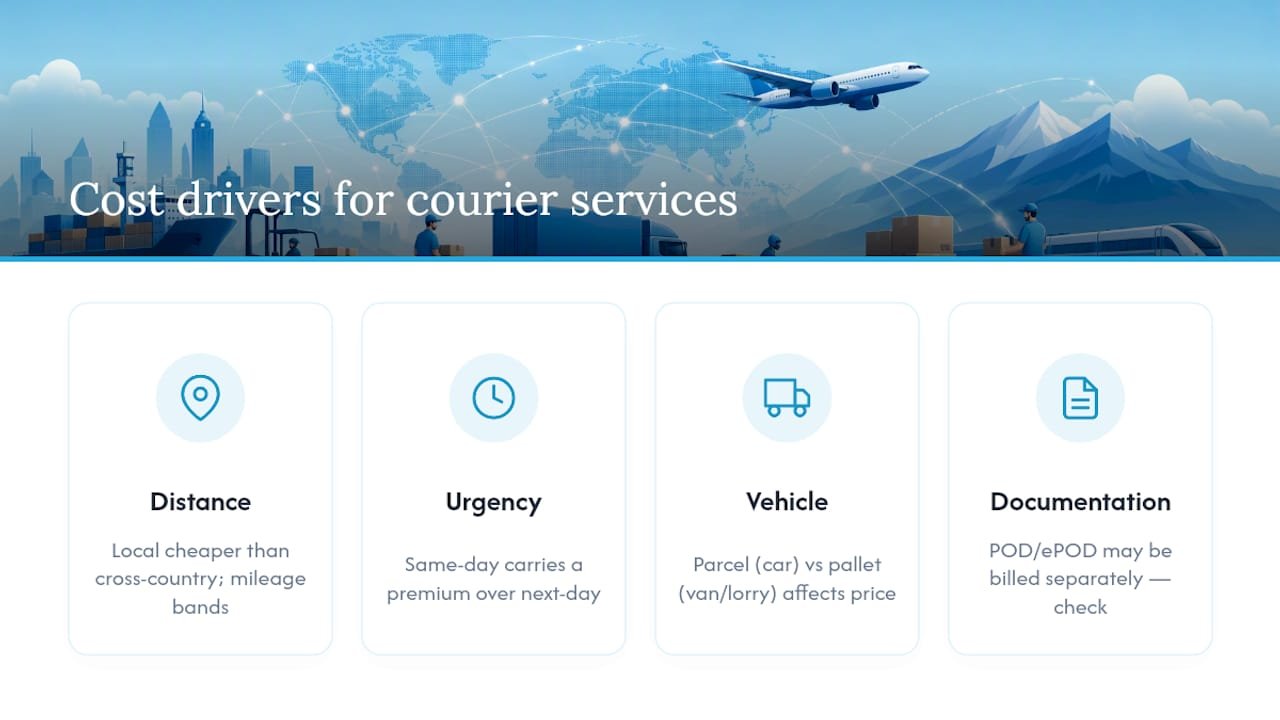
Vehicle type and load size shift the price too. A single parcel in a car-based courier costs far less than a pallet needing a van or a multi-drop lorry run. Specialist handling, temperature control, fragile goods care, or out-of-hours collection, adds to the base rate because it ties up equipment or driver time that could otherwise serve another job.
Then there’s the service layer: signed POD and evidence-grade ePOD are increasingly standard rather than an optional extra, but some providers still price documentation and tracking separately. Ask directly whether proof of delivery is baked into the quoted price or billed on top.
The most reliable way to control cost is matching urgency to genuine need, covered earlier in this guide, and getting a clear quote structure upfront: flat job rate versus mileage-banded, any out-of-hours surcharge, and whether documentation is included. A provider who can break this down clearly on the phone is usually one who prices fairly rather than opportunistically.
What legal and regulatory points matter here?
Courier and haulage operations sit inside a framework that affects how a job gets done, even when the service itself is straightforward. Vehicle operators need the right operator licensing for the type and weight of goods carried, and drivers handling certain freight categories, hazardous materials in particular, need specific certification under ADR rules.
Driving hours and rest requirements apply to longer haulage runs, which is part of why same-day capability depends on fleet size and network depth rather than a single driver working longer shifts. A provider with a personal fleet plus a vetted partner network can rotate capacity to stay compliant while still meeting a rapid collection SLA.
Data protection is relevant too, since ePOD systems capture personal information: names, signatures, delivery addresses, sometimes photos of premises. Providers handling this data are expected to manage it under standard data protection obligations, retaining records only as long as needed for reconciliation, disputes, or contractual requirements.
Contractually, liability for goods while in transit is typically set out in the provider’s terms of carriage rather than negotiated fresh for every job. It’s worth asking upfront how liability is defined for high-value or fragile shipments, particularly since standard terms often cap liability at a level below the goods’ actual value. None of this should slow down an urgent booking, but knowing the framework helps you ask the right question when it counts, rather than discovering the answer after a problem has already happened.
How does this compare with other cargo insurance types?
Goods in transit cover, as this article uses the term, describes an operational service: collection, secure handling, tracking, and documented delivery. It sits in a different category from financial insurance products, and conflating the two leads to gaps in either protection or expectation.
Marine cargo insurance, for instance, covers the financial value of goods moving by sea against a defined set of perils, and is negotiated as a standalone policy separate from the shipping line’s service. Freight liability cover, similarly, is a financial product addressing a carrier’s legal liability for loss or damage, often with capped payouts set by the terms of carriage rather than the goods’ full value.
What Frphaulage and comparable same-day and next-day operators provide instead is the operational layer: the part that determines whether goods arrive intact and on time in the first place, backed by proof that they did. Signed POD, ePOD with GPS and photo evidence, and real-time tracking are the tools that reduce the likelihood of a claim ever needing to be made under a separate insurance policy, and that make resolving any dispute faster if one does arise.
For a business running frequent urgent shipments, the practical approach is treating these as complementary rather than interchangeable: operational service quality from your courier or haulage partner, and, where the value or risk profile justifies it, a separate insurance conversation with a broker about financial protection for the goods themselves.
Why governance, not just speed, controls your freight costs
The real cost driver in emergency freight usually isn’t the courier, it’s the hours lost before anyone calls one. Decision latency, waiting for someone to approve a purchase order or confirm a supplier substitution, quietly pushes jobs from standard lead times into premium territory. A governed decision path with named owners and SLA-bound approvals can cut that gap from roughly fourteen hours to under two, often preserving a standard delivery window entirely.
Evidence-grade delivery matters here too. It’s not just proof after the fact, it’s the record that lets you diagnose where delay actually happened, so the next decision gets made faster.
— Catalin
Ready to book same-day cover for a critical shipment?
Frphaulage exists for exactly the moment this article describes: a shipment that cannot wait, and a business that needs proof it arrived. Where a standard courier might promise “same day” without much behind it, Frphaulage backs that promise with a 60 to 120 minute collection SLA, a personal fleet supported by a vetted partner network, and signed proof of delivery on every job, whether it’s a single urgent parcel or a multi-drop run across regions.
That combination matters most when the stakes are highest: a stalled production line, an event with a fixed start time, or high-value cargo that needs documented handling from collection to signature. If you’re weighing up a provider right now, the fastest way to find out what Frphaulage can do for your situation is to call and ask for a collection window on the spot. For more detail on how the service is structured, see how to choose a same-day courier service, or go straight to booking a collection.
Sources
- Evidence-grade delivery (nShift content library)
- Time-Critical Logistics: Build the Capability to Respond
- e‑Invoicing & ePOD for faster B2B reconciliation (eShipz)