Expect to pay somewhere between £0.70 and £1.80+ per mile for same-day courier work in the UK, depending on vehicle size, distance and how urgent the job is. That’s a commercial rate, not the same thing as HMRC’s Approved Mileage Allowance Payments, which sit at 55p for the first 10,000 business miles from April 2026. Confusing the two is the single most common budgeting mistake small businesses make.
TL;DR:
- Market courier rates in the UK typically range from £0.70 to over £1.80 per mile, depending on vehicle size, distance, and urgency.
- Short urban trips with small vans can cost around £1 to £1.80+ per mile, usually with a minimum charge that inflates the effective cost for small jobs.
- Factors like fuel prices, congestion charges, waiting time, handling needs, and delivery zones notably influence pricing, often adding costs beyond the base rate.
- Small businesses should build their own cost base including fuel, maintenance, insurance, and labor, then compare with actual market quotes, not just HMRC reimbursement rates.
- Conflating HMRC’s tax-free mileage allowances with actual courier market rates leads to underbudgeting or overspending; use market rates for outsourced deliveries.
Table of Contents
- What are typical UK courier mileage rates by vehicle and job type?
- What drives courier prices up or down?
- How do you calculate a fair price per mile?
- Are HMRC mileage rates the same as courier prices?
- Does location or time of year change what you pay?
- How can you reduce delivery costs without cutting corners?
- What should a professional same-day quote actually include?
- What do industry contracts say about mileage reimbursement?
- How do mileage rates affect courier earnings and margins?
- An honest read on courier pricing confusion
- Sources
What are typical UK courier mileage rates by vehicle and job type?
Short urban runs in a car or small van tend to sit at the higher end of the pence-per-mile scale, simply because fixed costs get spread over fewer miles. A five-mile cross-town delivery might cost as much per mile as a fifty-mile motorway run, because the driver, fuel and vehicle wear cost roughly the same whether the trip is short or long.
Driver-sourced rate guides put small-van subcontracting rates at a midpoint of roughly 85p to £1.20 per mile through early 2026, with lower figures for high-volume, long-distance contracts and higher ones for one-off urgent jobs. Larger vehicles change the maths further. Freight consultancy data shows Luton vans and 7.5-tonne trucks carrying a noticeably higher cost-per-mile than a small van, driven by fuel consumption, insurance and, often, a second crew member for loading.
Roughly, you should expect to see:
- Car or small van, short urban trips: often £1 to £1.80+ per mile, frequently with a minimum charge applied regardless of distance.
- Medium van, same-day regional work: typically 85p to £1.20 per mile once distance covers the minimum.
- Luton or transit-sized vehicles: a higher baseline per mile than a small van, reflecting fuel and payload capacity.
- Multi-drop or long-haul motorway legs: the lowest effective pence-per-mile, because fixed costs are spread over more distance.
Minimum charges matter more than the headline pence-per-mile figure for short jobs. A courier quoting 90p per mile with a £45 minimum will actually charge over £2 a mile on a 20-mile run once you do the sums.
What drives courier prices up or down?
Fuel is the obvious variable, but it’s rarely the biggest one.
Multi-stop jobs complicate pricing further. Waiting time at each drop, proof-of-delivery paperwork and handling fragile or high-value goods all add minutes that couriers convert into pounds. Time sensitivity is its own cost driver: a “collect within 90 minutes” job commands a premium over a next-day booking, because it blocks a vehicle and driver from taking other work.
Local charges add a layer most first-time senders overlook. London’s congestion charge and ULEZ apply to vehicles entering central zones, and couriers typically pass these straight through, alongside tolls and parking costs in restricted city centres.
Cost drivers worth flagging when you request a quote:
- Fuel type and current diesel/petrol prices, which shift base rates seasonally.
- Vehicle size and whether a tail-lift or extra manpower is needed.
- Number of stops, waiting time allowances, and handling requirements.
- ULEZ, congestion charge, tolls and city-centre parking, usually itemised separately.
Pro Tip: Ask upfront whether ULEZ and congestion charges are included in the quoted price or billed separately. Couriers that itemise them tend to be more transparent overall.
How do you calculate a fair price per mile?
Building your own per-mile rate, whether you’re a courier setting prices or a business estimating a quote, comes down to six components stacked together.
- Fuel cost per mile. Take your vehicle’s average mpg, current fuel price, and convert to pence per mile.
- Maintenance and depreciation. Spread servicing, tyres and depreciation across your expected annual mileage.
- Insurance. Divide your annual commercial insurance premium by expected mileage.
- Driver labour. Convert an hourly rate into pence per mile using average job speed, including loading time.
- Overhead allocation. Add a share of fixed costs like a depot, phone, and admin.
- Margin. Add your profit margin on top of the true cost base.
For a 50-mile small-van same-day job, a typical build-up might land around £45 to £70 in true operating cost once fuel, labour and overhead are combined, before margin. That’s the internal figure. The customer-facing quote will usually sit higher to account for urgency, insurance on the goods carried, and the opportunity cost of holding a vehicle ready to collect within the hour. Businesses reimbursing staff who use their own vehicle for occasional courier-style runs should apply HMRC’s AMAP rate rather than the commercial figure, since these are different calculations for different purposes.
Add a minimum call-out fee for jobs under roughly 10 to 15 miles. Without one, short urban trips routinely undercharge relative to the fixed cost of dispatching a vehicle at all.
Are HMRC mileage rates the same as courier prices?
No, and this is where most confusion sits. AMAPs are HMRC’s tax-free reimbursement thresholds for employees or self-employed people using their own vehicle for business travel. They are not a market price for hiring a courier.
These figures apply for the 2026/27 tax year, up from previous levels. Employers aren’t obliged to pay exactly this amount. The House of Commons Library notes AMAPs set the ceiling for tax-free reimbursement, not a mandatory pay level. Pay above the threshold and the excess typically becomes taxable income for the employee.
If you’re reimbursing staff for occasional mileage, use AMAPs. If you’re budgeting for outsourced courier spend, use market rates instead. They serve entirely different purposes.
Does location or time of year change what you pay?
Rates climb in London and other major cities, partly from ULEZ and congestion charges, partly from denser traffic slowing average job speed. Remote areas, particularly the Scottish Highlands and islands, often carry a premium too, since return legs frequently run empty.

Demand swings seasonally. The run-up to Christmas and the final weeks of each financial quarter tend to push same-day rates higher, as capacity tightens and urgent B2B shipments spike.
How can you reduce delivery costs without cutting corners?
Consolidating multiple parcels into a single collection is the easiest lever most senders ignore. One collection carrying three items nearly always costs less per parcel than three separate bookings, even to the same address.
Accuracy on dimensions and access saves money too. Understating a parcel’s weight or failing to mention a lack of loading-bay access at the destination is the single most common cause of on-the-day surcharges.
- Batch deliveries where timing allows, rather than booking multiple same-day collections.
- Give exact weight, dimensions and access details when requesting a quote.
- Ask whether your job genuinely needs same-day service, or whether standard depot-to-depot parcel pricing would work, since small non-urgent parcels can cost a fraction of dedicated courier rates.
- Negotiate account rates if you book regularly, and ask for a transparent, published fuel-surcharge formula rather than a vague percentage.
Pro Tip: If a parcel isn’t genuinely time-critical, ask for a next-day quote alongside the same-day one. The price gap is often larger than people expect, and next-day frequently covers the job just as well.
What should a professional same-day quote actually include?
A proper same-day quote covers more than distance and fuel. It should specify a collection SLA, confirm signed proof of delivery, and state whether insurance for high-value cargo is included or added separately. Extras worth asking about upfront include waiting time beyond a grace period, charges for failed delivery attempts, and whether tail-lift or two-person handling is built into the price or billed on top.
Frphaulage structures its same-day quotes around a 60 to 120 minute collection window, backed by a personal fleet plus a vetted partner network for coverage when demand spikes. Every job comes with signed proof of delivery as standard, whether the shipment is a single urgent document or a multi-drop run of manufacturing components. That combination of speed and paperwork is what separates a dependable same-day provider from a courier quoting on price alone.
What do industry contracts say about mileage reimbursement?
Business account agreements with courier and haulage providers rarely price purely on distance. Most standard contracts reference a base rate per mile or per job, layered with defined surcharges for fuel, waiting time and out-of-hours collection, agreed in advance rather than applied ad hoc.
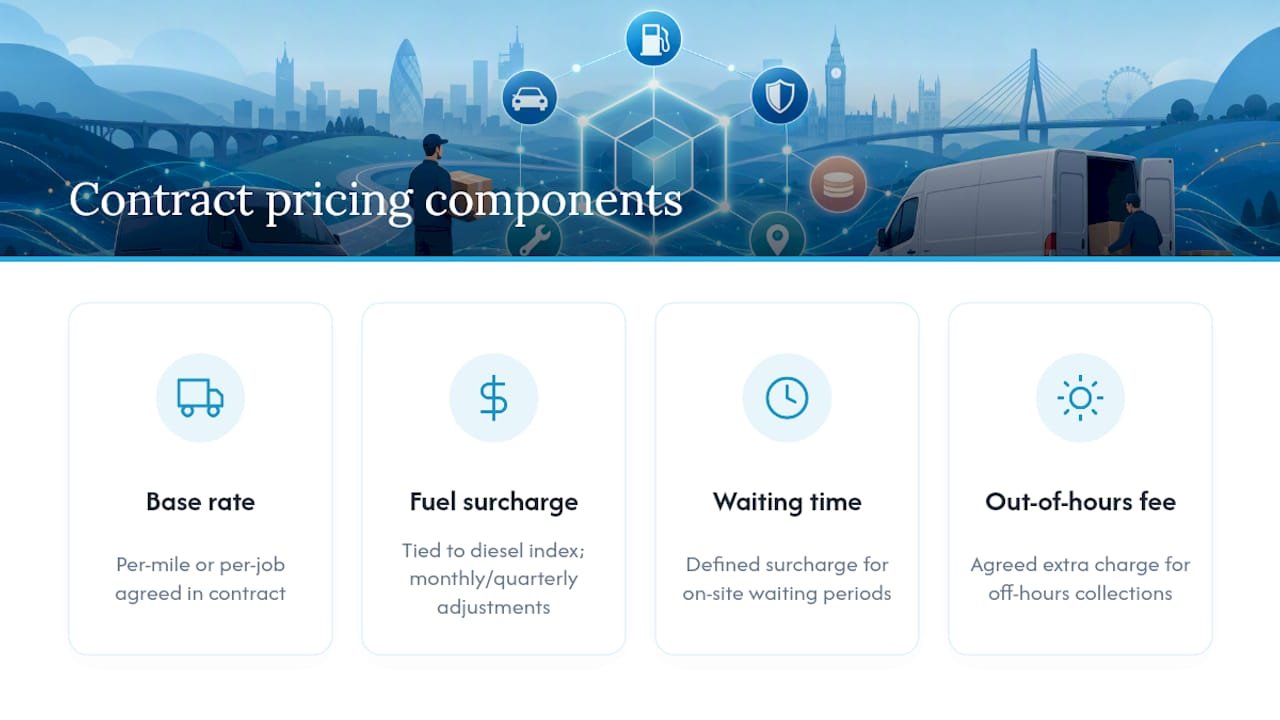
Fuel surcharge clauses are near-universal in commercial haulage agreements. They typically link to a published diesel index, adjusting monthly or quarterly rather than per job, which gives both parties a predictable formula instead of a fresh negotiation every time fuel prices move. A well-drafted contract states the index used and the adjustment frequency in plain terms.
Service level agreements sit alongside the mileage or job-rate structure. These specify collection windows, proof-of-delivery requirements and liability limits for goods in transit, effectively bundling the “what you pay” question with “what you’re covered for” in one document. For businesses booking regular multi-drop or scheduled runs, this bundling matters more than the headline pence-per-mile figure, because a cheap rate with weak liability cover can cost far more if something goes wrong in transit.
Where staff use personal vehicles for company business, contracts of employment or expense policies typically reference AMAP rates directly, either matching them or setting a lower internal rate. That’s a separate document from the commercial haulage contract governing outsourced deliveries, and conflating the two in a policy document is a common drafting error worth checking for.
How do mileage rates affect courier earnings and margins?
For a self-employed courier or a small haulage operator, the pence-per-mile rate charged to customers determines profitability far more directly than most people assume, because fixed costs (insurance, vehicle finance, depot overhead) don’t shrink on quiet weeks.
A courier charging £1 per mile on a vehicle costing 45p per mile to run has a healthier margin than the raw numbers suggest, once empty return legs are factored in. Return-leg mileage without a paying job attached is the quiet profit killer in this industry. A driver who charges well but routinely drives back empty is often earning less per hour than one charging slightly less but securing a return-leg booking through a partner network.
Volume and consistency matter more than chasing the highest headline rate. A courier running steady multi-drop contracts at 90p per mile with minimal empty mileage will usually outearn one chasing premium one-off jobs at £1.50 per mile with long gaps between bookings. Fuel price volatility eats into margin fastest for operators without a fuel-surcharge clause in their contracts, which is why that clause matters as much for the courier’s earnings as for the customer’s budget.
An honest read on courier pricing confusion
The biggest gap in this topic isn’t a lack of data. It’s that AMAPs and market courier rates get treated as interchangeable when they answer completely different questions. One is a tax threshold for reimbursing an employee’s own car. The other reflects a live market for urgent, insured, time-critical transport. Conflating them leads small businesses to either underbudget for genuine same-day work or overpay staff mileage and create an unexpected tax liability.
Conventional advice tends to stop at “check HMRC’s rate,” which is only half the job. The more useful habit is building your own cost base, fuel, labour, overhead, margin, and comparing that against live market quotes rather than a government reimbursement figure that was never meant to price a delivery job. If you take one thing from this: budget using real courier quotes, and reserve AMAPs strictly for what they’re designed for, reimbursing your own staff’s mileage.
— Catalin
Need a same-day quote that spells out exactly what you’re paying for? Frphaulage collects within 60 to 120 minutes, 24/7/365, with signed proof of delivery on every job. Read our guide on how to choose a same-day courier service before you book your next urgent shipment.
Sources
- Gov
- Mileage allowance payments – House of Commons Library
- UK Delivery Cost Statistics – United Kingdom