A standard Category B car licence lets you drive a van up to 3,500 kg gross vehicle weight, or 4,250 kg if it’s a qualifying zero-emission van. Beyond that headline figure, you’re also bound by the plated axle limits stamped on the vehicle. Ignore either number and DVSA can issue an on-the-spot fine or a prohibition that parks your van until the load comes off.
TL;DR:
- The 3,500 kg maximum authorized mass applies to most vans driven with a Category B license, with a 4,250 kg limit for qualifying zero-emission models.
- Overloading axle limits or gross train weight can lead to separate legal violations, fines, and vehicle prohibitions, even if total weight remains within the MAM.
- Weighbridge checks and proper load distribution are critical for legal compliance, especially since many overloads result from axle weight issues rather than total mass exceedance.
- Carrying a trailer can increase weight limits up to 3,500 kg combined if the trailer is not heavier than the van’s GTW; exceeding this requires additional licensing.
- For safe and legal operation, drivers should always verify vehicle plate figures before loading and use weighbridges regularly to prevent fines and vehicle damage.
Table of Contents
- Quick summary of legal limits: 3.5t, 4.25t, axle and train weights
- Who can drive which van? Licence categories and key dates
- What do MAM, kerb weight and payload actually mean?
- How do weighbridges and DVSA roadside checks actually work?
- Towing with a van: how trailer rules change your weight limit
- Practical compliance checklist: how to avoid getting caught overweight
- How professional couriers stay legal without losing time
- Why this topic gets more confusing than it needs to be
- Sources
Quick summary of legal limits: 3.5t, 4.25t, axle and train weights
The numbers you see quoted everywhere, 3,500 kg and 4,250 kg, aren’t arbitrary marketing figures. They come straight from statute. The Road Vehicles (Construction and Use) Regulations 1986 and the Road Vehicles (Authorised Weight) Regulations 1998 set out the maximum authorised mass (MAM), sometimes called gross vehicle weight (GVW), for every category of goods vehicle on UK roads. Your driving licence category then determines which of those weight bands you’re legally allowed to pilot.
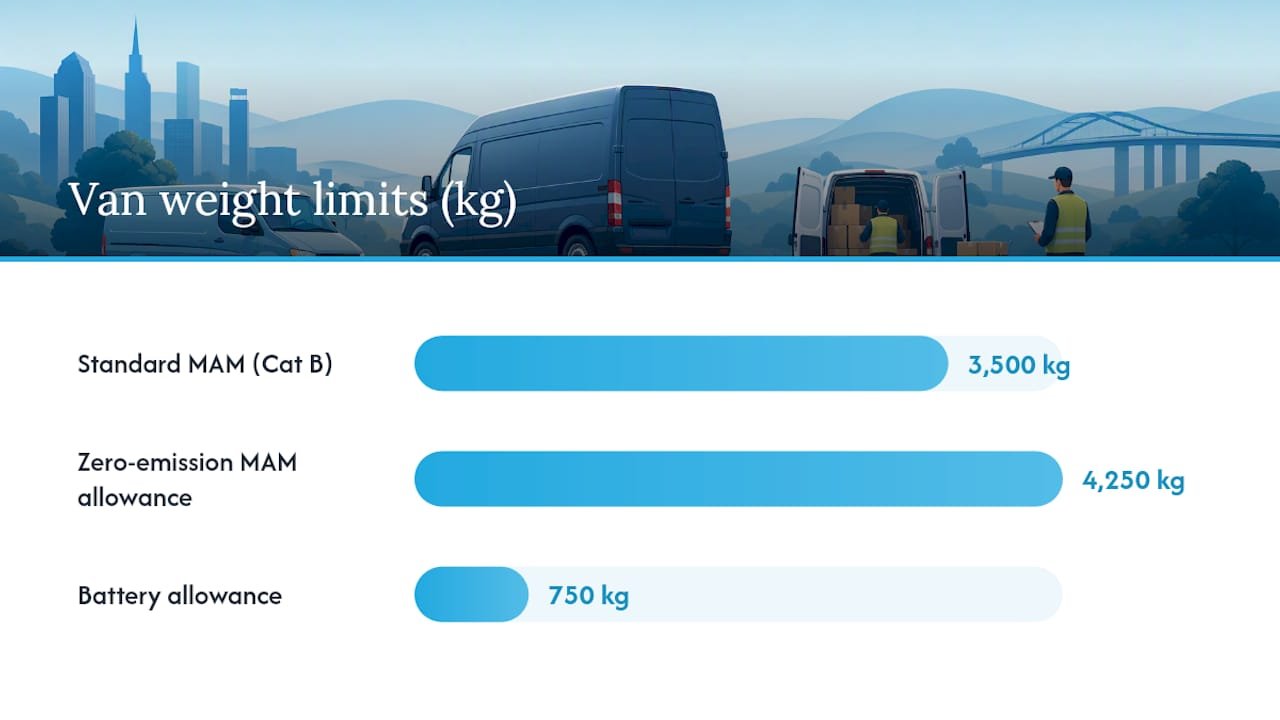
For most van drivers, the working limit is 3,500 kg MAM. That’s the standard cutoff for a Category B licence, and it covers the overwhelming majority of Transit-sized vans, Sprinters, and long-wheelbase panel vans on British roads.
Electric and hydrogen vans get a concession. GOV.UK’s guidance on driving zero-emission vehicles confirms that qualifying battery or hydrogen-powered vans can run up to 4,250 kg on a standard Category B licence, an extra 750 kg to offset the weight of the battery pack. The allowance isn’t automatic for every electric van on sale; it applies specifically to goods vehicles designed to be zero-emission, and some manufacturers require you to complete a short training module before the higher limit applies commercially. Always check the specific model’s documentation rather than assuming.
Gross vehicle weight is only half the picture. Axle weight limits and gross train weight (GTW, the vehicle plus anything it’s towing) are separate legal constraints that sit alongside MAM, not underneath it. You can be entirely within your 3,500 kg overall limit and still commit an axle overload offence if the load sits too far back or too far forward.
The figures that matter in practice:
- 3,500 kg: standard MAM for a Category B licence, no special certification needed.
- 4,250 kg: MAM allowance for qualifying zero-emission vans on the same licence.
- Axle limits: set individually per axle on the manufacturer’s plate; exceeding either axle is a distinct offence from exceeding gross weight.
- Plated weight: the figure stamped on the VIN or manufacturer’s plate is legally conclusive, according to GOV.UK’s guidance for van drivers, whatever your own maths says.
Who can drive which van? Licence categories and key dates
Licence entitlement in the UK isn’t just about age or when you passed your test. It’s tied to a specific weight band, and the rules shifted meaningfully in 1997.
If you hold a standard Category B licence, you can drive any van up to 3,500 kg MAM, full stop, no extra tests required. That covers the vast bulk of light commercial vehicles used for parcel work, trades, and small business deliveries.
The zero-emission uplift to 4,250 kg sits on top of that same Category B entitlement. GOV.UK’s guidance is the reference point here, and it’s worth reading in full if you’re switching a fleet to electric, since eligibility depends on the vehicle being purpose-built as a zero-emission goods vehicle rather than a converted diesel model.
Once you go above 3,500 kg, the picture changes:
- Category C1: covers vehicles from 3,500 kg up to 7,500 kg, plus a small trailer allowance. You’ll need a medical examination and a theory and practical test specific to this category.
- Category C: required for anything above 7,500 kg. This is the full HGV entitlement and comes with tighter medical and training requirements.
- Test-date caveat: drivers who passed a car test before 1 January 1997 often retain grandfathered C1 entitlement automatically on their existing licence. Anyone who passed after that date needs to take the C1 test separately if they want to drive in that weight band.
Driving a vehicle beyond what your licence permits isn’t a grey area. It’s treated the same as driving without a licence for that category, which means fines, penalty points, and potentially a court summons if it happens repeatedly. You can check exactly what your licence covers using the government’s online licence-checking service, and it’s worth doing before you hire or buy anything close to that 3,500 kg threshold.
What do MAM, kerb weight and payload actually mean?
Every van has four weight figures that matter, and mixing them up is the single most common reason people load beyond the legal limit without realising it.
- MAM/GVW (maximum authorised mass): the absolute ceiling for the vehicle including everything, driver, passengers, fuel, tools, and cargo. This is the number DVSA enforces against.
- Kerb weight (or unladen weight): the van as it left the factory, empty, with no driver, no fuel, and no cargo. Manufacturers occasionally quote this without a full tank, so check the specific definition used.
- Mass in running order: kerb weight plus a full tank of fuel, driver, and standard equipment. This is usually the more realistic starting figure for payload maths.
- Payload: the weight you’re actually allowed to add. Calculate it as MAM minus mass in running order, not MAM minus the bare kerb weight, or you’ll overestimate what you can legally carry.
Gross train weight (GTW) is a separate figure again, covering the van plus any trailer. If your plate shows a GTW of 5,000 kg and your van alone weighs 3,500 kg, you’ve got 1,500 kg available for a laden trailer, not the full trailer capacity the manufacturer might advertise separately.
You’ll find all of these figures on the VIN plate or manufacturer’s plate, usually riveted inside the driver’s door frame, under the bonnet, or on the chassis rail. GOV.UK’s van driving guidance explains exactly where to look and confirms that whatever figure is stamped there overrides any handbook estimate or online spec sheet. If the plate and the brochure disagree, the plate wins in law.
How do weighbridges and DVSA roadside checks actually work?
DVSA officers don’t need to guess at your van’s weight. Roadside checks use portable axle weighers or, for a definitive figure, a full weighbridge, and the result is compared directly against the plated weights on your vehicle.
You can check your own load before you’re ever pulled over. The government’s weighbridge finder lists public weighbridges across the country, and a ticket from one of these is worth keeping. It’s proof of compliance if you’re stopped later, and insurers increasingly ask for weighbridge evidence when settling claims involving an accident where load weight is in question.
Overloading isn’t a minor administrative slip. It’s an offence with real financial teeth, and the penalties scale with how far over the limit you are. Fixed penalty notices are the baseline response for moderate breaches, but the fines increase in bands, and a serious or repeated overload can end up in court rather than dealt with roadside. Crucially, an axle overload is prosecuted as a separate offence from a gross weight overload, so it’s entirely possible to be fined twice from a single stop if your load is both over gross weight and unevenly distributed across the axles.
If DVSA finds your van dangerously overloaded, expect one of these immediate consequences:
- Prohibition notice: the vehicle is stopped from continuing until the excess weight is removed or redistributed.
- Fixed penalty or court referral: depending on severity, either an immediate fine or a summons.
- Financial deposit for non-UK registered vehicles: overseas operators without a UK presence may be required to pay a deposit against the fine on the spot.
- Ongoing operator record: repeated stops feed into an operator’s compliance history, which affects future roadside targeting and, for licensed operators, their operator compliance risk score.
Overloading isn’t only a legal risk either. GOV.UK’s own guidance on vehicle weight and overloading notes that excess weight degrades braking performance and accelerates tyre and suspension wear, so a van that’s routinely pushed close to its limit costs more to run even before a fine arrives. For fleet managers weighing up whether to upsize a vehicle rather than manage load more carefully, this partner guide on axle weight planning is a useful practical companion to the official rules.
Towing with a van: how trailer rules change your weight limit
Hitching a trailer to your van pulls a second set of rules into play, and they trip up more drivers than gross vehicle weight ever does.
- The common case: if you passed your car test on or after 1 January 1997, GOV.UK’s towing guidance confirms you can usually tow a trailer up to 750 kg behind a vehicle up to 3,500 kg without any extra entitlement.
- Heavier trailers, same licence: you can tow a trailer heavier than 750 kg on a standard licence too, provided the combined weight of van plus laden trailer doesn’t exceed 3,500 kg. This is the bit most people miss; it’s a combined limit, not two separate 3,500 kg allowances.
- When you need more: if the combined weight goes over 3,500 kg, you’ll need additional entitlement, category BE, which requires a separate test.
Before you tow anything, check the van’s plated GTW rather than assuming the trailer manufacturer’s braked or unbraked rating tells the whole story. A van rated to tow 2,000 kg on paper might have a GTW that leaves far less room once the van itself is loaded. Drivers modifying a vehicle for heavier towing sometimes look at engine or transmission remaps, and this technical breakdown of what a towing remap actually changes is worth a read before spending money chasing capability the chassis weight limit won’t actually allow.
Practical compliance checklist: how to avoid getting caught overweight
Most overload cases aren’t drivers deliberately cramming in an extra pallet. They’re the result of nobody doing the maths before the van left the yard.
Start every job with the same three checks. First, find the plated MAM on the VIN plate or manufacturer’s plate; don’t rely on memory or a spec sheet from when the van was new. Second, work out mass in running order (kerb weight plus fuel, driver, and any permanently fitted equipment like racking or a tail lift, which can eat several hundred kilograms of payload before a single parcel goes in). Third, subtract that from MAM to get your real usable payload, then weigh your actual load against it before departure, not after a DVSA officer asks you to.
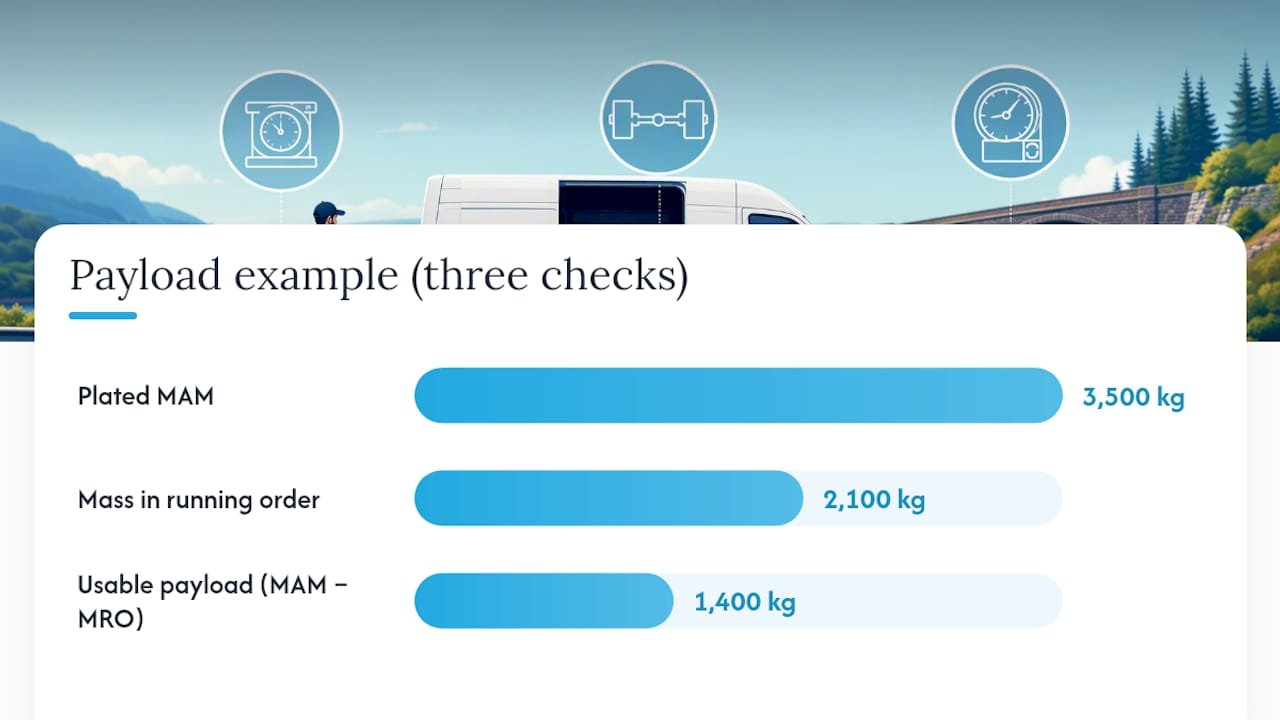
A worked example makes this concrete: a panel van plated at 3,500 kg MAM with a mass in running order of 2,100 kg (including a fitted tail lift) leaves you 1,400 kg of genuine payload, not the 1,600 kg or so a brochure might quote against bare kerb weight.
Distribution matters as much as total weight:
- Load heavy items low and towards the front axle rather than letting weight bunch over the rear doors.
- Secure loads properly; shifting cargo mid-journey changes the effective axle distribution even if nothing was added.
- Use a public weighbridge periodically, not just when you suspect a problem, and keep the tickets on file.
- Retain weighbridge receipts alongside your proof of delivery paperwork; both matter if an insurer or DVSA officer questions a specific job later.
Pro Tip: Weigh your van laden but before final securing on any new route or new type of cargo, just once. It tells you whether your mental estimate of payload is actually accurate, and most drivers are surprised by how wrong their guess was.
If your regular loads are outgrowing what a 3,500 kg van can carry, it’s often cheaper to plan routes and vehicle choice properly than to keep testing the plate limit; a route optimisation approach that matches vehicle size to typical load weight avoids the problem before it starts.
How professional couriers stay legal without losing time
Same-day and next-day operators can’t afford the downtime a prohibition notice causes, so weight compliance gets built into planning rather than checked as an afterthought.
Loads get planned against the plate before the van leaves the depot, not estimated by eye. Where a job looks marginal, a weighbridge stop is factored into the route rather than skipped to save ten minutes, because a prohibition costs far more time than a weighing detour ever would.
When a load turns out heavier than expected on collection, professional operators have a short list of fixes rather than a shrug:
- Redistribute the load across the axles before departure if the gross weight is fine but the balance isn’t.
- Offload part of the consignment locally and arrange a second drop if the total genuinely exceeds the plate.
- Call out an alternative vehicle from a wider fleet rather than risk the stop entirely.
Signed proof of delivery and dated paperwork on every job also matter here. They’re not just customer reassurance; they’re the record that shows a load was handled correctly if a dispute or insurance query surfaces weeks later.
Why this topic gets more confusing than it needs to be
The conventional advice on van weight limits stops at “3,500 kg on a car licence” and leaves it there, which is technically correct and practically useless. Most overload cases we’d expect to see in this sector aren’t gross weight failures at all; they’re axle distribution problems on vans that were within their overall limit the whole time. That’s the gap nobody talks about.
The 2026 tachograph change for international van movements between 2.5 and 3.5 tonnes is going to catch operators off guard for the same reason: it’s a scheduling problem dressed up as a weight problem, and firms that only track gross vehicle weight won’t see it coming. If you take one thing from this article, make it this: weigh loaded, not just gross, and check the axle split before you check the total. Everything else in the drivers’ hours rules for 2026 follows from getting that habit right first.
— Catalin
When a load genuinely outgrows what a 3,500 kg van can carry safely and legally, the answer isn’t to push the plate limit; it’s to call in a vehicle built for the job. Frphaulage runs same-day and next-day collections across the UK, with rapid pickup and a personal fleet vetted for exactly this kind of weight-sensitive work, backed by signed proof of delivery on every job. Find out how the same-day courier process works from call to delivery before your next oversized or time-critical consignment leaves the yard.