Signature on delivery is a delivery option where a named recipient, or an authorised person at the address, signs to acknowledge receipt and the carrier records that signature as proof of delivery (POD). It does not guarantee the right person signed, and it does not prove the contents were undamaged. What it does prove is that someone at that address accepted the parcel at a specific time. Under the Electronic Communications Act 2000, electronic signatures are admissible in evidence, and the Electronic Trade Documents Act 2023 extends that legal weight to electronic trade records from reliable registered delivery systems. In practice, the strength of your proof depends on what the carrier records alongside the signature.
The most common proof elements collected at delivery are:
- Signature image or digital squiggle captured on a handheld device
- Recipient name (typed or printed, separate from the signature)
- Timestamp showing date and time of delivery
- Delivery photo showing the parcel at the address
- GPS coordinates logged at the moment of delivery
- Driver notes (safe place, neighbour name, access instructions)
Services such as Royal Mail Signed For, Royal Mail Special Delivery (Guaranteed), and specialist couriers like Frphaulage all collect some combination of these, but the depth of the record varies considerably between them.
Key takeaways
Signature on delivery proves receipt at a specific address and time, but the strength of that proof depends entirely on what the carrier records alongside the signature.
| Point | Details |
|---|---|
| What it proves | A signature confirms someone at the address accepted the parcel; it does not confirm contents or condition. |
| Signed For vs Special Delivery | Signed For covers up to £20 and is not guaranteed; Special Delivery is guaranteed next working day with substantial compensation cover suitable for more valuable items. |
| Signature upload timing | Royal Mail signatures may take up to 72 hours to appear on the tracking page. |
| Stronger POD elements | A readable name, delivery photo with a visible house number, and GPS coordinates all strengthen a claim over a signature alone. |
| Frphaulage for urgent shipments | Frphaulage provides signed POD for every job, with collection within 60–120 minutes, 24/7/365 across the UK. |
Table of Contents
- How signature on delivery is collected and recorded
- Royal Mail Signed For vs Special Delivery: which service suits you?
- What a proof of delivery record actually contains
- How to view or request your signature and delivery record
- Costs, cover limits, and how to make a claim
- What to do if a parcel is missing despite showing as delivered
- When is signature on delivery worth paying for?
- When a same-day courier gives you stronger signed proof
- An operator’s perspective on what actually goes wrong
- Frphaulage: signed proof of delivery for urgent UK shipments
- Sources
How signature on delivery is collected and recorded
The process follows a consistent sequence, though the technology and depth of record differ between carriers.
- Shipment creation. The sender books a signed service and the carrier generates a barcode or QR label. For some services, the sender can add delivery instructions at this stage, including a named authorised recipient.
- In-route scanning. The parcel is scanned at each depot or hub, creating a chain of custody timestamps. These scans are not signatures, but they establish the parcel’s journey and are useful if a dispute arises later.
- Arrival at the delivery address. The driver presents the parcel and requests a signature. On most modern services, this is captured on a handheld scanner or smartphone using a stylus or fingertip.
- Signature capture. The recipient signs digitally, and the device may also record a typed name, a photo of the parcel at the door, and GPS coordinates. Paper-based signature cards are still used by some smaller carriers but are increasingly rare.
- Upload to the tracking system. The signature and associated data are transmitted to the carrier’s servers. Royal Mail states that signatures may take up to 72 hours to appear on the tracking page, though in practice they often appear within a few hours for Special Delivery.
- Proof record stored. The full POD record, including the signature image, timestamp, and any photos, is held on the carrier’s system and can be requested by the sender or seller.
Pro Tip: When booking a signed service, add the recipient’s full name and a contact phone number to the delivery instructions. If the carrier’s system allows it, specify that the parcel must not be left with a neighbour. This gives you a stronger POD if the delivery is later disputed.
Royal Mail Signed For vs Special Delivery: which service suits you?
The difference between these two services is not just price. It is the difference between a delivery aim and a delivery guarantee, and between limited cover and meaningful compensation.
Royal Mail Signed For adds a signature requirement to a standard First or Second Class letter or parcel. It provides limited tracking, with scans on acceptance and delivery but not necessarily at every depot in between. Compensation is limited, often covering only very low-value items, which makes it unsuitable for anything of real value. The UK Post Scheme sets out the operational rules for signature requirements, neighbour delivery, and redelivery options that underpin both services.
Royal Mail Special Delivery (Guaranteed) is a different product. Delivery is guaranteed by 1pm or 9am the next working day (depending on the tier), and the compensation limit is substantially higher. Saturday delivery is available as an add-on. Special Delivery items receive comprehensive tracking at every stage and typically cannot be left with a neighbour, which matters for high-value or sensitive consignments.
| Service | Guarantee | Speed | Compensation cover | Proof detail | Typical cost shape |
|---|---|---|---|---|---|
| Royal Mail Signed For | Aim only (First or Second Class speed) | 1–3 working days | Up to £20 | Signature image, timestamp | Lower cost add-on |
| Royal Mail Special Delivery (Guaranteed) | Guaranteed by 1pm or 9am next working day | Next working day | Up to £750 (higher tiers available) | Full tracking, signature image, timestamp | Higher cost |
| Specialist courier signed POD (e.g. Frphaulage) | Guaranteed same-day or next-day | Same day (60–120 min collection) | Agreed per shipment, can be higher | Signature, photo, GPS, driver notes, direct liaison | Premium, per-job pricing |
Post Office signed services use the same Royal Mail infrastructure for standard letters and parcels, so the proof and compensation rules are identical to Royal Mail Signed For for those products.
For a commercial sender dispatching items worth more than £20, Signed For offers almost no financial protection. The upgrade to Special Delivery or a specialist courier with insured POD is not a luxury at that point.
What a proof of delivery record actually contains
A POD record is only as strong as its weakest element. Proof of delivery commonly comprises a combination of signature image, delivery photo, GPS coordinates, timestamps and driver notes, and none should be read in isolation. Each element has limits.
- Signature image. A digital squiggle on a handheld device is legally admissible under the Electronic Communications Act 2000, but an unreadable signature is only partial evidence. A readable name alongside the signature strengthens the record considerably.
- Typed recipient name. Where the carrier’s device prompts the recipient to type their name, this is often more useful in a dispute than the signature image alone.
- Timestamp. Confirms the date and time of delivery. Useful for corroborating other evidence but cannot stand alone.
- Delivery photo. Shows the parcel at the address. A photo that includes a visible house number or door feature is far stronger than one showing only a doorstep.
- GPS coordinates. Logged at the moment of delivery, these can confirm the driver was at the correct address. Absent from many standard postal services.
- Driver notes. Record safe-place instructions, neighbour names, or access details. Vague notes (“left in porch”) create evidence gaps if the parcel is later reported missing.
- Neighbour or safe-place note. A card left at the address or a tracking entry noting a neighbour delivery. The UK Post Scheme allows addressees to opt out of neighbour delivery for some services, which is worth doing for sensitive items.
Signatures may take up to 72 hours to appear on Royal Mail’s online tracking, per Royal Mail’s own guidance. For time-sensitive disputes, this delay matters. Modern courier POD systems that combine signature images with GPS and delivery photos can materially reduce dispute resolution time compared with signature-only records, as tracking platforms covering complex logistics have noted.
How to view or request your signature and delivery record
Accessing your proof is straightforward in most cases, but knowing exactly what to ask for saves time.
- Check the carrier’s tracking page first. Enter your tracking number on the carrier’s website or app. For Royal Mail, the signature image and delivery details usually appear on the “Track your item” page within 72 hours of delivery.
- If the signature is not visible, contact customer services. Royal Mail allows customers to request signature copies via customer services. Have your tracking number and proof of postage ready.
- Request the full POD record, not just the signature. Ask specifically for the delivery photo, recipient name, GPS data, and driver notes. A carrier may not volunteer all of these unless you ask.
- If you are the recipient, contact the sender first. The sender is the carrier’s customer and has the contractual relationship. They can request the full record and open a delivery investigation on your behalf.
- Open a delivery investigation if the parcel is marked as delivered but not received. Most carriers have a formal investigation process. Royal Mail’s process requires the sender to raise the query, not the recipient.
Pro Tip: Screenshot the tracking page immediately when a problem arises. Carrier tracking systems sometimes update or overwrite entries, and a timestamped screenshot is useful evidence if you need to escalate.
When to contact the carrier directly versus asking the seller to act depends on the service. For Royal Mail services, the sender holds the contract and must raise the investigation. For a courier booked directly by the recipient, contact the courier.
Costs, cover limits, and how to make a claim
The cost gap between Signed For and Special Delivery reflects a genuine difference in what you get, not just branding.
- Royal Mail Signed For is an add-on to a standard First or Second Class service. Compensation is commonly stated at up to £20 for loss or damage, which covers very little beyond a low-value item.
- Royal Mail Special Delivery (Guaranteed) carries significantly higher compensation limits suitable for more valuable items, with higher limits available for an additional fee.
- Specialist couriers with insured POD can agree cover limits per shipment, making them the practical choice for high-value cargo.
For a claim, the sender typically files it, not the recipient. You will need:
- The full POD record (signature image, delivery photo, GPS data, timestamps)
- Proof of the item’s value (receipt, invoice, or valuation)
- Proof of postage (certificate of posting or booking confirmation)
- Correspondence showing the delivery dispute (screenshots, emails)
Royal Mail requires claims to be submitted within a set timeframe, so do not delay. A full proof of delivery record helps insurers and sellers verify delivery before processing claims, and sellers are advised to retrieve the carrier’s complete delivery record before passing it to an insurer.
What to do if a parcel is missing despite showing as delivered
A “delivered” status with a signature does not always mean the right person received the parcel. Here is the ordered approach.
- Check the tracking page for the full delivery record, including any safe-place or neighbour note.
- Ask neighbours and any reception desk or concierge at the address.
- Request the full POD record from the carrier or ask the sender to do so.
- Contact the seller or sender and ask them to open a formal delivery investigation with the carrier.
- Gather and preserve your own evidence: screenshots of tracking, photos of the delivery point, any witness statements, and your order confirmation.
- If the signature does not match anyone at the address, state this explicitly in the investigation. Carriers take misdelivery claims seriously when the signature is clearly not from a resident.
- If the investigation does not resolve the matter, escalate to the carrier’s formal complaints process, then to the postal redress scheme (POSTRS) for Royal Mail disputes.
- For high-value items, a civil insurance claim or, in cases of suspected theft, a police report may be appropriate. Trading Standards is relevant if the seller is uncooperative.
Evidence to collect and preserve:
- Timestamped screenshots of the tracking page
- Photos of your delivery point (door, letterbox, any safe place)
- Witness statements from neighbours or building staff
- Order confirmation and payment proof
- Any correspondence with the seller or carrier
When is signature on delivery worth paying for?
The honest answer: it depends almost entirely on the value and sensitivity of what you are sending.
- Low-value retail returns (under £20): standard Signed For is adequate. The signature proves receipt and the cost is low.
- Items worth £20–£750: Special Delivery is the rational choice. The guarantee and compensation cover justify the higher cost.
- Items worth more than £750, or time-critical: a specialist courier with agreed cover and insured POD is the only sensible option. Royal Mail’s compensation ceiling is a hard limit.
- Legal documents: use Special Delivery or a courier with signed POD. The timestamp and signature image create a clear record of when the document was received, which can matter in legal proceedings.
- High-value manufacturing components or business-critical parts: same-day courier with signed POD. The combination of speed, cover, and detailed proof record is not matched by postal services.
For sensitive items, opting out of neighbour delivery is worth doing. Special Delivery cannot be left with a neighbour by default, which removes one common source of disputes.
When a same-day courier gives you stronger signed proof
Some shipments simply cannot wait for next-day postal services, and some proof requirements go beyond what a standard signed postal service records.
- Urgent manufacturing parts: a production line waiting on a component cannot absorb a 24-hour postal window. A same-day courier with collection within 60–120 minutes resolves the delay and provides a full signed POD on arrival.
- High-value cargo: when the item’s value exceeds Royal Mail’s compensation ceiling, a courier with agreed cover per shipment is the only way to protect the sender financially.
- Time-critical legal documents: court deadlines, contract exchanges, and regulatory submissions all carry consequences for late delivery. A guaranteed same-day service with a timestamped signed POD creates a clear, defensible record.
- Business-to-business multi-drop deliveries: where multiple recipients across a region each need a signed receipt, a dedicated courier can manage the route, collect signatures at each stop, and report back in real time.
Frphaulage provides signed proof of delivery for every shipment, combining signature capture, timestamps, and direct customer liaison into a single record. Collection typically happens within about one to two hours of booking, and the service runs 24/7/365. For businesses that need to know a delivery happened, at what time, and who signed, that level of detail matters. When you are choosing between postal upgrades and a dedicated courier, the criteria for selecting a same-day courier service are worth reviewing before you book.
Pro Tip: For business shipments where the POD may be used in a contractual or insurance context, ask your courier explicitly what the POD record contains before booking. A courier that provides a photo, named signature, GPS coordinates, and a timestamp gives you materially stronger evidence than one that provides only a digital squiggle.
An operator’s perspective on what actually goes wrong
The gap between what a sender expects from a signed delivery and what the driver actually records is where most disputes begin.
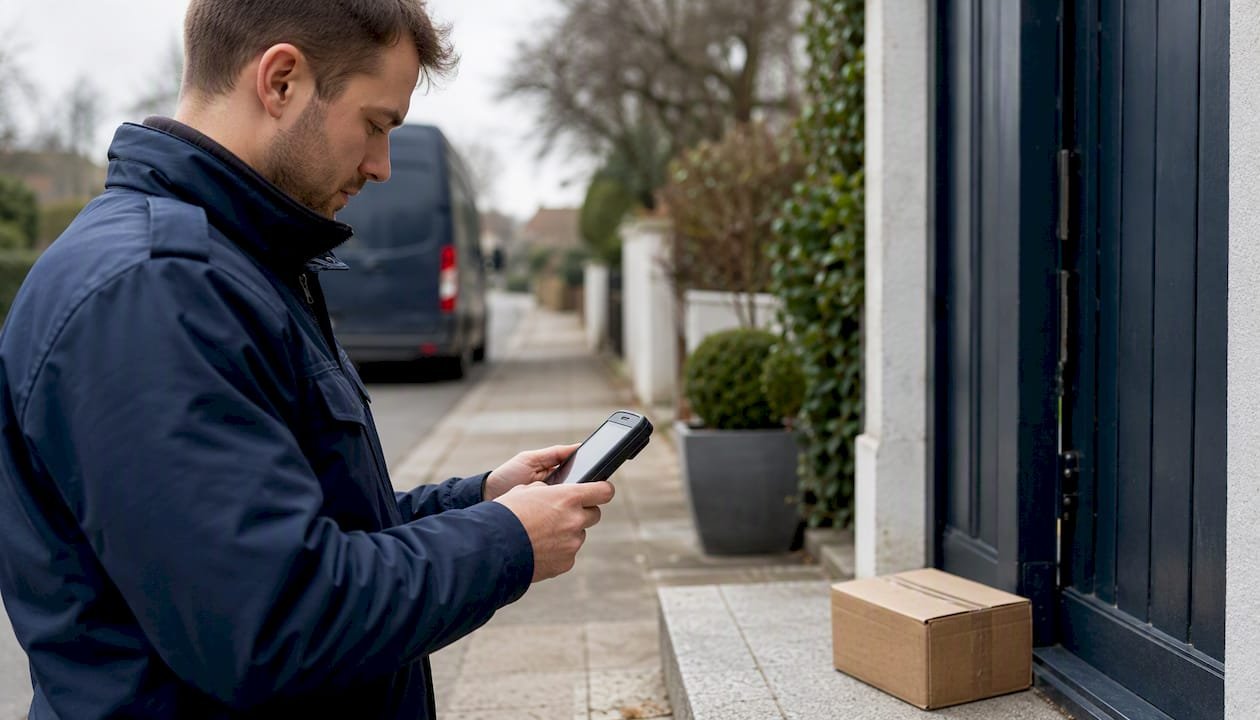
Drivers work under time pressure. On a busy round, the priority is completing the delivery and capturing a signature, not writing detailed notes about the safe place or confirming the recipient’s full name. That is not negligence; it is the reality of high-volume delivery. The result is POD records that are technically complete but evidentially thin: a signature that looks like a line, a photo of a doorstep with no house number visible, a note that says “left in porch” with no further detail.
Small sender actions reduce this significantly. A clear, correct address with a postcode that matches the label eliminates the most common misdelivery cause. A contact phone number on the label means the driver can call ahead for access instructions rather than leaving a card. Marking a named authorised recipient on the booking, and opting out of neighbour delivery for valuable items, removes the ambiguity that makes disputes hard to resolve. These are not complicated steps. They are the ones that experienced logistics managers do as a matter of course, and that first-time senders rarely think to do until something goes wrong.
Frphaulage: signed proof of delivery for urgent UK shipments
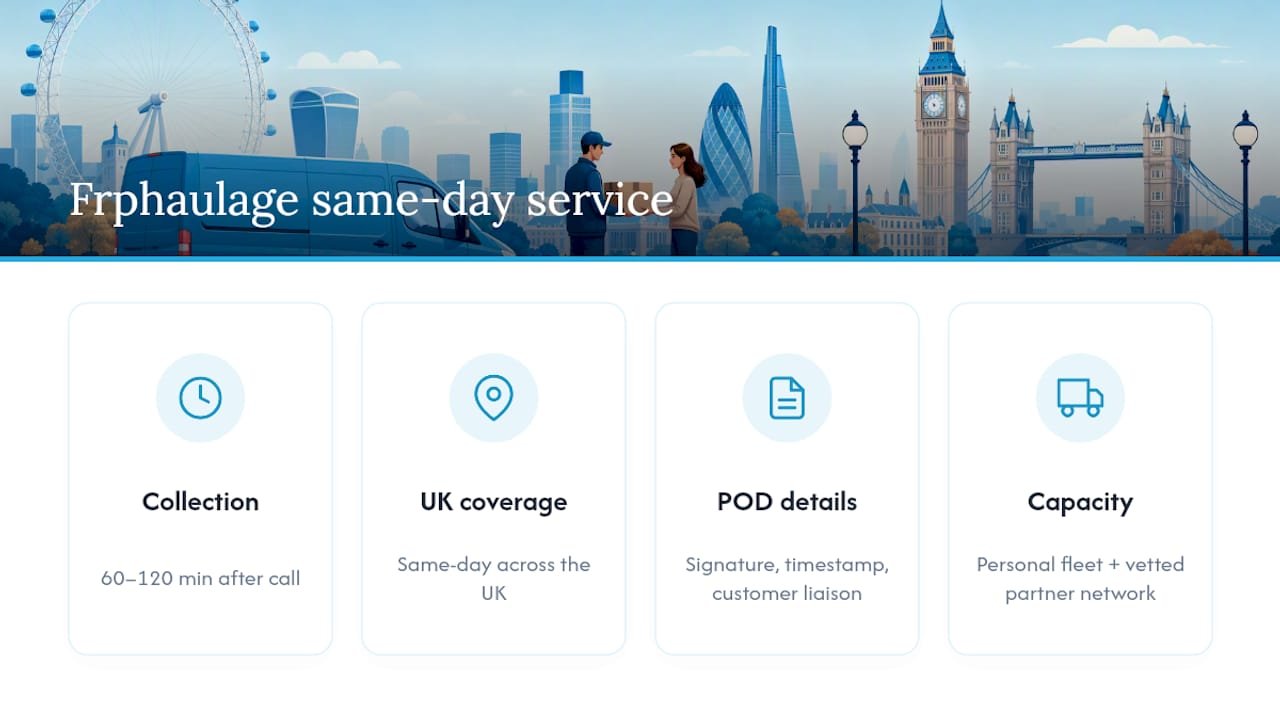
When the stakes are too high for a standard postal service, Frphaulage offers same-day courier and haulage services across the UK, with signed proof of delivery provided for every single shipment. Collection happens within 60–120 minutes of your call, around the clock, every day of the year.
The POD record covers signature, timestamp, and direct customer liaison, giving businesses a clear, defensible record for contracts, insurance, and compliance. Whether you are moving manufacturing components, high-value cargo, or time-critical documents, the service is built for shipments where “probably delivered” is not good enough. Frphaulage operates a personal fleet backed by a vetted partner network, so capacity is not the constraint it can be with ad-hoc courier bookings.
To book an urgent job or get a quote, visit the Frphaulage same-day courier service page or review the complete guide to choosing a same-day courier before you call.
Sources
The following official sources underpin the guidance in this article and are worth bookmarking if you need to verify policy, check compensation rules, or support a formal claim.
- Electronic Communications Act 2000 — part II (electronic signatures)
- Proof of delivery explained for UK parcels
- Signatures on track your item — Royal Mail help
- The Royal Mail United Kingdom post scheme (PDF)