A proof of delivery (POD) is the document that confirms a shipment reached its named recipient and closes the chain of custody for that consignment. To get one in the UK, check your carrier’s tracking portal or app first, download or screenshot the record, and if nothing appears within 24 hours of the delivery scan, contact the carrier’s customer service with your tracking number, delivery address, and the date of the consignment.
Ways to obtain a POD in the UK:
- Carrier tracking portal — log in and search by tracking number (Royal Mail, DPD, Evri, Parcelforce, DHL UK, UPS UK all publish delivery records online)
- Courier app — most major carriers surface a signature or photo confirmation in their mobile app
- Emailed receipt — many carriers send an automatic delivery notification with a photo or signature image attached
- Request to the sender — ask the shipper to pull the POD from their carrier account or transport management system
- Frphaulage delivery note — for jobs booked through Frphaulage, a signed POD is issued for every shipment and can be supplied on request
A POD matters because it is your primary evidence for invoicing, insurance claims, and any dispute about whether goods arrived safely.
Key takeaways
A proof of delivery is only as useful as the fields it contains — a signature alone is rarely enough for a serious claim or an unpaid invoice.
| Point | Details |
|---|---|
| Check the carrier portal first | Most UK carriers publish a delivery receipt within 24 hours; download it immediately. |
| Condition notes are critical | Damage or shortage must be recorded at handover — a clean signature makes later claims harder. |
| ePOD beats paper for disputes | Combined signature, photo, and GPS evidence is far stronger than a scan event or paper note. |
| Retain records for six years | UK contract law under the Limitation Act 1980 supports a six-year minimum for delivery documents. |
| Frphaulage issues a signed POD on every job | Digital records are attached to every load file and available on request for invoicing or claims. |
Table of Contents
- What is proof of delivery and why does it matter?
- What types of POD will you encounter?
- What should a valid POD include?
- How do you get a proof of delivery for UK shipments?
- What should you do if a POD is missing or disputed?
- How is POD used in claims, insurance, and legal disputes?
- ePOD best practices for businesses
- A simple proof of delivery template you can adapt
- Frphaulage covers every delivery with a signed POD
- Sources
What is proof of delivery and why does it matter?
According to Planlogi, a POD is the final legal record in a shipment: it confirms goods left the sender’s custody and were accepted by the recipient. That single document does a lot of work across the delivery lifecycle.
For individuals, the most common use is a parcel dispute. Say a retailer insists an order was delivered but you never received it. Without a POD showing a signature or a photo at your door, the carrier has no evidence of actual handover, and your claim is far stronger. For businesses, the stakes are higher. In freight and haulage, carriers often cannot get paid until they submit a signed POD; factoring companies routinely require a legible signed POD as part of their funding documents. A missing or illegible POD can delay payment by days or weeks.
Two quick examples illustrate the difference. A consumer orders a laptop; the tracking status shows “delivered” but the parcel never arrived. Without a photo or signature POD, the retailer’s insurer has no evidence of handover and the claim proceeds on the consumer’s side. In a B2B context, a manufacturer ships £40,000 of components to an assembly plant. The invoice is due on delivery. Without a signed POD confirming receipt, the accounts team cannot raise the invoice, and the payment cannot be initiated.
What types of POD will you encounter?
POD formats have evolved considerably, and the type you receive shapes how useful it is as evidence.
| POD type | Speed of availability | Evidential strength | Best use case |
|---|---|---|---|
| Paper signed delivery note | Slow (manual scanning required) | Moderate (can be lost or illegible) | Low-volume, local deliveries |
| Electronic signature (e-sign) | Fast (near real-time) | Good (timestamped, stored digitally) | Parcel and courier deliveries |
| Photo evidence | Fast (near real-time) | Good (visual confirmation of location) | Unattended deliveries |
| Tracking scan event only | Immediate | Weak (no signature or photo) | Basic status confirmation |
| Combined ePOD (signature + photo + GPS) | Fast (near real-time) | Strong (multi-layer, hard to dispute) | High-value or B2B freight |
ePOD systems capture signature, photo, GPS and timestamp at the moment of delivery, which speeds up invoicing and strengthens evidence in disputes compared with signature-only records. The combined format is the one to request when the shipment has real commercial value.
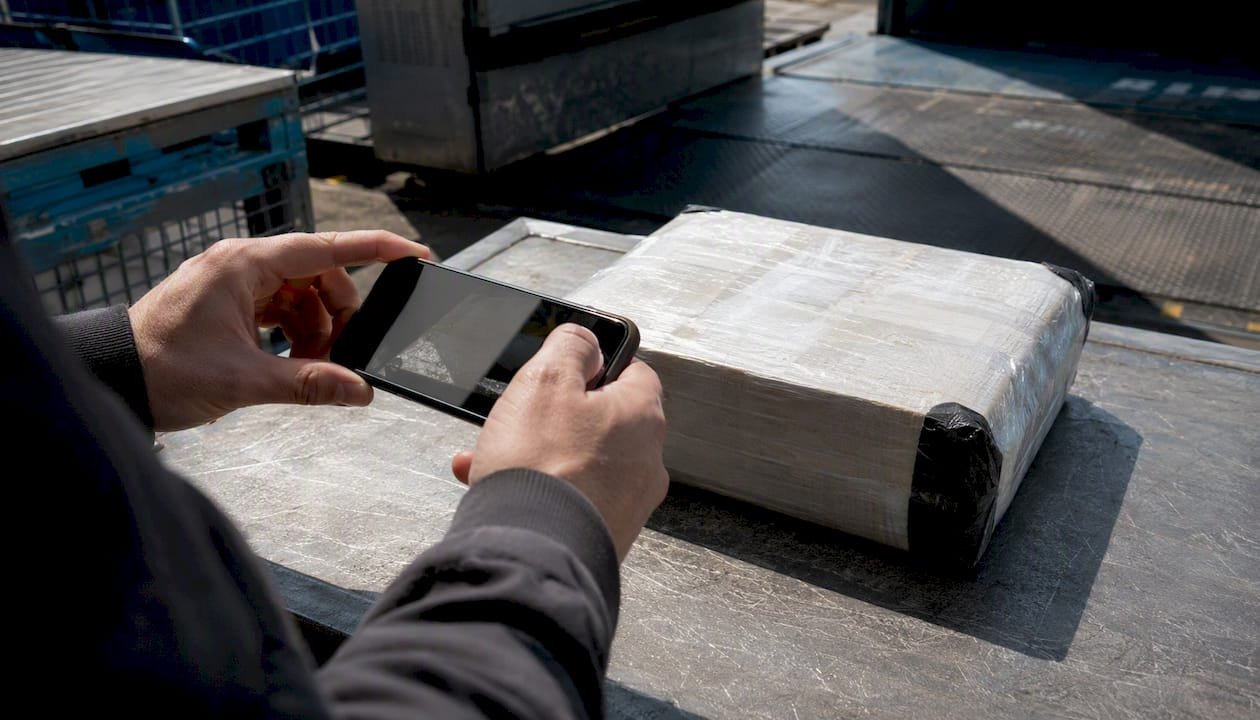
One point worth flagging: a tracking status that reads “delivered” is not a full POD. A tracking number alone is not itself a full proof of delivery — it tells you the carrier’s system registered a delivery event, but it carries no signature, no photo, and no condition record. That distinction matters most when you need to escalate a dispute.
What should a valid POD include?
A POD is only as useful as the information it contains. These are the fields that make a delivery receipt reliable for invoicing, claims, and insurance:
- Recipient name — printed clearly, not just a signature squiggle
- Recipient signature (or recorded e-signature with timestamp)
- Date and time of delivery — to the minute where possible
- Delivery address or specific drop location (e.g. reception desk, side gate)
- Order or reference number — ties the POD to the invoice and the bill of lading
- Carrier name and driver or vehicle ID
- Piece count — number of items or pallets delivered
- Condition notes — any damage, shortage, or discrepancy noted at the time
- Photo evidence — image of goods at the door or on the loading bay
- GPS coordinates — confirms the physical delivery location
A valid POD in trucking and freight should include date/time, receiver printed name and signature, BOL or load reference, piece count, and condition notes. Condition notes are the field most often skipped and the one that causes the most trouble later: if damage is not recorded at handover, proving it occurred in transit becomes significantly harder.
How do you get a proof of delivery for UK shipments?
The process is straightforward, but the timeline and method vary by carrier.
- Check the tracking portal immediately after delivery. Most UK carriers publish a delivery confirmation within minutes of the driver completing the stop. Log in with your tracking number at the carrier’s website or app.
- Wait up to 24 hours for the full POD to appear. A scan event may show instantly, but a signature image or photo often takes a few hours to sync from the driver’s device to the portal.
- Download or screenshot the record. Do not rely on the portal keeping it accessible indefinitely — save it to your records as soon as it appears.
- If nothing appears, contact the carrier’s customer service. Have your tracking number, delivery address, and the consignment date ready. Ask specifically for a “signed proof of delivery” or “delivery receipt” rather than a general tracking update.
- If the carrier cannot help, ask the sender. Shippers with carrier accounts can often pull PODs directly from their transport management system or carrier portal, faster than a consumer-facing request.
Carrier-specific notes for UK shipments
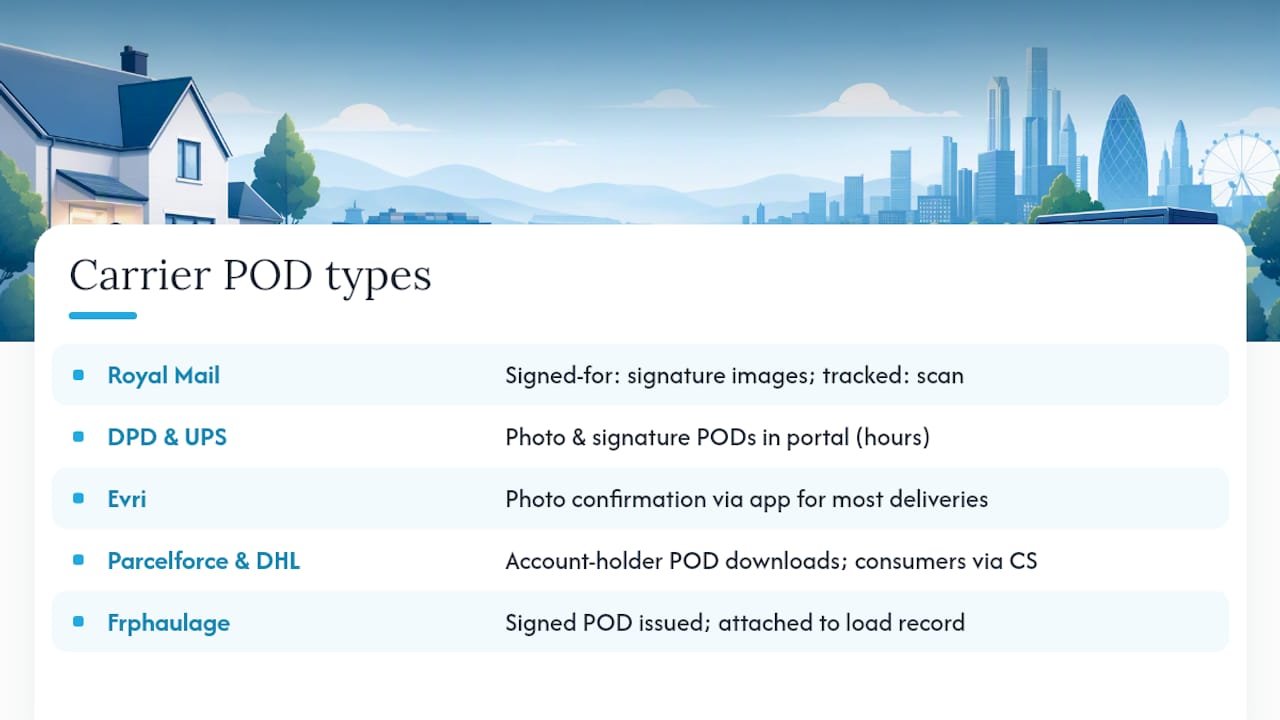
Royal Mail allows senders to request a signature check or advice of receipt through their Royal Mail help pages. Signed-for services retain signature images, but standard tracked services may only show a scan event. DPD and UPS UK both surface photo and signature PODs in their tracking portals, usually within a few hours of delivery. Evri provides photo confirmation for most deliveries through its app. Parcelforce and DHL UK offer POD downloads for account holders, with consumer requests handled through customer service. For freight and haulage jobs booked through Frphaulage, a signed POD is issued for every shipment and attached digitally to the load record.
Pro Tip: When emailing a carrier’s customer service to request a POD, include four things in the subject line: your tracking number, the delivery date, the full delivery postcode, and the word “POD request”. In the body, state the consignee name and the number of items. A specific, complete request cuts response time considerably compared with a vague “where is my delivery” message.
For businesses handling high volumes, ePOD apps that capture multi-media evidence at the point of delivery remove the need to chase carriers after the fact. Require signature or photo in the delivery instructions, and attach the POD to the invoice the same day. For high-value or time-sensitive deliveries, pairing reliable dispatch records with accurate packing data — as manufacturers using palletising automation increasingly do — reduces discrepancies before the goods even leave the warehouse.
What should you do if a POD is missing or disputed?
Acting quickly is the difference between a recoverable situation and a lost claim.
- Note the time and date immediately. Record when you discovered the issue and what the tracking status showed at that moment.
- Photograph the delivery location. If goods were left somewhere unexpected, or if the area shows no sign of a delivery, photograph it. This is your counter-evidence.
- Save every tracking screenshot and delivery email. These form the baseline of your evidence file even before a formal POD appears.
- Gather witness details. Building reception staff, neighbours, or colleagues who were present at the delivery time can provide supporting statements.
- Contact the carrier in writing. Email is better than phone for this — you need a paper trail. Include your tracking number, delivery date, address, and a clear statement of the problem.
- Escalate to the sender if the carrier is unresponsive. The shipper has a commercial relationship with the carrier and can often obtain internal records faster than a recipient can.
- Open a formal claim with the carrier or insurer. Most UK carriers have a claims window — typically 28 days for loss, shorter for damage. Missing this deadline can forfeit your right to compensation.
If a signed POD is genuinely unavailable, alternative evidence that insurers and claims teams will consider includes: driver notes or exception logs from the carrier’s system, CCTV footage from the delivery address, building reception logs, GPS telemetry from the vehicle, and the original invoice and order confirmation emails. None of these individually replaces a signed POD, but together they build a credible picture of what happened.
How is POD used in claims, insurance, and legal disputes?
A signed POD is evidence of delivery and acceptance, but its legal weight has limits that are worth understanding before you rely on it.
- What a POD proves: that a named person accepted goods at a specific address and time. This satisfies the carrier’s obligation under the contract of carriage and is the standard the carrier uses to demonstrate completed delivery.
- What a POD does not automatically prove: the condition of the goods at the point of delivery, unless condition notes or photos are included. A clean signature with no notes does not prevent a recipient from claiming damage later, but it does make that claim harder to substantiate.
- How insurers evaluate PODs: claims teams typically review the POD alongside the bill of lading, the commercial invoice, and any photographic evidence. A POD with condition notes and photos carries far more weight than a signature alone.
- Record-keeping for businesses: retain PODs and related shipping documents for a minimum of six years in the UK, which aligns with the Limitation Act 1980 for contract claims. For VAT audit purposes, HMRC expects delivery records to be available on request.
- Legal disputes: in county court proceedings, a signed POD is admissible as documentary evidence of delivery. Courts will consider it alongside other evidence — it is not automatically conclusive, particularly if the signature is illegible or the signatory’s authority is disputed.
ePOD best practices for businesses
Capturing reliable ePOD data is an operational discipline, not just a technology choice.
Minimum fields every ePOD record should contain:
- Order or reference number
- Recipient printed name
- Electronic signature
- Timestamp (date and time to the minute)
- GPS coordinates at point of capture
- Driver and vehicle ID
- Photo of goods at the delivery point
- Condition notes (including exception codes for damage or shortage)
Process recommendations:
- Require the driver to complete all ePOD fields before marking the stop as complete in the system — incomplete records should not be closeable
- Auto-attach the POD to the load record and the invoice the moment it is submitted
- Keep digital archives searchable by reference number, date, and consignee name
- Standardise exception codes so that “short delivery”, “damaged on arrival”, and “refused” are recorded consistently across all drivers and routes
Pro Tip: Require a photo plus a written note for every exception, not just a code. A photo of a crushed corner and a note reading “outer carton damaged, contents unchecked” is far more defensible in a claim than an exception code alone.
Frphaulage issues a signed POD for every shipment, with the digital record attached to the job file. For businesses that need urgent collections within 60–120 minutes, that documentation trail starts from the moment the job is booked. Rapid, reliable delivery paired with a complete ePOD record is what makes same-day haulage genuinely useful for high-value or time-sensitive freight. For context on how digital delivery practices are developing across the UK market, the future of same-day delivery is worth reading alongside this guide.
A simple proof of delivery template you can adapt
The table below shows the core fields, the format each field should take, and why it matters to insurers and claims teams.
| Field | Format | Why it matters |
|---|---|---|
| Recipient name | Printed text, full name | Identifies who accepted the goods |
| Recipient signature | Handwritten or e-signature | Confirms acceptance at that moment |
| Date and time | DD/MM/YYYY, HH:MM | Establishes the delivery timeline |
| Delivery address | Full postcode included | Confirms the correct drop location |
| Order / reference number | Alphanumeric, matches invoice | Links POD to the commercial record |
| Piece count | Number of items or pallets | Detects short delivery at handover |
| Condition notes | Free text or exception code | Records damage or shortage on arrival |
| Driver / vehicle ID | Name or badge number, reg plate | Identifies the responsible party |
| Photo reference | File name or image attached | Visual confirmation of delivery state |
| GPS coordinates | Latitude / longitude | Confirms physical delivery location |
A compact paper template using these fields works for low-volume operations. For anything above a handful of deliveries per week, embedding the same fields into an ePOD app or a fillable PDF that auto-populates from your transport management system removes transcription errors and makes records searchable. The electronic data interchange literature on message acknowledgement and transaction logging is relevant background for teams building automated POD exchange between systems.
Why POD reliability matters more than most businesses realise
The document that closes a delivery is also the one that opens a payment, defends a claim, and settles a dispute. Most businesses treat POD as an afterthought — something the driver handles — until the first time a £20,000 invoice sits unpaid because the POD is missing a printed name, or a damage claim fails because no one noted the condition at handover.
The gap between a POD that exists and a POD that is actually useful is almost entirely in the fields. A signature without a printed name, a timestamp without a date, a photo without GPS — each omission is a gap an insurer or a court can drive through. The businesses that capture POD well treat it as a discipline from day one: required fields, required photos, required exception notes, all locked before the driver can close the stop. That rigour pays for itself the first time a claim lands.
Frphaulage covers every delivery with a signed POD
Every job booked with Frphaulage includes a signed proof of delivery as standard, with the digital record attached to the load file and available on request. That applies whether you are moving a single urgent parcel or running multi-drop freight across the UK. Collections happen quickly after your call throughout the day and year, via a personal fleet and a vetted partner network.
For businesses that need a reliable documentation trail alongside fast, dependable transport, Frphaulage is a practical fit. Every shipment is tracked, every delivery is signed for, and the POD is there when you need it for an invoice, a claim, or an audit. To book an urgent collection or set up a business account, visit the Frphaulage same-day courier services page or read the guide on choosing a same-day courier to see how the service compares for your specific freight needs.