Modern delivery tracking technology must deliver continuous, carrier‑agnostic visibility with predictive ETAs and electronic proof of delivery. Anything less leaves gaps that customers notice and operations teams pay for.
That’s the whole answer, but it’s worth unpacking why. A shipment status logged every 30 to 60 minutes tells you where a parcel was, not where it is, and it certainly doesn’t warn you it’s about to miss its window. Real value comes from low‑latency updates, refreshed in seconds rather than minutes, fed into machine learning models that recalculate arrival times as traffic and route conditions change.
For logistics managers, the immediate payoff looks like this:
- Fewer “where is my order” (WISMO) calls hitting your support team
- Exception handling that happens before a delay becomes a missed delivery
- Signed, timestamped proof of delivery for every drop, verifiable on demand
- A single dashboard view regardless of which carrier or driver moved the parcel
Key Takeaways
Reliable delivery tracking technology combines continuous carrier‑agnostic visibility, predictive ETAs built on real‑time data, and verified proof of delivery to cut WISMO calls and speed up exception handling.
| Point | Details |
|---|---|
| Refresh cadence matters | Insist on updates measured in seconds, not periodic 30 to 60 minute polling. |
| Predictive ETA needs real data | Vendor accuracy claims should be backed by traffic and historical route data, not GPS pings alone. |
| ePOD closes the loop | Signed, timestamped proof of delivery resolves disputes and builds customer trust. |
| Pilot on your hardest lane | Test any platform on your busiest, highest‑value route before wider rollout. |
| Integration beats manual polling | A unified API with webhook updates removes the lag of checking each carrier separately. |
Table of Contents
- Where delivery tracking technology fits in the delivery stack
- Which sensing technologies actually power real-time tracking?
- Which software features actually move your KPIs?
- How should multi‑carrier integration and data quality work?
- Choosing hardware: apps, plug-ins, or hardwired trackers?
- What should a procurement checklist look like?
- What does reliable tracking look like in practice?
- Does better tracking actually improve customer satisfaction?
- Where is delivery tracking technology heading next?
- Why operational fit beats feature lists
- Sources
Where delivery tracking technology fits in the delivery stack
Tracking data doesn’t originate from one place. It flows up through layers, and each layer adds a different kind of intelligence.
- Driver device or vehicle telematics captures the raw signal: GPS coordinates, speed, stops, sometimes engine diagnostics.
- Carrier or fleet management systems translate that raw signal into events: collected, in transit, out for delivery, delivered.
- A unified API or dashboard normalises those events across every carrier and vehicle type into one consistent view.
The business outcomes this stack should enable are straightforward: full visibility into where every job stands, predictable delivery windows customers can plan around, fewer inbound enquiries, and a faster response when something goes wrong. A multi‑drop regional run, for instance, uses live location data to reorder stops on the fly when one address turns out to be inaccessible. An urgent same‑day collection uses the same data to confirm pickup happened within the promised window, without anyone needing to phone the driver. When the stack works properly, tracking data stops being a reporting tool and becomes an operational one, feeding decisions in real time rather than explaining them after the fact.
Which sensing technologies actually power real-time tracking?
Every tracking claim rests on hardware somewhere. Knowing what that hardware can and can’t do saves you from vendor promises that outrun the physics.
GPS and vehicle telematics form the backbone of most fleet visibility. Plug‑in OBD‑II devices are quick to install and cheap to scale across a fleet, but they lean on the vehicle’s onboard diagnostics port and can be less robust for heavy‑duty or older vehicles. Hardwired units cost more and take longer to fit, but they’re harder to accidentally disconnect and better suited to enterprise fleets that need constant, unattended reporting.
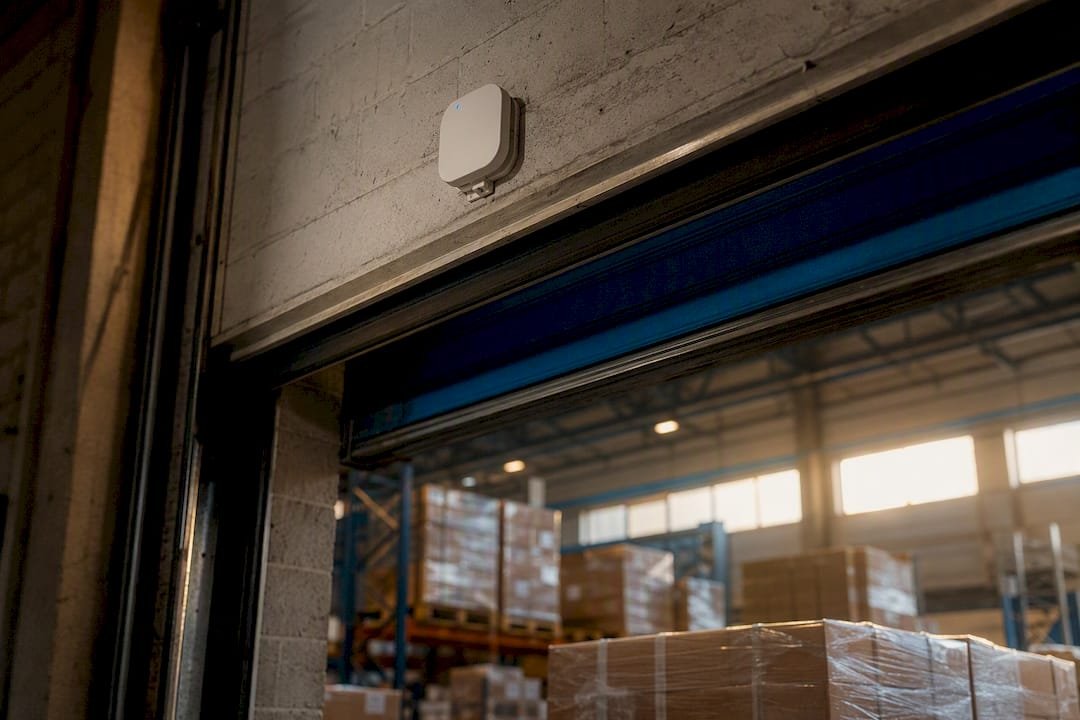
Bluetooth Low Energy (BLE) and RFID solve a problem GPS can’t: pinpoint accuracy over short distances. GPS drifts by metres and struggles indoors, so warehouses and depots increasingly use BLE beacons to detect exactly when a parcel crosses a specific threshold, like a loading bay door. RFID tags do similar work at item level, useful when you need to prove a specific parcel, not just a vehicle, reached a location.
Barcode and camera scanning create the authoritative milestone events auditors and customers actually trust. A scan at collection, a scan at each handover, and a photo or signature capture at delivery together form the backbone of electronic proof of delivery.
IoT sensors add a further layer for sensitive cargo, monitoring temperature, humidity or shock. These sensors trade off battery life against reporting frequency: report every few seconds and you’ll be changing batteries weekly; stretch the interval and you risk missing a brief but damaging temperature spike.
Which software features actually move your KPIs?
Hardware gathers the signal. Software decides what you do with it, and this is where vendor claims deserve the most scrutiny.
- Electronic proof of delivery (ePOD) with a timestamped signature, photo, or geotagged confirmation creates an audit trail that resolves disputes in minutes rather than days.
- Predictive ETA models combine live location with traffic conditions and historical route patterns to keep arrival windows accurate as circumstances change, rather than freezing an estimate at dispatch.
- Exception detection flags a delay while there’s still time to act. Increasingly, systems can trigger a “smart intercept”: automatically rerouting a courier or alerting a dispatcher before a customer even notices anything’s wrong, a shift industry analysts describe as moving from reactive troubleshooting to proactive orchestration.
- Customer‑facing tracking pages with SMS, WhatsApp or email notifications keep customers informed without them ever needing to call.
Pro Tip: When a vendor claims “predictive ETA accuracy”, ask what data feeds the model. Real‑time traffic and historical route patterns matter far more than raw GPS pings alone.
Accurate ETAs paired with proactive notification channels are what actually cut WISMO call volumes, not the tracking page’s design.
How should multi‑carrier integration and data quality work?
If your operation touches more than one carrier, and most do, the integration model matters as much as any single feature.
- A unified tracking API beats polling individual carrier portals by hand. It pulls status updates from every carrier into one normalised event structure, so “delivered” means the same thing regardless of who moved the parcel.
- Carrier auto‑detection removes the manual work of matching a tracking number to a carrier, something platforms with broad carrier coverage handle as standard.
- Webhooks or streaming updates push data to you the moment it changes, rather than forcing your system to ask repeatedly. This is the difference between near‑instant awareness and a 30‑minute lag.
- On data handling, insist on clear answers about encryption in transit and at rest, retention periods, and exactly which carriers are covered before you sign anything.
- During any trial, log timestamps from device to vendor to webhook and measure the actual end‑to‑end delay under real mobile network conditions, not the vendor’s lab conditions.
Choosing hardware: apps, plug-ins, or hardwired trackers?
Matching hardware to your operation is mostly a question of scale and how much diagnostic detail you actually need.
- A driver smartphone app is often enough for small fleets or subcontracted courier networks. It’s fast to deploy and needs no vehicle modification, though it depends on the driver’s phone staying charged and connected.
- OBD‑II and plug‑in devices suit fleets wanting quick rollout across many vehicles without workshop time, giving you GPS location plus basic engine data.
- Hardwired units with CAN‑bus integration suit enterprise fleets that need deeper vehicle diagnostics such as fuel consumption, fault codes and idle time, alongside location.
- Sensor add‑ons for temperature or shock monitoring should be chosen against battery life, connectivity range and how they’re mounted, since a sensor that dies mid‑route is worse than no sensor at all.
Weigh total cost of ownership, not just unit price. Connectivity contracts and installation labour often outweigh the hardware itself.
What should a procurement checklist look like?
Before signing anything, run through a short but non‑negotiable list.
- Latency: what’s the actual refresh cadence, and is it seconds or minutes?
- Coverage: does the platform support every carrier and vehicle type you use?
- API access: can you pull data into your own systems, or are you locked into their dashboard?
- Scale and cost model: does pricing hold up as your shipment volume grows?
Then put vendors on the spot with direct questions: What’s the SLA for uptime and support response? How long does onboarding realistically take? Will they support a live pilot before you commit? Can you export your own historical data if you leave?
Pro Tip: Run any pilot on your busiest lane and highest‑value SKUs first. That’s where tracking failures cost the most, and where a vendor’s real performance shows fastest.
Match the method to your carrier mix and integration needs rather than picking the platform with the longest feature list.
What does reliable tracking look like in practice?
Frphaulage runs same‑day and next‑day courier and haulage services across the UK, with rapid collection typically within 60 to 120 minutes of a call, operating 24 hours a day, every day of the year. That kind of turnaround only works if tracking is built into the workflow from the first minute, not bolted on afterwards.
A driver collecting a high‑value shipment at short notice can’t be fumbling with a scanner or a slow app while the clock runs. Proof of delivery has to be immediate, and signed at the point of handover, every single time, whether that’s a single parcel or a multi‑drop regional run.
Every job Frphaulage handles, whether it’s manufacturing components, urgent documents or high‑value cargo, generates signed proof of delivery as standard, using a personal fleet backed by a vetted partner network for coverage when demand spikes. If you’re evaluating a system, pilot it on your most time‑critical lane first. If it can’t confirm delivery within seconds of the driver’s signature, it isn’t ready for urgent freight.
Does better tracking actually improve customer satisfaction?
Yes, but the mechanism is worth understanding rather than taking on faith. Customers don’t complain because a delivery is late; they complain because they don’t know it’s late and have no idea when it will actually arrive. A tracking page that shows an accurate, continuously updated ETA removes the uncertainty that drives most WISMO calls in the first place.
Operationally, the effect compounds. When your team can see an exception the moment it happens rather than after a customer reports it, you resolve problems before they become complaints. That shifts customer service from reactive firefighting to occasional intervention, freeing staff to handle genuinely complex cases instead of answering the same “where’s my order” question dozens of times a day.
There’s a second, quieter benefit: internal trust. When dispatchers, drivers and account managers all see the same real‑time data, fewer decisions get made on guesswork. Route planning improves because it’s based on where vehicles actually are, not where a schedule assumed they’d be. Multi‑drop runs get reordered on the fly when a stop turns out to be delayed, rather than falling apart at the fourth address. None of this requires exotic technology. It requires accurate, low‑latency data reaching the people who need it, at the moment they need it, rather than in a report at the end of the day.
Where is delivery tracking technology heading next?
The clearest shift is from tracking as a passive record to tracking as an active decision‑maker. Systems increasingly don’t just report that a delivery is running late; they act on it, rerouting a courier or alerting a dispatcher automatically through what the industry is now calling agentic shipment orchestration. Expect this kind of automated intercept to become standard rather than a premium add‑on within the next couple of years.

Predictive ETA models will keep improving as they draw on richer inputs: live traffic, weather, historical route‑specific patterns, and even driver‑specific behaviour. The accuracy gap between a basic GPS‑only estimate and a properly trained ML model is only going to widen.
Expect deeper convergence between tracking and route optimisation, too. Rather than tracking simply reporting a vehicle’s position, it will feed directly into dynamic re‑routing engines that adjust multi‑drop sequences in real time as conditions change.
Data standardisation is the less glamorous trend, but arguably the more important one. As more carriers expose APIs and adopt common event structures, the friction of multi‑carrier aggregation should keep falling, making unified dashboards easier to build and cheaper to maintain. For logistics managers, that means the tools available in a couple of years will likely demand less custom integration work than today’s do.
Why operational fit beats feature lists
The conventional advice on delivery tracking technology spends too much time comparing dashboards and not nearly enough time asking whether a system survives contact with a driver in a moving vehicle at 6am. Feature lists are easy to write and easy to compare. Operational reliability under pressure is not, and it’s the only thing that actually protects a customer relationship when a delivery goes sideways.
What gets underestimated most is proof of delivery. Everyone talks about predictive ETAs because they sound impressive, but a beautiful ETA model means nothing if you can’t prove, with a signature and a timestamp, that the parcel actually arrived. Prioritise that capability first, then layer in the predictive intelligence.
If you take one thing from this guide, let it be this: pilot any platform on your worst‑case scenario, not your easiest route. A same‑day, high‑value, tight‑window job will expose a tracking system’s weaknesses far faster than a relaxed multi‑day delivery ever will. Systems that only look good on paper tend to fail exactly where you need them most.
— Catalin
Sources
Shipsy live tracking, Track123 platform, AfterShip tracking, and Frphaulage’s courier guide.
- Live Tracking API for Logistics | Real‑Time Vehicle Tracking | Shipsy
- Track123 – All in one global shipment tracking platform
- Samsara tracking and agentic shipment centre closes visibility gap — Supply & Demand Chain Executive
- Choosing the right tracking method for your delivery process — nShift blog