Yes, if you ship regularly. A business courier account is worth setting up the moment your parcel volume becomes predictable, because it converts unpredictable retail postage costs into three concrete gains: lower per-parcel rates, monthly credit billing instead of pay-as-you-go, and direct integration with your existing systems.
Most carriers set the entry point somewhere between 10 and 50 parcels a month, with savings becoming genuinely meaningful once you cross 50 parcels. Below that, a retail account might still make sense.
If you already ship enough to notice postage costs on your monthly outgoings, here’s what changes straight away:
- Negotiated rates replace standard retail pricing on every shipment
- One consolidated invoice replaces dozens of individual payments
- API and dashboard access replace manual booking and tracking
Key Takeaways
A business courier account pays off once monthly volume passes roughly 50 parcels, delivering lower rates, monthly credit billing and system integration that together cut both cost and admin time.
| Point | Details |
|---|---|
| Check your volume threshold | Meaningful savings typically start around 50 parcels a month, with smaller shippers benefiting from 10 to 20. |
| Prepare documents early | Have business registration, VAT ID, bank details and signatory ID ready before applying. |
| Negotiate the details, not just the discount | Push on COD remittance timing, RTO charges, insurance and dispute SLAs before signing. |
| Test integrations before full rollout | Run a sandbox or small batch test to catch weight and dimension pricing errors. |
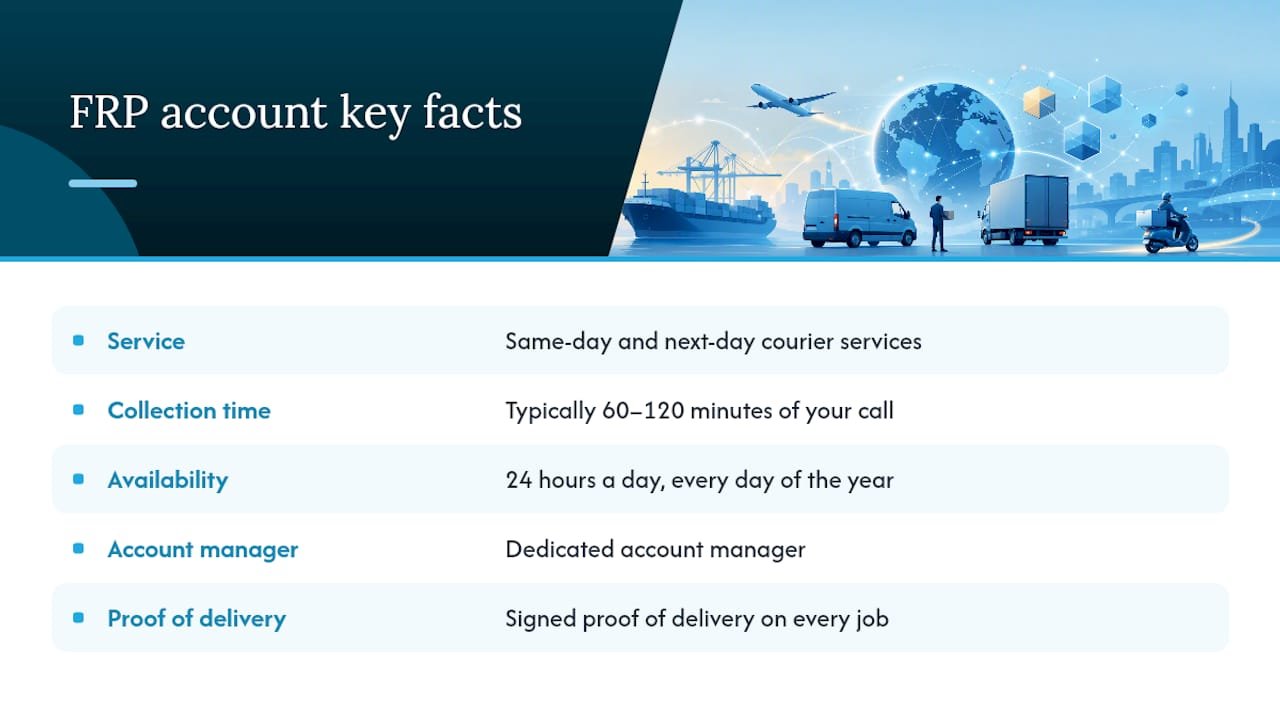
| Consider FRP Haulage for urgent UK shipments | FRP Haulage offers 60 to 120-minute collection, a dedicated account manager and signed proof of delivery for every job. |
Table of Contents
- What does a business courier account actually give you?
- Who benefits from an account, and at what volume?
- How do you apply, and what does onboarding actually involve?
- How does pricing, invoicing and credit actually work?
- Getting your systems talking to your carrier
- What should you expect from account management and claims?
- FRP Haulage’s view from inside a same-day operation
- Ready to open a business account with FRP Haulage?
- Sources
What does a business courier account actually give you?
The discounts get talked about most, but they’re rarely the biggest win. Volume-tier pricing typically shaves a meaningful percentage off retail rates as your monthly parcel count climbs, with the steepest jumps usually happening at the 50 and 200 parcel marks. That matters, but the operational unlocks matter more for most businesses.
Monthly consolidated invoicing means you stop paying per shipment and start paying on 15 to 30-day credit terms, which frees up working capital that would otherwise sit tied up in postage. Combine that with API access, dashboard reporting, bulk label uploads and automatic tracking webhooks, and shipping stops being an admin task someone does manually every morning.
A handful of other things typically come bundled in:
- Priority pickup slots instead of queuing behind retail customers
- A dedicated account manager for escalations and rate reviews
- Faster claims handling, since collection and pre-delivery scans give carriers more evidence to work with
- Packaging support, insurance pass-through and a proper returns account
Pro Tip: Ask any prospective carrier exactly which tier your current volume qualifies for before you sign anything. Some carriers advertise headline discounts that only kick in two tiers above where most small businesses actually sit.
Who benefits from an account, and at what volume?
The maths shifts in your favour faster than most business owners expect. Industry guidance puts the inflection point for significant savings at roughly 50 parcels a month, though smaller shippers sending 10 to 20 parcels can still benefit depending on parcel size and destination mix.
Certain business models tend to see the case sooner than others:
- Direct-to-consumer brands with steady order flow
- Marketplace sellers juggling multiple sales channels
- B2B distributors sending regular scheduled runs
- Time-sensitive shippers who need guaranteed collection windows
If your volume is sporadic, a handful of parcels one month and none the next, a retail pay-as-you-go option often still wins on flexibility.
How do you apply, and what does onboarding actually involve?
Getting an account live is more paperwork than process. Most carriers ask for the same core documents before they’ll open one:
- Proof of business registration and your VAT or business ID
- A bank account details for invoicing and direct debit
- Photo ID for the authorised signatory on the account
Once you’ve submitted those, the carrier will typically review your volume profile, route mix, average parcel weight and any cash-on-delivery share before confirming terms. This isn’t box-ticking, it directly shapes the rate card you get offered.
Activation is often quicker than businesses expect. Typical onboarding, including KYC checks and an initial volume assessment, can complete in under a week for many carriers. After approval, the immediate next steps are generating API keys, setting up dashboard access and running a small batch of test shipments before you commit full volume.
Pro Tip: Run your first week of shipments as a trial batch rather than switching everything over at once. It catches weight and dimension errors before they turn into disputed invoices.
How does pricing, invoicing and credit actually work?
Three pricing models turn up repeatedly: fixed tiered rate cards, individually negotiated rates for higher-volume shippers, and aggregator pricing that routes each parcel to whichever carrier is cheapest for that route. None is universally better, it depends on how consistent your shipping pattern is.
What matters more day to day is the credit mechanics. Carriers typically offer monthly consolidated invoicing with 15 to 30-day payment windows, and credit limits usually scale up once you’ve built a clean billing history, sometimes starting smaller or requiring a deposit for brand-new accounts.
Before signing, push on the details that determine your real cost:
- When cash-on-delivery funds actually get remitted to you
- What return-to-origin charges apply and how they’re calculated
- Whether insurance is included or passed through as an extra line
- What the SLA is for resolving a disputed charge or a lost-parcel claim
Get those four in writing. They matter more than the headline discount percentage.
Getting your systems talking to your carrier

Integration is where a business courier account either saves you hours a week or becomes another system nobody trusts. Most sellers connect through a handful of common routes: a Shopify or marketplace connector for automatic order sync, a CSV bulk upload for batch processing, or a direct API for full control.
API and dashboard access materially cuts manual workload once it’s bedded in, particularly for label generation, tracking webhooks and returns reconciliation. Those three features are worth prioritising above anything else on a carrier’s integration list.
Don’t flip the switch on day one, though:
- Test in a sandbox or with a small live batch before full rollout
- Confirm weight and dimension defaults are pulling through correctly
- Keep a manual fallback process ready while the integration settles
Pro Tip: Testing with a small production batch before full rollout catches pricing errors caused by wrong weight or dimension defaults, which is the single most common integration mistake.
What should you expect from account management and claims?
A dedicated account manager earns their place by doing three things well: handling escalations quickly, running periodic rate reviews as your volume grows, and negotiating bespoke terms rather than leaving you on a standard card. That combination of renegotiation and escalation handling is what separates a business account from a retail one.
Claims should move faster too, since business accounts generate signed proof of delivery and pre-delivery scan data that retail shipments often lack.
Track a few numbers monthly and bring them to your account review:
- On-time delivery rate by route
- Claims rate and average resolution time
- Cost per parcel against your contracted tier
FRP Haulage’s view from inside a same-day operation
Business courier accounts aren’t theoretical for us, they’re how we run every shift. Priority collection windows get mapped directly against client SLAs, so a call for an urgent multi-drop run triggers a scheduled pickup rather than a queue. Every job closes with signed proof of delivery, which is what makes claims fast rather than a guessing game. That’s the same operational logic this guide has been describing, just running in real time across the country.
— Catalin
Ready to open a business account with FRP Haulage?
If everything above sounds right but you’d rather not spend weeks comparing rate cards, FRP Haulage runs same-day and next-day courier services across the UK with rapid collection typically within 60 to 120 minutes of your call, available 24 hours a day, every day of the year. Unlike a standard retail courier, you get a dedicated account manager, priority scheduling built around your SLAs, and signed proof of delivery on every job, whether that’s a single urgent parcel or a scheduled multi-drop run.
Business accounts with FRP Haulage suit companies moving manufacturing components, high-value cargo or time-critical documents who need collection to happen on a phone call, not a booking form. If that matches how your business ships, the fastest next step is to request a quote and get your account set up so your next urgent job runs on account terms rather than a one-off payment.
Sources
For background on account mechanics, see ParcelPlanet’s guide and CourierBook’s benefits breakdown. For practical next steps, visit FRP Haulage’s services page.
- Role of courier accounts for sellers: 2026 guide | ParcelPlanet
- Business courier account benefits explained | CourierBook