For most same-day courier fleets, the right starting point is a mobile-first GPS tracking setup paired with live customer tracking links and photo-based proof of delivery. Fitted telematics hardware still matters for high-value or regulated loads, but for the majority of multi-drop and urgent collection work, a driver app that updates every 30 to 60 seconds and hands dispatchers a live map is the faster, cheaper route to visibility.
If you run a small fleet (under 15 vehicles), start with a two-week pilot on one route before signing anything. If you run a complex, multi-depot operation, prioritise a platform with strong API and TMS integration over one that just looks good on a map.
- Best all-round pick for same-day operators: a managed courier service like FRP Haulage, which builds live tracking and signed proof of delivery into every job rather than selling it as a bolt-on.
- Best for small fleets: a mobile-only app such as Zeo Route Planner or Timeero, low setup cost and fast onboarding.
- Best for complex, multi-stop operations: Onfleet or DispatchTrack, built for route density and integration depth.
Pro Tip: Ask any vendor for a free trial or live demo before you commit. If they hesitate, that tells you something about their onboarding support.
Key Takeaways
The most reliable approach to courier driver GPS tracking combines live location updates, customer-facing tracking links, and photo or signature proof of delivery.
| Point | Details |
|---|---|
| Pilot before you scale | Test one route for two to four weeks before committing to a fleet-wide rollout. |
| Update frequency is the key metric | Ask vendors for an exact refresh interval, not the vague label “real-time”. |
| Tracking links cut calls | Live links sent by SMS reduce inbound “where’s my parcel” enquiries significantly. |
| Data ownership matters | Confirm you can export tracking and POD data before signing any contract. |
| FRP Haulage suits urgent same-day work | For businesses wanting managed collection and signed POD without running the software themselves, FRP Haulage builds tracking into the service itself. |
Table of Contents
- Why courier businesses invest in GPS tracking
- What features actually matter when comparing GPS tracking tools
- How the main courier GPS tracking options compare
- How courier fleets typically deploy GPS tracking
- What GPS tracking actually costs, and where the ROI comes from
- A buyer’s checklist before you sign anything
- How FRP Haulage puts tracking into practice
- What the industry gets wrong about GPS tracking
- A different way to get the visibility without running the software
- Frequently asked questions about courier driver GPS tracking
- Sources
Why courier businesses invest in GPS tracking
The case for GPS tracking comes down to four things: fewer phone calls, fewer disputes, better routes, and better data on your drivers.
Live map visibility lets a dispatcher see every vehicle without radioing round for updates, which is the single biggest time saver in a busy control room. Platforms built for courier work typically show colour-coded job status alongside the live map, so a dispatcher spots a delayed drop early.
Customer-facing tracking links do the rest of the work. Some platforms push a live tracking URL by SMS the moment a driver is assigned, updating positions frequently without requiring an app download. That single feature is one of the strongest drivers of reduced inbound calls, because customers stop ringing to ask “where’s my parcel” and just check the link.
- Route history and playback help you coach drivers and spot recurring delays on the same run.
- GPS-stamped proof of delivery cuts “it never arrived” disputes down to a data lookup rather than an argument.
- Automated ETA notifications reduce the volume of calls landing on your dispatch desk during peak hours.
What features actually matter when comparing GPS tracking tools
Not every feature on a vendor’s brochure earns its place in your stack. Some genuinely change how your operation runs; others are marketing filler.
Update frequency is the one to interrogate first. A platform refreshing positions every 30 seconds gives dispatchers a genuinely live view; one refreshing every five minutes is closer to a historical log than real-time tracking. Ask for the actual update frequency, not the word “real-time” on its own.
ETA accuracy and tracking links should be tested, not taken on faith — request a live demo and watch how the ETA shifts when a driver hits traffic. Route optimisation varies enormously too: some tools handle simple point-to-point runs, while others solve genuine multi-stop, multi-constraint routing problems.
- Proof of delivery: photo capture, e-signature, and a GPS timestamp together, not just one of the three.
- Integrations: open APIs for your TMS, dispatch, or billing system, so tracking data doesn’t sit in a silo.
- Deployment: decide early whether you want a driver-owned smartphone app or fitted telematics hardware, since this shapes your entire rollout cost and timeline.
How the main courier GPS tracking options compare
Twelve names come up repeatedly when courier operators research this category, spanning managed courier services, mobile route-planning apps, and dispatch-heavy delivery management platforms.
| Provider | Best for | Update frequency | ETA & tracking links | Route optimisation | POD |
|---|---|---|---|---|---|
| FRP Haulage | Same-day collections and multi-drop with signed POD | Live, job-by-job updates | Direct communication, not a self-serve link | Managed by dispatch team | Signed POD on every shipment |
| Journease | Fleets wanting live GPS with job colour-coding | Live map, near real-time | Built-in tracking dashboard | Basic to moderate | Digital capture |
| Onfleet | Complex, high-volume multi-stop delivery | Frequent, app-based | Automated customer links | Advanced multi-stop | Photo/signature |
| Routific | Route-heavy operations prioritising optimisation | Standard app refresh | Basic ETA sharing | Strong optimisation engine | Limited |
| OptimoRoute | Planning-first fleets with complex constraints | Standard app refresh | ETA sharing | Advanced constraint-based | Limited |
| Track-POD | Businesses needing rigorous delivery proof | Live tracking | Customer link with ETA | Moderate | Strong photo/signature/timestamp |
| Detrack | Multi-industry delivery teams needing simple POD | Live tracking | Customer tracking page | Moderate | Photo/signature |
| Spoke Dispatch | Smaller dispatch teams needing lightweight tools | App-based updates | Basic | Basic | Digital capture |
| DispatchTrack | Enterprise delivery fleets needing tight scheduling | Live, frequent | Advanced ETA precision | Advanced | Strong |
| Timeero | Driver time and mileage tracking alongside location | GPS-based, frequent | Not the core focus | Minimal | Not the core focus |
| Everlance | Mileage and expense tracking for driver fleets | Passive GPS logging | Not applicable | None | Not applicable |
| Zeo Route Planner | Small fleets wanting a simple, affordable app | Standard app refresh | Basic sharing | Good for small route counts | Basic |
FRP Haulage sits apart from the rest of this list because it is not software you configure yourself. It is a managed same-day and next-day courier service where rapid collection windows and signed proof of delivery come as standard, and a free consultation replaces the usual free trial. For businesses that want visibility without managing a tracking platform, that is a meaningfully different proposition.
Journease, Onfleet, and DispatchTrack lean hardest into dispatch-heavy, multi-stop operations. Routific and OptimoRoute compete on route-optimisation depth rather than customer-facing polish. Timeero and Everlance are closer to driver time and mileage tools than full tracking platforms, useful if payroll accuracy matters more than customer ETAs. Most of these vendors offer a free trial or demo; ask for one before you commit to a contract term.
How courier fleets typically deploy GPS tracking
Deployment splits into three practical routes: bring-your-own-device apps on drivers’ personal phones, company-issued phones running a locked-down app, or fitted telematics hardware wired into the vehicle.
- Pilot on one route or depot for two to four weeks, tracking ETA accuracy, POD capture rate, and any drop in customer calls.
- Staged rollout across the rest of the fleet once drivers are comfortable with the app and dispatchers trust the data.
- Full deployment, including integration with your TMS or billing system if the pilot justified it.
Offline behaviour deserves real scrutiny. Rural routes, basements, and multi-storey car parks all break GPS signal, and the better platforms use offline-first apps that cache stop history and POD data locally, syncing automatically once signal returns.
Pro Tip: During your pilot, compare the app’s reported delivery time against your driver’s own paper log for a week. Any consistent gap tells you whether the update frequency is genuinely fit for purpose.
What GPS tracking actually costs, and where the ROI comes from
Pricing usually breaks into three components: a per-vehicle monthly subscription, a one-off hardware cost if you’re fitting telematics, and onboarding or integration fees for connecting to your existing systems.
The reduction in inbound “where’s my parcel” calls driven by live tracking links is often the fastest payback, since every call your team doesn’t have to answer is time redirected to dispatch or sales. Fewer missed deliveries and shorter routes from optimisation add up over months, not days.
- Watch for long minimum contract terms that outlast your pilot’s findings.
- Check whether pricing is per-vehicle or per-driver, since seasonal staff can inflate per-user costs fast.
- Confirm API access isn’t locked behind an enterprise tier you don’t yet need.
A buyer’s checklist before you sign anything
Work through this in order, and don’t skip the contract-terms step just because the demo went well.
- Define your pilot scope. One route, one depot, two to four weeks, with clear success metrics.
- Ask about update frequency in writing. “Real-time” means nothing without a number attached.
- Ask who owns the data and whether you can export it freely if you switch providers later.
- Ask how the app behaves offline and whether POD data is preserved during a signal drop.
- Check integration depth with your existing TMS, billing, or dispatch software before assuming an API exists.
- Read the contract minimum term and cancellation notice period before you sign.
A structured vendor checklist that covers hardware fit, update frequency, and feature support prevents most of the buyer’s remorse that comes from choosing on price alone.
Pro Tip: If a vendor can’t answer the data-ownership question clearly on the first call, treat that as a red flag rather than a detail to chase up later.
Watch for these red flags specifically: no GDPR or data-control statement anywhere on their site, onboarding support limited to a help-centre article, and export tools that only produce a PDF rather than usable raw data.
How FRP Haulage puts tracking into practice
FRP Haulage runs same-day and next-day courier and haulage jobs with collection windows of 60 to 120 minutes, and live tracking sits underneath every job rather than being sold as an add-on.
- Every shipment gets signed proof of delivery, whether it’s a single parcel or a multi-drop regional run.
- Dispatchers use live tracking internally to confirm collection and delivery status without chasing drivers by phone.
- Clients get direct updates rather than a self-serve dashboard, which suits businesses that want a person accountable for the job, not just a data feed.
Client feedback consistently points to professionalism and clear communication as the reason they stick with FRP Haulage over switching providers, particularly on urgent or high-value cargo where visibility matters most.
What the industry gets wrong about GPS tracking
Most advice on this topic treats GPS tracking as a software decision. It isn’t, not entirely. The technology is genuinely commoditised now, most platforms update frequently enough, most apps handle basic proof of delivery competently, and the feature gaps between them are narrower than the marketing suggests.
What actually separates a good outcome from a disappointing one is the operational layer wrapped around the software: who answers the phone when a delivery runs late, who chases the driver when the app shows a stall, and whether proof of delivery is actually checked or just filed away unread. A courier business that buys the best tracking platform on the market and still lets deliveries go unmonitored has bought a dashboard, not a solution.
That’s the argument for treating tracking as part of a managed service relationship rather than a standalone software purchase, particularly for urgent or high-value work where the cost of a missed delivery outweighs any subscription saving. Buy the visibility, but buy the accountability behind it too.
A different way to get the visibility without running the software
If the comparison above left you weighing up subscription tiers, onboarding fees, and which app your drivers will actually tolerate, there’s a simpler route. FRP Haulage gives you the outcome those platforms are built to deliver, live visibility, accurate ETAs, and verified proof of delivery, without you having to select, configure, or manage any tracking software yourself.
Every job booked through FRP Haulage comes with signed proof of delivery and rapid collection windows of 60 to 120 minutes, 24 hours a day, every day of the year. Instead of running a pilot on Onfleet or Routific and training your team on a new interface, you get a personal fleet and vetted partner network that already tracks and reports on your behalf. That’s a genuine time saving for operators who need reliable delivery visibility now, not after a four-week onboarding process.
If you’ve got an urgent shipment or a recurring multi-drop schedule to sort, book a same-day collection with FRP Haulage and see the tracking and reporting in action on your next job.
Frequently asked questions about courier driver GPS tracking
What is the best GPS tracking method for a small courier fleet?
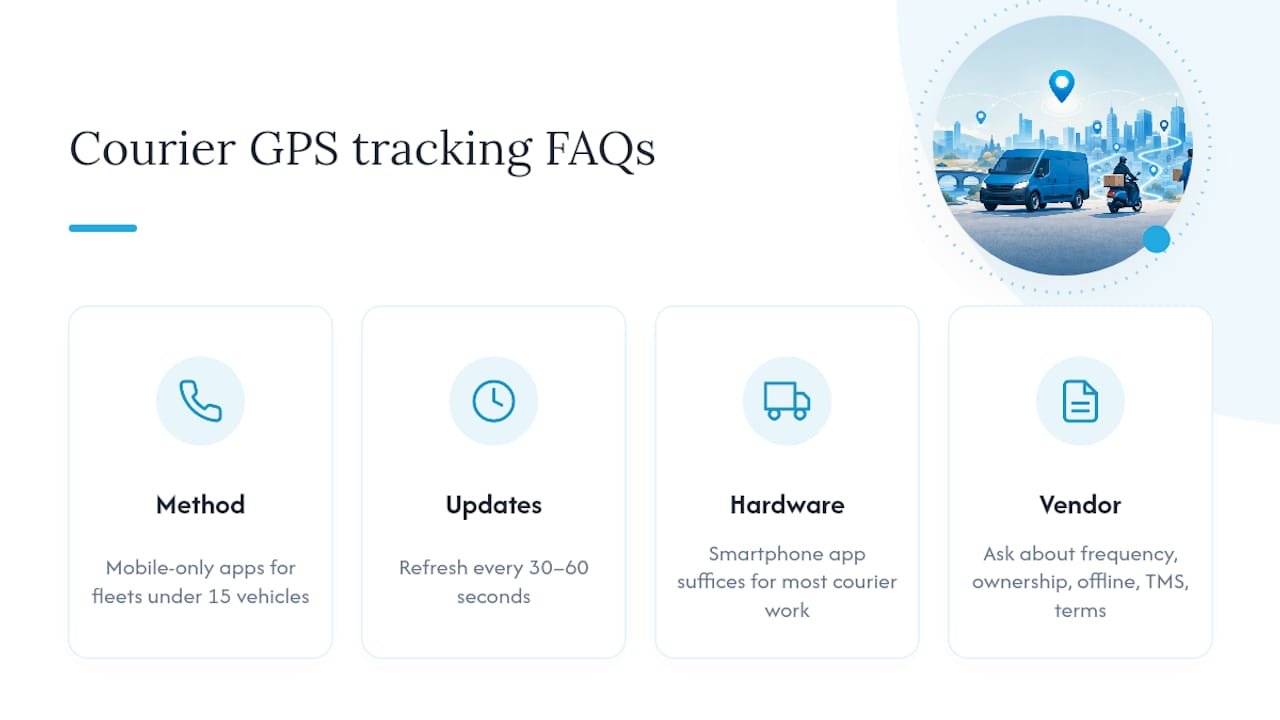
For fleets under 15 vehicles, a mobile-only app such as Zeo Route Planner or Timeero usually offers the fastest setup and lowest cost, since it avoids fitted hardware entirely.
How often should courier driver GPS tracking update?
Look for updates every 30 to 60 seconds. Anything slower starts to feel like a historical log rather than a live view, especially during peak delivery windows.
Do I need fitted telematics hardware or is a smartphone app enough?
A driver’s smartphone app is sufficient for most same-day and multi-drop courier work. Fitted hardware earns its cost mainly for high-value cargo or regulatory compliance needs.
Can customers track their own delivery without downloading an app?
Yes. Most platforms, and services like FRP Haulage, send a live tracking link by SMS or direct communication so customers can follow progress without installing anything.
What should I ask a GPS tracking vendor before signing a contract?
Ask about update frequency, data ownership and export rights, offline behaviour, integration depth with your TMS, and the minimum contract term before committing.
Sources
- How to choose vehicle tracking for your courier business