For valuable or fragile consignments, choose a specialist dedicated transport service, not a shared multi-drop van. Verify four things before you book: vetted, background-checked drivers, real-time GPS tracking with a control room behind it, tamper-evident seals with logged seal numbers, and insurance that actually matches the item’s declared value rather than a carrier’s default liability cap. Specialist providers often build their high-value service around exactly these four pillars.
TL;DR:
- Using a dedicated vehicle eliminates risks associated with transhipment and multiple handling points, reducing chances of theft or mix-ups.
- Implementing layered security measures like tamper-evident seals, high-frequency GPS pings, and real-time geofencing ensures immediate detection of route deviations or unauthorized access.
- Proper booking requires detailed item information, clear recipient verification, and itemized quotes covering all security-related charges to avoid surprises or incomplete coverage.
- Effective packaging involves double-boxing with neutral outer wraps, impact protection, and photographing items beforehand, as inadequate packaging is a common claim denial reason.
- Insurance should be a separate policy from carrier liability, with declared values and evidence logs critical for processing claims, especially beyond several thousand pounds in value.
Table of Contents
- What specialist high value goods transport services actually provide
- How do you book a high value goods transport service?
- Packaging and handling standards that actually protect fragile or valuable goods
- Insurance and liability: why declared value isn’t the same as cover
- Chain of custody and proof of delivery: what a complete record looks like
- Why FRP Haulage matches the criteria buyers need to verify
- Regulatory compliance and legal considerations you can’t skip
- Customs and cross-border considerations for high value shipments
- Provider vetting: certifications, reputation and reliability metrics that matter
- Risk assessment: threats differ by what you’re actually shipping
- Practical trade-offs: choosing the right service level
- Get a quote for secure, high value goods transport with FRP Haulage
- The trade-off nobody wants to say out loud
- Sources
What specialist high value goods transport services actually provide
A dedicated vehicle changes the risk profile entirely. On a multi-drop route, your consignment sits in a van with other customers’ freight, gets handled by multiple people, and waits at unrelated stops where it’s exposed and unattended. A dedicated vehicle goes from collection to delivery with one consignment, one driver, and no intermediate handling. That single change removes most of the opportunity for theft or mix-up before you’ve even discussed security equipment.
The vehicle itself matters too. Locking mechanisms beyond a standard van lock, anti-slash curtains on load areas, and door sensors that alert the moment a door opens unexpectedly are all standard asks for genuinely secure logistics solutions. Some operators run unmarked vehicles specifically so a van full of electronics or jewellery doesn’t advertise its contents to anyone watching the yard, an approach used by specialist high-value couriers who avoid transhipment entirely and keep loading supervised at every stage.
Monitoring is the layer that catches problems before they become losses. Look for GPS pings frequent enough to reconstruct a route minute by minute, geofencing that flags a deviation instantly, and a control room watching live rather than reviewing logs after the fact. Providers building high-value freight programmes commonly combine tamper-evident seals, frequent GPS pings and 24/7 monitoring as layered protocol, not a single feature.
- Dedicated vehicle: removes transhipment and third-party handling risk
- Door sensors and anti-slash curtains: prevent covert or forced access
- GPS ping frequency and geofencing: catch route deviation in real time
- Vetted, trained drivers: reduce insider risk and handling errors
Pro Tip: Ask for a sample tracking screenshot and the ping interval in minutes, not just a claim of “real-time tracking” — a five-minute ping is a very different product to a thirty-second one.
How do you book a high value goods transport service?
Booking well is mostly about giving the provider enough information to plan properly, not just enough to move the item.
- State the declared value and item detail upfront. Include serial numbers, model information, and any handling restrictions (orientation, temperature, shock sensitivity) at the point of enquiry.
- Confirm who receives it. Recipient ID checks and named-recipient-only delivery matter for high-value courier work, especially where the item is going to a private address.
- Choose the service model deliberately. Same-day dedicated transport suits urgent, high-value single items; scheduled secure runs work for recurring shipments where you can plan lead time; hand-carry suits items too sensitive to leave a courier’s custody at any point.
- Ask what’s included in the quote. Security supplements, insurance fees, and standby or waiting charges should all be itemised, not bundled into a vague “handling fee”.
- Check lead time against cost. Shorter notice periods generally mean a narrower pool of available vehicles and drivers, which pushes price up.
A short procurement checklist helps you compare bids on the same basis: ask each provider for their driver vetting standard, their tracking ping interval, their seal numbering process, and their insurance ceiling per consignment. A pre-booking risk assessment before same-day shipments also flags route or timing issues while there’s still time to adjust the plan.
Packaging and handling standards that actually protect fragile or valuable goods
Good packaging isn’t just about preventing physical damage. It’s often the deciding factor in whether an insurance claim succeeds at all.
Double-boxing with a neutral, unbranded exterior is the baseline for shipping high value items. It hides the contents from casual observation and gives you two layers of impact protection. Add roughly two inches of void fill around the item, and account for humidity or shock exposure if the item is electronic or sensitive to vibration, following the packing standards Secursus recommends for high-value shipments.
- Double-box with neutral, unmarked outer packaging
- Add two inches of void fill minimum around the item
- Photograph the item, its serial numbers and its condition before handover
- Apply tamper-evident seals and log the seal number at both pickup and delivery
Photographing the item before dispatch and recording valuation documents alongside it gives you an evidence trail if anything goes wrong in transit. Packaging failures are consistently cited as a leading reason claims get denied, since insurers and carriers use inadequate packing as grounds to reject liability. That single fact makes the packing checklist above a financial control, not just an operational one.
Insurance and liability: why declared value isn’t the same as cover
A carrier’s default liability is not insurance. It’s a contractual cap, usually modest, that applies automatically unless you’ve arranged something else. Declared value increases what the carrier is liable for up to a point, but third-party cargo insurance is a separate policy that actually pays out regardless of fault under policy terms.
That distinction matters most once the shipment’s worth clears a few thousand pounds. Specialist guidance on shipping high value items generally recommends third-party insurance above typical carrier caps, since most standard liability limits sit well below what a single item of electronics, jewellery, or specialist equipment is worth. Consignments above roughly £5,000 to £10,000 in value usually justify the extra premium for dedicated cover.
Common exclusions catch people out: unsupervised drops, inadequate packaging, and missed reporting windows can all void a claim regardless of the policy’s headline coverage. Reviewing cargo insurance options for UK businesses before you ship, rather than after a loss, is the only way to know what’s actually covered.
- Carrier default liability: automatic, but capped and often low
- Declared value: raises the cap, doesn’t replace insurance
- Third-party cargo insurance: pays regardless of fault, subject to policy terms
- Claims windows: usually short, and missing them is a common reason for denial
Pro Tip: Report any suspected damage or loss within the carrier’s stated window, in writing, with photos attached, the same day you notice it. Late reporting is one of the easiest ways an otherwise valid claim gets rejected.
Chain of custody and proof of delivery: what a complete record looks like
A proper chain-of-custody record has four elements: a timestamp for every handover, driver identification, photographic evidence of the item’s condition at pickup and delivery, and a signature confirming receipt. Miss any one of these and you’ve got a gap that’s hard to close after the fact.
Electronic proof of delivery systems have made this far easier to get right. A geotagged signature, combined with timestamped photos taken at the exact moment of handover, gives you a record that’s difficult to dispute. Chain-of-custody data with photos and geodata attached speeds up claims and audits significantly compared with a paper signature alone.
- Timestamped handover at every stage, not just collection and final delivery
- Driver ID recorded against each leg of the journey
- Geotagged, timestamped photos at pickup and delivery
- Secure, retained digital storage of the full record for audit purposes
Ask any provider how long they retain this documentation and how it’s transferred securely. Reviewing proof of delivery standards before you sign a contract tells you whether their default process meets what your insurer or auditor will actually ask for.
Why FRP Haulage matches the criteria buyers need to verify
Some providers run same-day collection within 60 to 120 minutes of your call, 24 hours a day, every day of the year, using a personal fleet backed by a vetted partner network for coverage when demand spikes. Shipments may come with signed proof of delivery, providing documented handover records useful for audits and insurance claims. Client feedback often highlights clear communication and professional handling as factors that set some services apart, particularly on urgent or sensitive jobs.
This combination can map onto the requirements covered above: rapid dedicated collection can reduce the exposure window, signed proof of delivery may satisfy chain-of-custody standards, and specialist handling capabilities can extend to manufacturing components, legal documents, and high-value cargo alike, whatever the consignment.
Regulatory compliance and legal considerations you can’t skip
Transporting high-value goods sits under several overlapping compliance obligations, and which ones apply depends on what you’re moving and how.
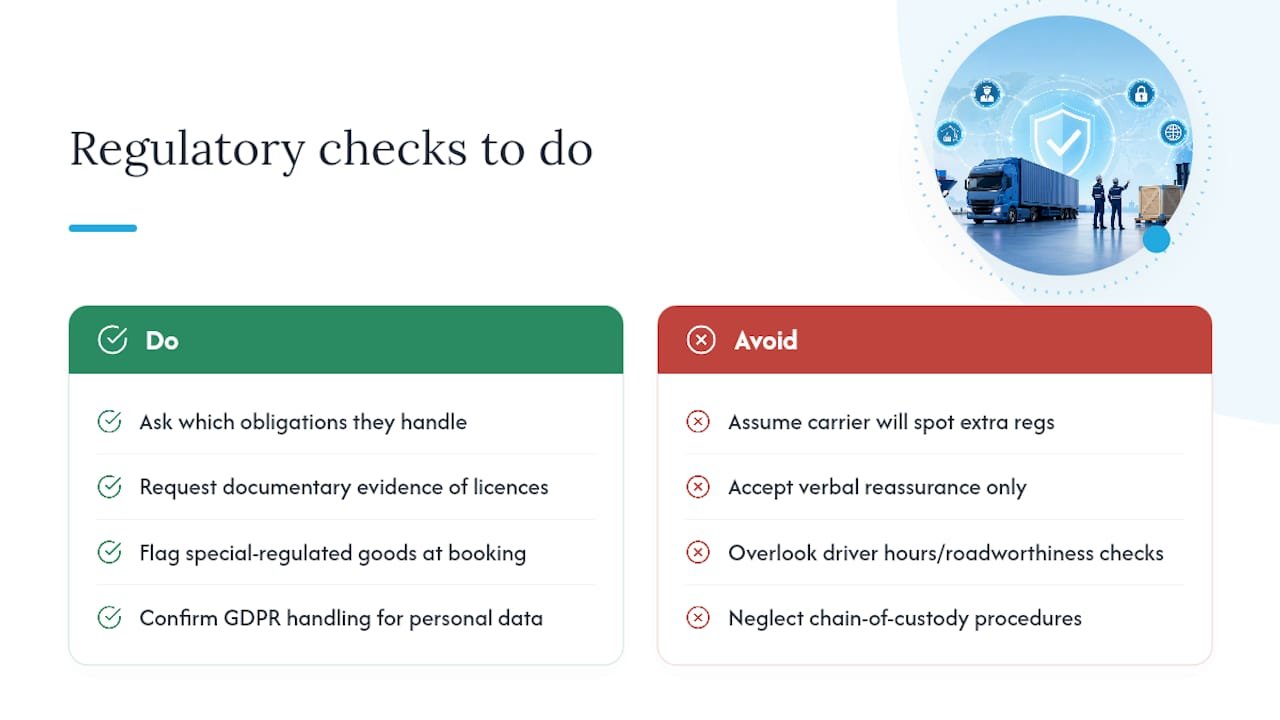
Personnel licensing is one of the clearest. Where a shipment involves security personnel or escort staff rather than a standard driver, the Security Industry Authority regulates certain security activities in the UK, and any provider offering escorted or guarded transport should be able to show relevant licensing for staff performing those roles.
Duty of care obligations apply too, particularly around driver hours, vehicle roadworthiness, and safe loading practice, all standard road transport law rather than anything specific to high-value cargo. Where goods carry additional regulatory status, controlled substances, certain medical equipment, or items subject to export licensing, extra documentation requirements sit on top of the standard transport contract, and it’s the shipper’s responsibility to flag these at booking rather than assume the carrier will catch them.
Data protection also matters more than people expect. If a shipment includes personal data, whether on physical documents or on IT hardware being relocated, GDPR obligations around secure handling and chain of custody apply just as much as they would to a data breach in an office. Providers moving sensitive IT equipment need handling procedures that account for this, not just physical damage prevention.
None of this replaces legal advice for your specific consignment. But asking a provider directly which of these obligations they’ve handled before, and asking for evidence rather than reassurance, tells you quickly whether they understand the compliance side or just the driving side.
Customs and cross-border considerations for high value shipments
Moving high-value goods across a border adds a layer of complexity that domestic transport doesn’t have, and it starts well before the vehicle leaves.
Accurate customs declarations matter enormously for high-value items specifically, because undervaluing a shipment to reduce duty exposure is both illegal and a common way insurance claims fall apart if something goes wrong in transit. The declared value for customs purposes and the declared value for insurance purposes should match, and any discrepancy between the two is a red flag to both border authorities and insurers.
Commodity codes need to be correct, since misclassification can trigger delays, inspections, or unexpected duty bills that weren’t factored into the original quote. High-value electronics, jewellery, and specialist equipment often sit in commodity categories that attract closer scrutiny than standard consumer goods, so building in extra time for customs clearance on cross-border high-value shipments is sensible rather than optional.
Documentation needs to travel with the shipment, not arrive separately. Commercial invoices, certificates of origin where relevant, and any export or import licences should be physically present or digitally accessible at the point of inspection, since a border delay caused by missing paperwork exposes an unattended, high-value consignment for far longer than anyone wants.
If your business regularly ships high-value goods across borders, working with a provider who has handled that specific corridor before, rather than a generalist, reduces the number of surprises considerably.
Provider vetting: certifications, reputation and reliability metrics that matter
Marketing claims are cheap. Evidence is what actually protects your consignment, and procurement teams should treat security features as requirements to verify rather than promises to accept, in line with the approach the European Commission’s road freight security guidance recommends for road transport risk controls generally.
TAPA TSR certification is one of the clearest signals in this space. Several specialist providers in the high-value goods transport sector advertise it specifically because it represents an externally audited security standard rather than a self-declared one. Ask to see the certificate, not just the logo on a website.
ISO certifications, where a provider claims them, should be checked against the specific standard number, since “ISO certified” without a number attached tells you nothing verifiable. Ask which standard, which certifying body, and when it was last audited.
Reputation and reliability metrics matter just as much as paper certification. On-time delivery rate, claims frequency, and how a provider has handled a past incident (not whether they’ve ever had one, but how they responded) tell you more than a clean-sounding sales pitch. ASIS International publishes broader supply-chain security guidance that’s useful background when building out your own vetting questions for driver checks and control room standards.
Ask for references from clients moving similar goods, not just any client. A provider excellent at moving pallets of retail stock may have no relevant experience with jewellery, fine art, or sensitive electronics, and the vetting standard for drivers can differ substantially between those categories.
Risk assessment: threats differ by what you’re actually shipping
Not all high-value goods face the same threats, and treating them identically wastes security budget in the wrong places.
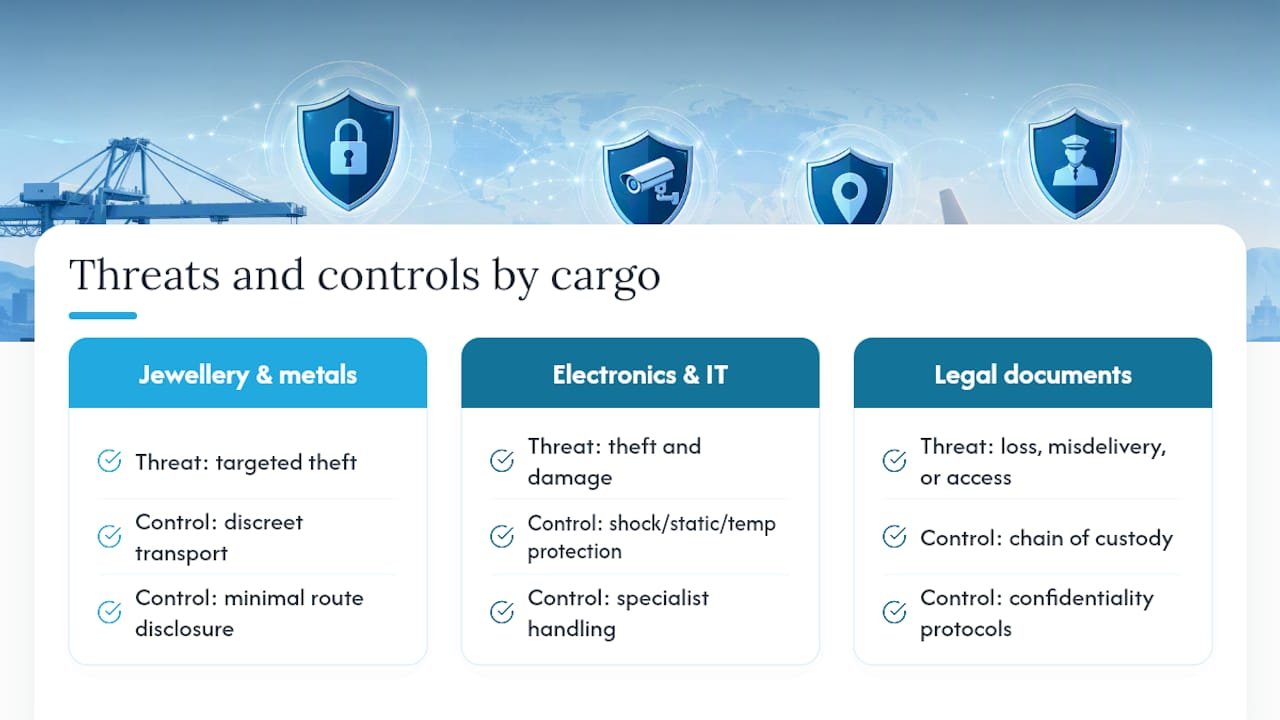
Jewellery and precious metals face targeted theft risk, since their value density (small size, huge value) makes them attractive to organised crime specifically. These consignments benefit most from discreet, unmarked transport and minimal advance notice of route or timing.
Electronics and IT equipment face a different profile: theft risk exists, but so does damage risk from shock, static, and temperature. Specialist handling for IT and data centre equipment needs to account for both threats simultaneously, which is why generic high-value protocols sometimes fall short for this category specifically.
Legal documents and sensitive paperwork carry low physical theft appeal but high consequence if lost, misdelivered, or accessed by the wrong party. Legal document delivery protocols prioritise chain of custody and confidentiality over the armoured-vehicle approach that fine art or jewellery might warrant.
A proper risk assessment asks what happens if this specific item is stolen, damaged, or delayed, then builds the security response around that answer rather than applying a one-size protocol across every consignment type.
Practical trade-offs: choosing the right service level
Dedicated, escorted transport costs more than consolidated shipping, and it should. The decision comes down to shipment value against business impact: a £50,000 prototype missing a trade show deadline justifies dedicated speed even at a premium. A recurring £2,000 stock transfer between depots usually doesn’t need an escort, just reliable scheduled secure transport with solid tracking. Match the service tier to what actually happens if the shipment goes wrong, not just to what it’s worth on paper.
Get a quote for secure, high value goods transport with FRP Haulage
Some providers specialize in shipments where speed, documentation, and security all matter at once, not just one of the three. Where a generalist courier treats a high-value item the same as any parcel, specialist same-day services may start with rapid dedicated collection, usually within 60 to 120 minutes of your call, backed by signed proof of delivery on every job to provide custody records useful for procurement and insurance teams.
Getting a quote is straightforward. Tell us the declared value, any handling restrictions, and your preferred pickup window, and we’ll confirm vehicle availability and pricing before you commit. For a full walkthrough of what happens between your call and delivery, read how our same-day courier service works from call to delivery, or check our guide to choosing the right same-day courier service if you’re still comparing options. Call us to get a quote for your next high-value or time-critical shipment.
The trade-off nobody wants to say out loud
Most procurement guidance on high-value transport reads like a checklist you tick once and forget. That’s the wrong way to think about it. Security and speed genuinely pull against each other, and any provider who tells you otherwise is either overcharging you for a service level you don’t need or underdelivering on one you do.
The overlooked point is this: the biggest risk in high-value transport usually isn’t the theft scenario everyone plans for. It’s the documentation gap that surfaces three weeks later when a claim gets filed and nobody can prove what condition the item was in at handover. Insurers don’t deny claims because goods got stolen. They deny them because the paperwork couldn’t prove the loss happened the way it was reported. That’s why chain of custody deserves as much procurement attention as the armoured van does, arguably more, because it’s the layer that determines whether every other security measure actually protects you financially when something does go wrong.
If there’s one habit worth building into every high-value shipment, it’s treating documentation as a security control in its own right, not an administrative afterthought bolted onto the end of the job.
— Catalin
Sources
- Gov
- Road freight security (abridged) — European Commission
- How to ship high-value items — Secursus
- High value freight — IGT Logistics