
Just-in-time delivery (JIT) is a supply chain strategy where goods arrive precisely when production or fulfilment requires them, not before. The primary outcome is a sharp reduction in inventory carrying costs and working capital tied up in stock. JIT synchronises material flow with production so that items arrive in the right quantity and quality exactly when needed.
TL;DR: JIT tends to work when your demand is reasonably predictable, your suppliers are close enough to deliver frequently, and your last-mile logistics are reliable. Without all three, you are building a production line on sand.
Quick fit check — start a pilot if:
- Your production volumes follow a consistent weekly pattern
- Key suppliers are within the UK or northern Europe
- You have (or can contract) a same-day or scheduled courier for urgent collections
- Your ERP or WMS can trigger automated replenishment
Pause and assess first if:
- Lead times from your main suppliers are long
- Demand varies week to week without reliable forecasting signals
- You have no contingency freight arrangement for emergency top-ups
Table of Contents
- What JIT delivery actually means, and where it came from
- How JIT delivery operates in practice
- What you actually gain from JIT delivery
- Risks, limitations and common failure modes of JIT delivery
- Which industries and business profiles use JIT most effectively
- Is JIT the right strategy for your UK business?
- Step-by-step implementation checklist for UK businesses
- What technology does reliable JIT delivery require?
- Contracts, SLAs and supplier performance management for JIT
- Contingency planning and risk mitigation for JIT environments
- KPIs to measure JIT performance and how to collect them
- Two case examples: Toyota’s origin and a UK logistics illustration
- Key takeaways
- The part of JIT that most guides get wrong
- How Frphaulage supports JIT operations across the UK
- Useful sources and further reading
What JIT delivery actually means, and where it came from
JIT was developed as part of the Toyota Production System (TPS) in post-war Japan, where Toyota engineers designed it to eliminate waste and improve production flow through daily or more frequent deliveries of supplies. The core insight was simple but radical: inventory is not an asset; it is a liability. Every pallet sitting in a warehouse represents cash that is not working.
The term “just in time” is sometimes misread as “zero inventory.” That is not what it means. JIT is a pull-based system: downstream demand triggers replenishment, and stock arrives in the quantity needed for the next production window, not a week’s worth at once. Lean inventory thinking holds that you should only hold stock that meets immediate, confirmed downstream demand. The difference between JIT and no-inventory is a buffer policy, not an ideology.
Toyota’s approach also gave us Kanban (visual signals that trigger replenishment) and Kaizen (continuous incremental improvement). These methods sit alongside JIT in practice, and any UK manufacturer adopting JIT without also adopting some form of continuous improvement culture is likely to find the system brittle.
Frphaulage operates in the last-mile layer of JIT supply chains, providing the urgent and scheduled collections that keep production lines moving when the delivery schedule is tight.
How JIT delivery operates in practice
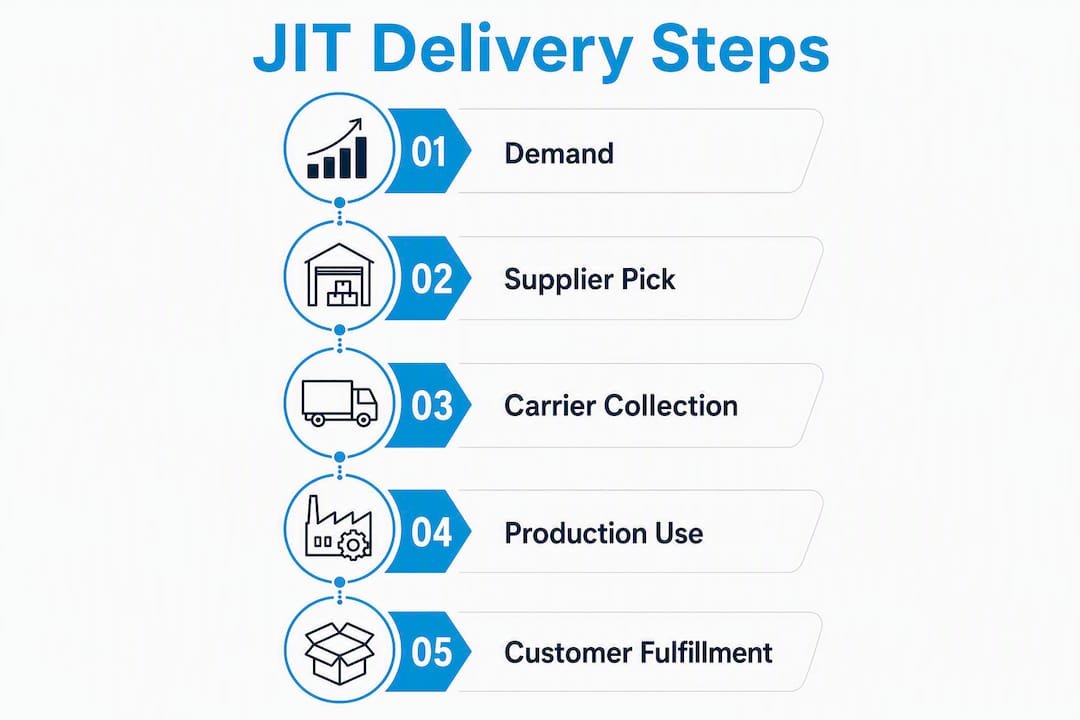
The mechanics of JIT are straightforward to describe and demanding to execute. Here is the typical process flow for a UK manufacturing operation:
- Demand signal generated. A production schedule or Kanban card signals that a component will be needed within a defined window, often 24–48 hours.
- Order trigger sent to supplier. An automated ERP message or EDI instruction (sometimes using the UN/EDIFACT DELJIT standard for high-frequency schedules) tells the supplier exactly what to pick and when to have it ready.
- Supplier picks and packs to schedule. The supplier prepares only the confirmed quantity, not a batch surplus.
- Transport scheduled or pre-booked. A carrier collects on a fixed window, often the same day or next morning. For urgent or variable-volume lines, a same-day courier with a guaranteed collection window handles the run.
- Last-mile delivery to production point. Goods arrive at the line-side or goods-in dock within the agreed window, with signed proof of delivery confirming receipt.
- Consumption triggers the next signal. As stock is consumed, the cycle restarts.
The critical handoff is between steps 4 and 5. A supplier who picks perfectly but whose carrier misses the collection window breaks the entire chain. That is why last-mile reliability is not a nice operational detail; it is the point where JIT either holds or collapses.

What you actually gain from JIT delivery
The financial case for JIT is well established. Lean inventory reduces working capital tied up in stock and focuses replenishment on confirmed demand rather than forecast buffers. For a UK manufacturer holding weeks of component stock, the cash release from moving to a JIT model can be substantial.
The operational benefits compound over time:
- Lower carrying costs. Warehouse space, insurance, handling labour, and obsolescence risk all shrink when stock levels fall.
- Reduced waste. Components that arrive just before use are far less likely to become obsolete, damaged, or superseded.
- Smaller warehouse footprint. Some manufacturers have converted freed warehouse space into production capacity, which is a direct revenue benefit.
- Improved responsiveness. When you are not sitting on six weeks of a component, switching to a revised specification is faster and cheaper.
- Higher production efficiency. Frequent small deliveries keep the production environment cleaner and reduce the time operatives spend managing stock.
The responsiveness point is underappreciated. Businesses that carry large buffers often discover they are effectively locked into their current product configuration because changing it means writing off existing stock. JIT removes that anchor.
Risks, limitations and common failure modes of JIT delivery
JIT’s strengths and its vulnerabilities are the same thing: it removes slack from the system. That is efficient when everything works and catastrophic when it does not.
- Emergency freight cost spikes — On-demand or emergency delivery services substantially increase operational complexity and cost compared with scheduled logistics. A single emergency run can wipe out a week’s carrying-cost savings.
The most common failure mode is not a dramatic disruption. It is a slow accumulation of small scheduling failures that force the operations team to quietly rebuild buffer stock, at which point JIT exists on paper only.
Which industries and business profiles use JIT most effectively
JIT works best in high-volume, repetitive production environments and is less suited to operations where component lead times are long or demand is highly variable. The clearest adopters are:
Automotive manufacturing is the canonical example. Toyota’s original TPS model has been replicated across the global automotive supply chain, with tier-one and tier-two suppliers delivering components to assembly lines on tightly defined schedules.
Electronics assembly uses JIT for high-turnover components where obsolescence risk is high. Holding six months of a processor that will be superseded in three is an obvious waste.
Retail and e-commerce fulfilment applies JIT principles differently: replenishing fast-moving lines from distribution centres based on point-of-sale data rather than fixed reorder points.

Make-to-order manufacturers across sectors from aerospace components to specialist packaging benefit from JIT because their production runs are defined in advance, making the demand signal reliable.
The profile that suits JIT least is a business with a long, geographically dispersed supply chain, high component variability, or a customer base whose orders are genuinely unpredictable.
Is JIT the right strategy for your UK business?
Use this checklist before committing to a pilot. Honest answers here save months of painful backtracking.
Green lights:
- Demand is predictable enough to schedule production at least 48 hours ahead
- Your primary suppliers are UK-based or in northern Europe with reliable transit times
- You can contract a same-day or next-day courier for urgent collections
- Your ERP or WMS supports automated replenishment triggers
- Your operations team has capacity to manage daily delivery schedules
Red flags:
- Key components come from Asia or other long-lead origins with variable transit
- Your largest customer changes orders with less than 48 hours’ notice regularly
- Supplier quality is inconsistent and you rely on incoming inspection to catch defects
- You have no contingency freight arrangement and no budget to create one
- Your inventory data is updated manually or in daily batch runs
If you have more green lights than red flags, a scoped pilot on one product line is a reasonable next step. If the red flags dominate, address the underlying constraints first — particularly supplier lead times and data quality — before attempting JIT.
Step-by-step implementation checklist for UK businesses
- Define pilot scope. Select one product line or production cell with stable demand. Map current lead times, delivery frequency, and stock levels as your baseline.
- Audit supplier readiness. Assess whether key suppliers can commit to daily or twice-weekly deliveries, near-zero defect rates, and electronic order acknowledgement.
- Draft supplier SLAs. Agree lead-time windows, on-time delivery targets, defect rate thresholds, and notification timelines for delays. Get these in writing before the pilot starts.
- Integrate your systems. Connect ERP to supplier ordering via EDI or the UN/EDIFACT DELJIT messaging standard for high-frequency schedules. Ensure WMS reflects real-time stock movements, not batch updates.
- Contract a last-mile partner. Identify a same-day courier with guaranteed collection windows for urgent top-ups. Frphaulage, for example, offers collection within 60–120 minutes and signed proof of delivery, which gives you an auditable record for every urgent run. Read how to choose a same-day courier service before committing to a provider.
- Define your buffer policy. Successful implementations keep targeted buffer stock for high-volatility parts rather than pursuing absolute zero inventory. Decide which components warrant a small safety stock and set the rules for when to use it.
- Train the operations team. JIT requires a shift in how planners, buyers, and warehouse staff think about stock. Kanban and Kaizen methods help embed the pull-system mindset.
- Run the pilot for 8–12 weeks. Measure inventory days, OTIF, and emergency freight costs weekly. Do not expand scope until the pilot line is stable.
- Review and adjust. Hold a structured review at week 12. Fix supplier or scheduling issues before rolling out to additional lines.
- Phase roll-out. Expand one line at a time, carrying the SLA templates and buffer rules from the pilot into each new scope.
Pro Tip: The single change that most reduces early failure risk is agreeing a formal delay-notification protocol with every supplier before the pilot starts. A supplier who calls you two hours before a missed delivery window is manageable. One who calls after the window has passed is a production stoppage.
What technology does reliable JIT delivery require?
JIT at scale is not a spreadsheet exercise. The technology layer is what separates a functioning system from one that collapses under its first disruption.
- ERP with real-time inventory visibility. Stock levels must update on consumption, not in overnight batches. Systems like SAP, Oracle, or Microsoft Dynamics 365 support this natively when configured correctly.
- WMS integration. Your warehouse management system needs to feed live data to the ERP so replenishment triggers fire on actual stock movements.
- EDI and DELJIT messaging. For high-frequency supplier schedules, UN/EDIFACT DELJIT allows precise shipping sequences and daily delivery windows to be communicated electronically, reducing manual scheduling errors.
- IoT sensors and telematics. Line-side sensors that track component consumption in real time, and vehicle telematics that confirm delivery ETAs, close the visibility gap between order and arrival.
- AI-driven demand forecasting. AI and real-time analytics offer up-to-the-minute inventory insights and better demand forecasting for more accurate replenishment. Tools like Blue Yonder or Kinaxis are used by larger manufacturers; mid-market businesses often start with the forecasting modules built into their existing ERP.
- Exceptions dashboard. A single screen showing late orders, low-stock alerts, and supplier performance flags lets your team act before a delay becomes a stoppage.
Contracts, SLAs and supplier performance management for JIT
JIT changes the nature of supplier relationships from transactional to integrated. The contract needs to reflect that.
Sample SLA clauses to include:
- Lead-time window: maximum hours from order receipt to goods-ready (e.g., 24 hours for standard lines, a short lead time for urgent callouts)
- On-time delivery target: a high OTIF percentage over a recent period
- Defect rate threshold: a low maximum acceptable defect rate per delivery
- Delay notification: supplier must notify within one hour of identifying a risk to the delivery window
- Emergency escalation: named contact and response protocol for out-of-hours issues
Operational scorecard metrics to track:
- OTIF (On Time In Full): the headline JIT metric; anything below 95% warrants a formal review
- Lead-time variance: the standard deviation of actual vs. agreed lead times; high variance is more damaging than a consistently longer lead time
- Defect rate per delivery: tracked per supplier and per component family
- Responsiveness score: how quickly the supplier acknowledges orders and flags issues
Governance: hold monthly performance reviews for critical suppliers, with quarterly business reviews for strategic partners. Include penalty clauses for persistent OTIF failure and incentive provisions for suppliers who consistently exceed targets. An escalation path to senior management on both sides should be written into the contract, not improvised when things go wrong.
Contingency planning and risk mitigation for JIT environments
The businesses that run JIT successfully are not the ones who never face disruptions. They are the ones who have planned for them.
- Expedited transport agreements — Pre-negotiate rates and collection windows with a same-day courier. Last-mile reliability and frequent collection are essential to maintain JIT service levels; having the agreement in place before the emergency means you are not negotiating price under pressure.
KPIs to measure JIT performance and how to collect them
| KPI | Definition | Measurement frequency | Owner |
|---|---|---|---|
| Inventory days | Average days of stock on hand | Weekly | Finance / Operations |
| Inventory turnover | Cost of goods sold ÷ average inventory value | Monthly | Finance |
| OTIF | Percentage of orders delivered on time and in full | Weekly | Procurement / Logistics |
| Fill rate | Percentage of demand met from available stock without delay | Weekly | Operations |
| Emergency freight cost | Total cost of unplanned urgent shipments | Weekly | Logistics / Finance |
| Supplier defect rate | Defective units as a percentage of units received | Per delivery / Monthly | Quality / Procurement |
| Lead-time variance | Standard deviation of actual vs. agreed supplier lead times | Monthly | Procurement |
Track inventory days and OTIF weekly during a pilot; they are the fastest indicators that something is drifting. Emergency freight cost is your early warning for a system under stress: if it is climbing, the root cause is almost always either a supplier SLA failure or a forecasting error, and you need to know which before it compounds.
Two case examples: Toyota’s origin and a UK logistics illustration
The Toyota Production System is the most studied manufacturing model of the 20th century, and JIT is its most exported idea. Toyota engineers designed the system around one principle: produce only what is needed, when it is needed, in the quantity needed. Supplier partnerships were transformed from arm’s-length transactions into near-integrated relationships where suppliers committed to near-zero defect rates and daily delivery windows. The lesson for UK manufacturers is not that you need Toyota’s scale. It is that JIT requires you to treat supplier relationships as a strategic asset, not a procurement exercise.
For a practical UK illustration: consider a mid-sized manufacturer of precision components in the West Midlands. Their production schedule runs 48 hours ahead, with daily deliveries from three UK-based suppliers. When one supplier flags a potential delay, the operations manager books an urgent collection through a same-day courier, who collects from the supplier’s site within 90 minutes and delivers to the production dock with a signed proof of delivery. The line does not stop. The emergency freight cost is logged, reviewed at the monthly supplier meeting, and the root cause addressed. That is JIT working as designed, with a reliable last-mile partner as the safety net.
Key takeaways
Just-in-time delivery succeeds when supplier reliability, real-time data, and a dependable last-mile partner are all in place before you remove your inventory buffer.
| Point | Details |
|---|---|
| JIT is a pull system, not zero stock | Goods arrive when production needs them; selective safety stock for volatile parts is standard practice. |
| Supplier SLAs are non-negotiable | OTIF targets, defect rate thresholds, and delay-notification protocols must be contractual before the pilot starts. |
| Technology is the backbone | Real-time ERP, WMS integration, and EDI/DELJIT messaging are prerequisites, not optional upgrades. |
| Last-mile reliability is the make-or-break factor | A pre-agreed same-day courier with guaranteed collection windows prevents a supplier delay from becoming a production stoppage. |
| Frphaulage covers the urgent last mile | Same-day collection within 60–120 minutes, signed POD, and 24/7 availability make Frphaulage a practical contingency partner for UK JIT operations. |
The part of JIT that most guides get wrong
JIT is consistently presented as an inventory strategy. The implementation checklists focus on ERP integration, Kanban boards, and supplier scorecards. All of that matters. But the businesses that actually sustain JIT over years tend to share one characteristic that the textbooks understate: they treat their logistics partners with the same rigour they apply to their suppliers.
A supplier SLA that specifies 98% OTIF is standard practice. A carrier agreement that specifies a 90-minute collection window, signed proof of delivery, and a named escalation contact is far less common. Yet the carrier is the last link in the chain. A supplier who picks perfectly and a carrier who misses the collection window produce exactly the same outcome: a production stoppage.
The other thing practitioners underestimate is the cultural shift required. JIT exposes every inefficiency in your process because it removes the buffer that was hiding them. That is the point, but it is also genuinely uncomfortable. Teams that have managed by holding safety stock for years will resist the change, and they will find ways to quietly rebuild buffers unless leadership is consistent. The lean literature calls this “reverting to push.” It happens in most implementations at least once.
The businesses that get through it are the ones who treat the first disruption as a learning event rather than a failure. They fix the root cause, update the SLA or the buffer policy, and move on. That is what continuous improvement actually looks like in practice.
How Frphaulage supports JIT operations across the UK
The last-mile gap is where JIT plans most often break down in practice. Frphaulage is built for exactly that problem.
When a supplier delay threatens your production schedule, Frphaulage collects within 60–120 minutes of your call, 24 hours a day, 365 days a year. Every shipment comes with a signed proof of delivery, giving you an auditable record that matters when you are reviewing supplier and carrier performance. For businesses running multi-drop regional schedules, Frphaulage handles those runs too, whether that is a daily component circuit or an out-of-hours emergency.
The same-day delivery trends shaping UK logistics in 2026 point clearly toward tighter delivery windows and greater demand for on-demand freight. Frphaulage’s combination of a personal fleet and a vetted partner network means capacity scales with your needs, not against them.
If you are designing a JIT pilot or looking to close a last-mile vulnerability in an existing operation, get a quote from Frphaulage and discuss your collection windows, route requirements, and proof-of-delivery needs directly.
Useful sources and further reading
- Just-in-time manufacturing (Britannica) — Authoritative encyclopaedic overview of JIT origins and the Toyota Production System. A reliable starting point for historical context.
- Just-in-time logistics: what it means and why it matters (INFORMS / PubOnline) — Practitioner-focused analysis of JIT logistics, technology requirements, and supplier integration. One of the stronger academic-practitioner sources on the topic.
- UN/EDIFACT DELJIT message specification — The primary standard specification for high-frequency JIT delivery scheduling messages. Relevant for IT and procurement teams implementing EDI.
- JIT just-in-time manufacturing (University of Cambridge, IfM) — Academic resource from the Institute for Manufacturing at Cambridge. Covers TPS principles and lean production in depth.
- Lean inventory management (Zoho Academy) — Practitioner guide to lean inventory principles, pull systems, and working capital management. Useful for operations teams new to lean thinking.
- Lean inventory management (NetSuite) — Covers Kanban, Kaizen, and continuous improvement methods alongside JIT. Good reference for implementation planning.
- Practical buffer stock guidance for JIT (Shopify) — Pragmatic guidance on selective safety stock policies within lean and JIT systems.
- Just-in-time (JIT) in construction (Lean Construction Institute) — Applies JIT principles to the construction sector; useful for UK contractors exploring lean delivery.