Milk run logistics is a multi-stop transport method where a single vehicle follows a planned circular route to collect from or deliver to several locations in one trip, replacing infrequent full-truck shipments with frequent, predictable runs that cut inventory and response times. For most UK manufacturing and distribution operations with clustered suppliers or customers, it is worth piloting. If your suppliers are scattered across wide geographies or your volumes are highly variable, a dedicated or same-day direct service will often serve you better.
Before committing, run through these three deciding criteria:
- Supplier or customer density: are multiple stops within a viable route corridor (typically within 50–80 miles of each other)?
- Frequency needs: do you require daily or multiple daily replenishments rather than weekly bulk deliveries?
- Inventory goals: are you actively trying to reduce safety stock, shorten lead times, or support a just-in-time (JIT) production schedule?
Pro Tip: If you can answer yes to all three, a milk run pilot is almost certainly worth the planning effort. Two out of three usually still justifies a feasibility review.
Key takeaways
Milk run logistics pays off when supplier density, consistent volumes, and short replenishment requirements align — and the first four weeks of any pilot are the most critical period for validating whether those conditions hold in practice.
| Point | Details |
|---|---|
| Core suitability test | Three or more stops in a coherent corridor, consistent daily volumes, and a JIT or lean production requirement. |
| Primary cost lever | Load consolidation across multiple stops reduces cost per unit; fill factor below 80% erodes the saving. |
| Biggest operational risk | Route fragility from supplier lateness; mitigate with tight SLAs, buffer time, and contingency capacity clauses. |
| Week 1–4 KPI to watch | On-time pickup rate: target high; anything noticeably low in the first four weeks signals a route or supplier readiness problem. |
| Frphaulage for UK pilots | Same-day multi-pickup with 60–120 minute collection, signed POD, and a vetted partner network for surge capacity. |
Table of Contents
- What is a milk run, and where does the term come from?
- How does milk run logistics actually work?
- What are the main benefits for UK operations?
- What are the risks and downsides?
- Is a milk run right for your operation?
- How to design and run a milk run pilot in the UK
- Lessons from UK same-day and multi-pickup operations
- Why the first four weeks of a milk run pilot reveal everything
- Frphaulage: same-day multi-pickup for UK milk-run pilots
- Sources
What is a milk run, and where does the term come from?
The name comes from the old dairy industry practice of a single vehicle driving a fixed morning route to collect milk from multiple farms before returning to the creamery. Wikipedia traces this origin directly to those circular collection routes, and the logistics industry adopted the term to describe any multi-stop circular transport pattern used for pickups or deliveries.
In modern supply chains, a milk run replaces the logic of waiting until a full truckload accumulates from one supplier. Instead, a vehicle visits several suppliers or customers on a timed loop, collecting or dropping partial loads at each stop and consolidating them into a single efficient movement.
The lean manufacturing connection matters here. Milk runs are not simply a routing trick. They are a cadence device, functioning much like a kanban signal: they create a regular, predictable transport heartbeat that allows production lines to pull materials in small quantities rather than hold large buffer stocks. Toyota’s production system popularised the concept in the 1970s and 1980s, and it has since spread across automotive, aerospace, FMCG, and pharmaceutical supply chains worldwide.
How does milk run logistics actually work?
A milk run follows a planned multi-stop route for pickups, deliveries, or both, with load sequencing and time windows as the two most critical planning inputs. Route optimisation specialists confirm that getting these two elements right is what separates a smooth operation from one that cascades into delays by the third stop.
A typical route lifecycle runs as follows:
- Route design and scheduling: define stops, sequence them to minimise travel time and handling, and assign time windows to each supplier or customer.
- Load sequencing: plan the order in which goods are loaded onto the vehicle so that the last stop’s cargo is loaded first and the first stop’s cargo is accessible immediately.
- Pickups or deliveries: the driver follows the sequence, collecting or dropping goods within each agreed time window.
- Consolidation: collected goods are either delivered directly to a production line, sorted at a cross-dock, or held at a consolidation hub for onward distribution.
- Return to base: the vehicle completes the loop and returns, ready for the next scheduled run.
Common variants include inbound supplier collection (gathering components from multiple suppliers for a single factory), outbound multi-drop delivery (distributing finished goods to several customers), combined pickup/delivery (collecting returns or empties while delivering), internal plant milk runs (moving parts between production cells within a large facility), and hub-and-spoke hybrids where a milk run feeds a central cross-dock that then dispatches onward.
A route diagram for a well-designed milk run should show each stop with its time window, the cumulative load build at each point, the vehicle’s return-to-base leg, and any consolidation or sorting step in between.
Pro Tip: Batch your time windows in clusters of short duration per stop to maintain schedule discipline. Wider windows sound flexible but they create slack that compounds into late arrivals at downstream stops. Tighter windows force supplier discipline and protect your schedule.
Shiptify’s implementation guidance reinforces that visibility tools and transport management systems (TMS) are what make multi-stop schedules reliable at scale, particularly when route conditions or supplier readiness varies day to day.
What are the main benefits for UK operations?
Milk runs reduce total transport cost per unit when conditions like supplier density and route frequency are favourable. That is the core claim, and the mechanism is straightforward: you are spreading the fixed cost of a vehicle movement across more stops and more cargo rather than running a dedicated truck for each supplier.
The practical benefits stack up quickly:
- Lower transport cost per unit through load consolidation across multiple stops.
- Higher vehicle utilisation by reducing empty or part-loaded movements.
- Fewer empty miles, which directly cuts fuel spend and carbon emissions.
- Reduced inventory and safety stock, because frequent small deliveries mean you do not need to hold large buffers to cover infrequent shipment gaps.
- Improved supplier cadence and quality visibility, since regular pickups create natural checkpoints for inspecting goods and catching quality issues early.
- CO2 reduction, relevant for UK operations working toward Scope 3 emissions targets under frameworks such as the Science Based Targets initiative (SBTi).
- Support for lean manufacturing, particularly kanban and JIT replenishment, where transport frequency is as important as transport cost.
ShipBob’s analysis of milk run logistics confirms that consolidation is the primary cost lever, but notes that the savings only materialise when planning and coordination are tight enough to keep vehicles full and on schedule.
The inventory reduction benefit is often underestimated. When a production line receives components twice daily instead of twice weekly, the quantity it needs to hold on the shop floor drops sharply. For UK manufacturers operating in constrained factory footprints, that freed floor space has real value beyond the working capital saving.
What are the risks and downsides?
Milk runs introduce scheduling and coordination risk that dedicated or direct services do not. One late supplier can delay every subsequent stop on the route, and that fragility is the single biggest operational concern for teams considering the model.
The main drawbacks to plan around:
- Route fragility: a delay at stop two affects stops three, four, and five. There is no slack to absorb it unless you have built buffer time into the schedule.
- Supplier punctuality dependency: every supplier on the route must have goods ready within the agreed time window. One consistently late supplier degrades the entire route’s performance.
- Increased handling complexity: partial loads at multiple stops mean more loading and unloading events, raising the risk of damage and increasing driver time per unit moved.
- Higher per-stop handling cost when stop density is low or volumes per stop are too small to justify the route.
- Contractual complexity: formalising time windows, penalties for missed readiness, and packaging standards across several suppliers takes meaningful procurement effort.
- Mismatch with variable demand: milk runs are optimised for consistent, predictable volumes. Seasonal spikes or erratic order patterns can leave vehicles under-loaded or force expensive route changes at short notice.
Pro Tip: Build a contingency capacity clause into your carrier agreement from day one. Specify that the carrier can call on a vetted partner network for surge capacity without requiring a new purchase order. This single clause prevents most of the operational crises that kill milk-run pilots in their first month.
For genuinely urgent, unplanned movements, a hot-shot delivery service is the right tool. Hot-shot delivery means a direct, point-to-point urgent movement for a small high-priority load, typically booked at short notice to protect a production line from downtime. It is the opposite of a milk run in design intent, and understanding that distinction helps you decide which model fits each scenario rather than forcing one approach onto every situation.
Is a milk run right for your operation?
Milk runs typically pay off when you have three or more suppliers or customers within a coherent route corridor, consistent daily or near-daily volumes, and a production or distribution model that benefits from short replenishment cycles.
Use this checklist before committing to a pilot:
- Three or more stops within a viable corridor (50–80 miles is a common UK benchmark).
- Consistent daily or weekly volumes at each stop, with low variability.
- Short replenishment lead times as a business requirement (JIT, kanban, or lean production).
- Handling capacity at a consolidation hub or production line to receive frequent small deliveries.
- Supplier willingness to commit to fixed time windows and packaging standards.
- Internal resource to manage route scheduling, supplier SLAs, and exception handling.
KPIs to model before you pilot
| KPI | What it measures | Target direction |
|---|---|---|
| Cost per line (or per stop) | Transport cost efficiency across the route | Aim to reduce compared to current dedicated runs |
| Vehicle utilisation (fill factor) | Percentage of vehicle capacity used per trip | Increase towards a high utilization rate |
| Empty miles percentage | Proportion of distance run without payload | Aim to reduce |
| Inventory days of cover | Stock held relative to daily consumption | Aim to reduce |
| On-time pickup rate | Percentage of stops completed within time window | Target a high compliance rate |
A realistic pilot runs several weeks to a few months. In the first four weeks you are validating timings and supplier readiness. Weeks five to eight reveal the true cost per line once novelty effects wear off. The final stretch is for adjusting frequency, stop sequence, or vehicle type before deciding whether to scale.
The main cost drivers to include in your spreadsheet model: driver hours and wages, fuel and vehicle running costs, handling labour at each stop, TMS or route planning software fees, and any consolidation hub rental or cross-dock charges.
How to design and run a milk run pilot in the UK
A tested eight-step sequence gives you the fastest path from concept to a running pilot without the common planning gaps that cause early failures.
- Scope the route: identify candidate suppliers or customers, map their locations, and confirm that stop density justifies a circular route over dedicated movements.
- Design the route and sequence: use a TMS or route optimisation tool to model stop order, time windows, and vehicle load build. Tools such as Paragon (now part of Aptean), Descartes Route Planner, or OptimoRoute are widely used in UK operations.
- Select vehicle and equipment: match the vehicle type to the load profile. A curtain-sided van or rigid HGV suits most inbound supplier collection runs; tail-lift capability is often needed for heavy components.
- Set the schedule: fix run frequency (daily is the standard starting point), departure times, and time windows at each stop. Share the schedule with all suppliers before the pilot begins.
- Agree supplier SLAs: formalise time windows, goods-ready requirements, packaging and labelling standards, proof-of-collection requirements, and penalties for missed readiness. Get these in writing.
- Configure TMS and visibility tools: set up real-time tracking, electronic proof of delivery (ePOD), and exception alerts. Shiptify’s guidance on milk run best practices identifies TMS integration as the single most important factor in scaling reliably beyond a small pilot.
- Train drivers and brief suppliers: drivers need to understand load sequencing and time-window discipline. Suppliers need to understand what happens if they miss their window.
- Measure and adjust: track on-time pickup rate, fill factor, and cost per line weekly. Make route or schedule adjustments after week four, not before, to allow the operation to stabilise.
UK regulatory considerations to verify with your compliance team
- Driver hours: GB domestic rules (or EU rules for international legs) cap daily driving time and mandate rest periods. Multi-stop routes with tight windows can push drivers close to limits faster than single-destination runs.
- Vehicle licensing: operators running goods vehicles over 3.5 tonnes require an operator’s licence from the Traffic Commissioner. Verify that any carrier you use holds the appropriate licence category.
- Vehicle Excise Duty (VED) and roadworthiness: confirm that vehicles used are correctly taxed and hold a valid MOT or annual test certificate. DVSA enforcement checks are routine on commercial routes.
- Insurance: goods-in-transit insurance must cover the consolidated load value across all stops, not just a single consignment. Check policy wording carefully.
Pro Tip: Start with daily frequency and two or three suppliers, not weekly frequency and ten. Daily runs expose timing problems within the first week. Weekly runs hide them for a month, by which point you have already committed resources to a flawed schedule.
Lessons from UK same-day and multi-pickup operations
A practical lesson from UK multi-pickup operations: the pilots that succeed fastest are the ones that treat route simplification as a non-negotiable first principle, not an aspiration. Operators who try to include every possible supplier in the first route design almost always end up with a schedule that is too fragile to survive real-world conditions. Starting with three stops and a vehicle that is genuinely suited to the load profile consistently outperforms the ambitious ten-stop launch.
When briefing a carrier for a milk-run pilot, ask these questions before signing anything:
- What is your guaranteed collection window from point of booking?
- Do you operate your own fleet, or do you rely entirely on subcontractors?
- How do you handle a supplier who is not ready within the agreed time window?
- What does your proof-of-delivery process look like, and is it electronic?
- Can you provide surge capacity from a vetted partner network without a new contract?
- What TMS or tracking visibility can you give us during the run?
A carrier that collects promptly after a call, operates a personal fleet with backup partner network, and issues a signed proof of delivery for every stop gives you the operational foundation a milk-run pilot needs: speed, accountability, and the flexibility to handle exceptions without the route collapsing.
Frphaulage operates exactly this model across the UK, with same-day multi-pickup capability, 24/7/365 availability, and signed POD on every shipment. For manufacturers or distributors running a first pilot, that combination of a personal fleet and a vetted partner network means you are not dependent on a single vehicle or driver to keep the route running. You can read more about what to look for in a carrier in the same-day courier selection guide.
Why the first four weeks of a milk run pilot reveal everything
The conventional wisdom is that you need three months of data before drawing conclusions from a logistics pilot. In practice, the first four weeks of a milk run tell you almost everything that matters. Supplier punctuality problems surface by day three. Load sequencing errors show up by the end of week one.
The mistake most teams make is treating week one as a shakedown period to be ignored. It is not. It is the most information-dense period of the entire pilot, and the teams that log every delay, every missed time window, and every handling problem in those first weeks are the ones who make the right call on whether to scale or redesign. The teams that wait for the data to “settle” often find they have committed to a route that was broken from the start.
One practical tip for managers: before the pilot launches, run a single dry-run with your carrier and two of your suppliers, with no actual goods. Walk the route, time each stop, and check that the vehicle can physically access each loading bay. This one-hour exercise eliminates roughly half the problems that would otherwise appear in week one.
Frphaulage: same-day multi-pickup for UK milk-run pilots
Running a milk-run pilot without the right carrier is the fastest way to prove the method does not work, when the real problem is the execution partner.
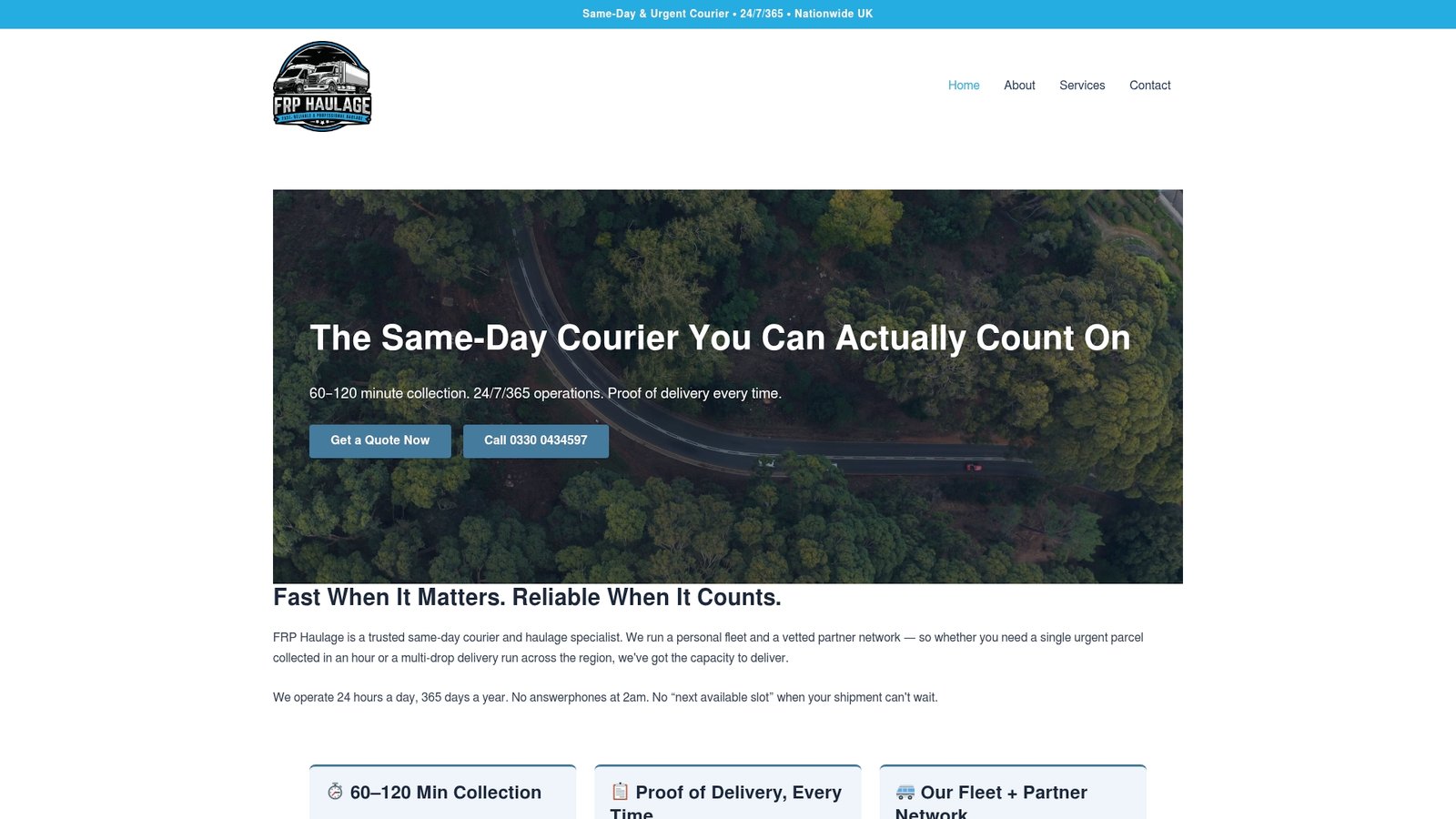
Frphaulage gives UK logistics teams a concrete operational option for same-day and scheduled multi-pickup runs, with collection within 60–120 minutes of booking, 24/7/365. The service combines a personal fleet with a vetted partner network, so surge capacity is available without a new contract. Every shipment carries a signed proof of delivery, giving you the documentation trail that supplier SLAs and quality audits require.
For manufacturers, distributors, and logistics managers ready to pilot a milk-run route, Frphaulage offers regional and national multi-drop delivery alongside scheduled business account runs and high-value cargo handling. That breadth means you can start with a three-stop pilot and scale to a full supplier network without switching carriers.
Contact Frphaulage for a pilot quote or route feasibility review, and read the complete courier selection guide to understand exactly what to specify before you brief any carrier.
Sources
- Route optimization — milk run method – Axes Software
- Milk Run in Logistics: Meaning, Pros, & Cons — ShipBob
- Milk Run logistics: benefits, challenges and best practices — Shiptify
- Milk run — Wikipedia