Controlling deliveries across multiple sites comes down to one operating model: central coordination, enforced booking slots, consistent site rules, and a delivery management tool that captures proof of delivery on every drop. Appoint a single booking owner this week and lock your first-week site windows before you touch anything else. HSE guidance, a proper delivery management system, and a managed courier partner like FRP Haulage exist to backstop that model when things go wrong.
TL;DR:
- Using a single delivery owner and fixed booking windows helps prevent schedule drift and improves site coordination and accountability.
- Batching deliveries is cost-effective only when sites are geographically clustered, urgent, or oversize; time-sensitive or restricted access deliveries should go direct.
- Implementing contingency plans with buffers and standby options minimizes disruptions caused by delays or cancellations across multiple sites.
- Compliance requires tracking local restrictions, vehicle sizes, and duty of care documentation, which vary by area and impact scheduling and logistics decisions.
- A reliable courier partner supports rapid response, proof of delivery verification, and tracking, reducing the need for increased internal headcount during disruptions.
Table of Contents
- Your multi-site delivery checklist for this week
- How do you plan deliveries across multiple sites?
- What booking rules should you set for suppliers?
- When should you batch deliveries instead of sending them direct?
- What HSE risks apply to multi-site deliveries?
- Which systems actually help with multi-site fulfilment?
- How do you handle delays and cancellations across sites?
- What compliance rules affect multi-site delivery in the UK?
- Publisher perspective: when a managed courier partner earns its place
- How FRP Haulage supports multi-site delivery operations
- Sources
Your multi-site delivery checklist for this week
Getting multi-site deliveries under control doesn’t require new software on day one. It requires sequence.
- Map every site with its address, access restrictions, and a named on-site contact.
- Assign one delivery owner who books, tracks, and answers supplier queries across all sites.
- Set fixed delivery windows per site and put booking rules in writing for every supplier.
- Decide your consolidation threshold (how many drops before batching beats direct delivery) and lock in recurring routes where demand is predictable.
- Require signed proof of delivery on every job and set up a simple non-conformance log for missed or damaged deliveries.
- Trial the new rules for one week with two or three key suppliers before rolling out fleet-wide.
That sixth step matters more than people expect. A one-week pilot exposes friction (a supplier who ignores slot windows, a site with no phone signal for confirmations) before it costs you a full month of chaos.
How do you plan deliveries across multiple sites?
Someone has to own the calendar. You have two real options: a central coordinator who books every slot across every site, or delegated booking where each site manager handles their own suppliers within shared rules.
Central coordination wins for consistency and reporting; it’s harder to scale past a certain number of sites without dedicated headcount. Delegated booking scales more easily but risks drift, where one site quietly renegotiates its own delivery windows and breaks the schedule everyone else relies on.
Whichever model you choose, timeline mapping needs the same rigour:
- Flag critical-path items (concrete pours, steel deliveries, time-sensitive components) and sequence everything else around them.
- Build in buffer time for late arrivals rather than stacking deliveries back to back.
- Require suppliers to confirm bookings in writing, with vehicle type and load details attached.
- Set a clear escalation rule: who gets called, and when, if a delivery is more than 30 minutes late.
Pro Tip: Give every site manager the same one-page delivery protocol. When the rules live in someone’s head rather than on paper, the first person on holiday becomes your biggest supply chain risk.
For construction-specific detail, our construction site delivery guide covers site-level controls in more depth.
What booking rules should you set for suppliers?
Slot management is where most multi-site operations lose time. Vague delivery windows (“morning” or “sometime Thursday”) invite queuing, wasted labour, and drivers turning up when nobody’s ready to receive them.
- Set slot windows in fixed increments (30 or 60 minutes), not half-days.
- Define how much notice a supplier needs to give for a slot change, and cap how many changes are allowed per week.
- Use a delivery management system that confirms bookings automatically, tracks ETA against the confirmed slot, and stores proof of delivery against the job record.
- Write a same-day escalation path into supplier terms: if a scheduled slot is missed, urgent replacement stock moves to a same-day courier, not the next standard run.
- Include a basic SLA in every supplier agreement: confirmation within two hours of booking, ETA notification 30 minutes before arrival, and signed proof of delivery on every drop.
Suppliers who can’t meet those terms consistently are telling you something about their reliability before a missed delivery does it for you.
When should you batch deliveries instead of sending them direct?
Multi-drop batching cuts cost, but not every delivery should be batched. Platforms offering multi-stop delivery report significant per-delivery cost reductions for routes with multiple stops in a tight geographic cluster, driven by fewer separate journeys and better vehicle fill.
Use these rules to decide:
- Batch when volume is moderate, urgency is low, and sites sit within a sensible drive-time radius of each other.
- Send direct when a delivery is time-critical, oversized, or the receiving site has restricted access windows that don’t line up with a shared route.
- Sequence stops by drop-off time sensitivity first, distance second. Getting this backwards is the single most common routing mistake site managers make.
- Use recurring routes for predictable weekly deliveries and dynamic routing only for genuine one-off or reactive requests.
Academic modelling of multi-hop routing and combined loads found utilisation gains of roughly 20% over naive direct routing in simulated fleet comparisons, largely from reduced cruising time between stops.
That gain came from smarter sequencing, not more vehicles. Most multi-site operations already have the fleet capacity they need; they just route it badly. Our guide to multi-drop delivery routes covers the optimisation side in more detail.
What HSE risks apply to multi-site deliveries?
Running deliveries across several sites multiplies your exposure to the same hazards you’d manage on one site, just in parallel. HSE guidance on multi-site delivery risk flags manual handling, working at height, and vehicle movement as the recurring hazards, and recommends a risk assessment per site rather than one blanket policy.
Practical controls that actually get followed:
- Segregate pedestrian and vehicle routes at every site, not just the ones with obvious traffic.
- Brief drivers on site-specific access rules before they arrive, not on arrival.
- Use POD and goods-in acceptance checks as your traceability layer. If something’s damaged or short, the record shows exactly when and where.
- Log near-misses (a reversing vehicle, a blocked fire exit) and review them monthly across all sites, not just the one where it happened.
A near-miss at one site is often a warning about every other site running the same layout.
Which systems actually help with multi-site fulfilment?
A delivery management system earns its cost if it does four things well: slot booking, ETA and POD capture, reporting across sites, and integration with whatever you already run for stock and finance.
- Require slot booking that suppliers confirm themselves, not one your team chases by phone.
- Insist on ETA tracking and digital POD capture tied to each job, not a paper docket that gets lost in a van.
- Check integration with your ERP, inventory system, and carrier accounts before signing anything.
- Monitor KPIs by site: on-time percentage, missed-slot rate, and cost per delivery.
For businesses running true multi-origin shipping, the system needs to decide whether to ship from the nearest origin or the fewest possible origins. That choice affects whether a customer sees split shipments and multiple delivery dates at checkout, which matters if any of your sites also fulfil customer orders directly. Distributed fulfilment makes sense once you’re running enough sites that positioning stock closer to demand cuts more cost than it adds in complexity; below that scale, central dispatch is usually simpler and just as fast. Vehicle tracking tools like those covered in LRD Track’s guide add a layer of live visibility on top of whatever booking system you choose.
How do you handle delays and cancellations across sites?
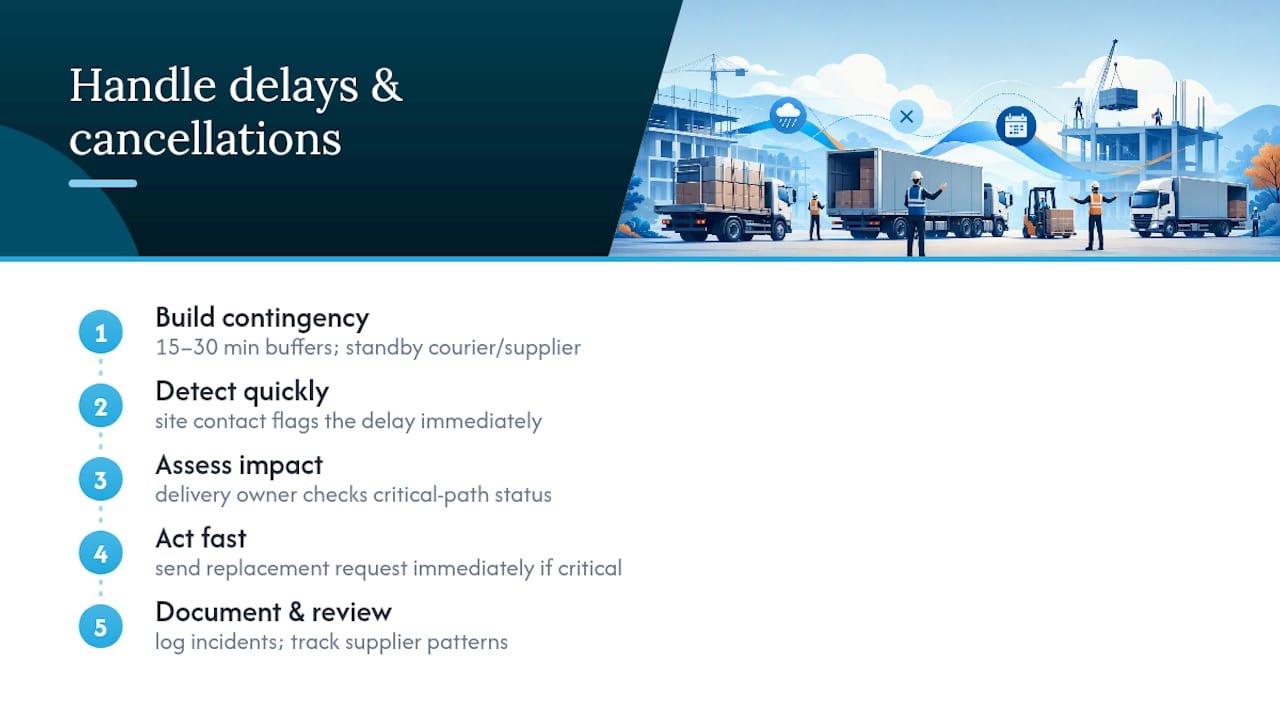
Every multi-site operation eventually loses a delivery to a cancelled slot, a broken-down vehicle, or a supplier who simply doesn’t show. The difference between a minor disruption and a lost day is whether you planned for it before it happened.
Build contingency into the schedule itself rather than treating every delay as a surprise. A buffer of 15 to 30 minutes between deliveries at the same site absorbs small slippage without cascading into every booking after it. For critical items (structural components, time-sensitive materials), keep a second supplier or a same-day courier on standby rather than discovering the gap when the truck doesn’t arrive.
When a delay does happen, the escalation chain needs to move fast: the site contact flags it, the delivery owner checks whether the item is critical-path, and if it is, the replacement request goes out immediately rather than after a round of phone calls trying to establish blame. Document every cancellation and delay against the supplier record. Patterns matter more than individual incidents. A supplier who’s late once is unlucky; a supplier who’s late every third delivery is a scheduling risk you’re carrying without pricing it in.
Cancellations at short notice cost more in wasted labour than the material itself. If a delivery falls through on a day when a crew is standing by to receive it, that’s the moment a same-day courier earns its fee many times over, because the alternative is a stalled site and idle wages.
What compliance rules affect multi-site delivery in the UK?
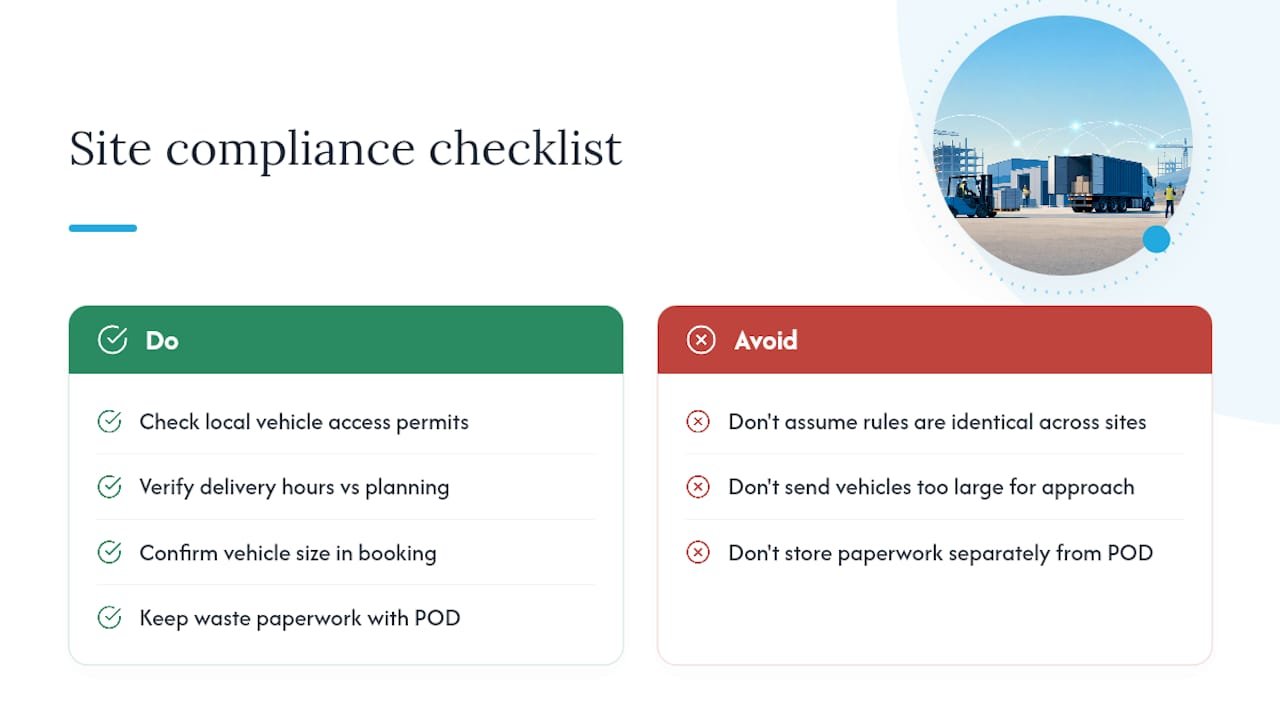
Running deliveries across several sites brings you into contact with rules that don’t apply the same way to a single fixed location. Vehicle access permits, loading restrictions, and local traffic management orders vary by council area, and what’s allowed outside one site may be restricted at another only a few miles away.
Construction sites in particular often need to check delivery hours against local planning conditions; some boroughs restrict HGV movements during specific hours to manage residential noise and congestion. Getting this wrong doesn’t just risk a fine, it risks a driver turning up to a site they legally can’t unload at, which cascades straight back into the delay problem above.
Weight limits and vehicle restrictions on approach roads matter just as much as site-level rules. A supplier booking a vehicle that’s too large for the access route wastes a slot and creates a knock-on delay for everyone booked after them, so vehicle specification needs to be part of every booking confirmation, not an afterthought.
Waste transfer and duty of care documentation also applies where deliveries involve returning materials or packaging from site. Keep this paperwork with your proof of delivery records rather than as a separate system. When several sites are involved, one central compliance file per site, checked quarterly, catches drift before an inspection does.
Publisher perspective: when a managed courier partner earns its place
The failure modes that break a schedule are predictable: a supplier misses a slot, a critical component runs late, or a site simply can’t wait for the next scheduled run. That’s the point where signed proof of delivery, a vetted driver, and a named point of contact stop being nice extras and start being the difference between a stalled site and a solved problem. FRP Haulage’s model exists for exactly that gap.
— Catalin
How FRP Haulage supports multi-site delivery operations
FRP Haulage exists for the moment your central plan hits a gap. When a supplier misses a slot or a critical component runs late across sites, waiting for the next scheduled run isn’t an option. Rapid collection within 60 to 120 minutes, a personal fleet backed by a vetted partner network, and signed proof of delivery on every job mean you get the same accountability your internal booking system demands, without adding headcount to cover exceptions.
Before requesting a quote, have your site addresses, load sizes, delivery windows, and any vehicle access restrictions ready. That’s the same information your delivery management system already holds, so pulling it together takes minutes, not a planning meeting. Multi-drop runs across regions, single urgent parcels, and scheduled account work all run on the same proof-of-delivery standard, so your reporting stays consistent whether it’s a routine drop or a same-day rescue.
Read how the process works from call to delivery, then get in touch to book a slot or request a quote for your next multi-site run.
Sources
The HSE risk findings referenced above come from RTITB’s summary of multi-site delivery hazards, a useful starting point for any site-level risk assessment. For the technical side of multi-origin fulfilment, ShipperHQ’s setup documentation explains how origin logic affects split shipments and rates. The routing efficiency figures cited in this guide draw on Purdue’s distributed delivery fleet research, and multi-stop savings estimates come from Getcho’s platform data.
- Distributed delivery fleet research (multi-hop routing & combined load)
- Set up multi-origin shipping to optimize order fulfillment (ShipperHQ docs)
- Multi-stop delivery | Getcho
- What is distributed fulfillment? A guide to decentralized order fulfillment