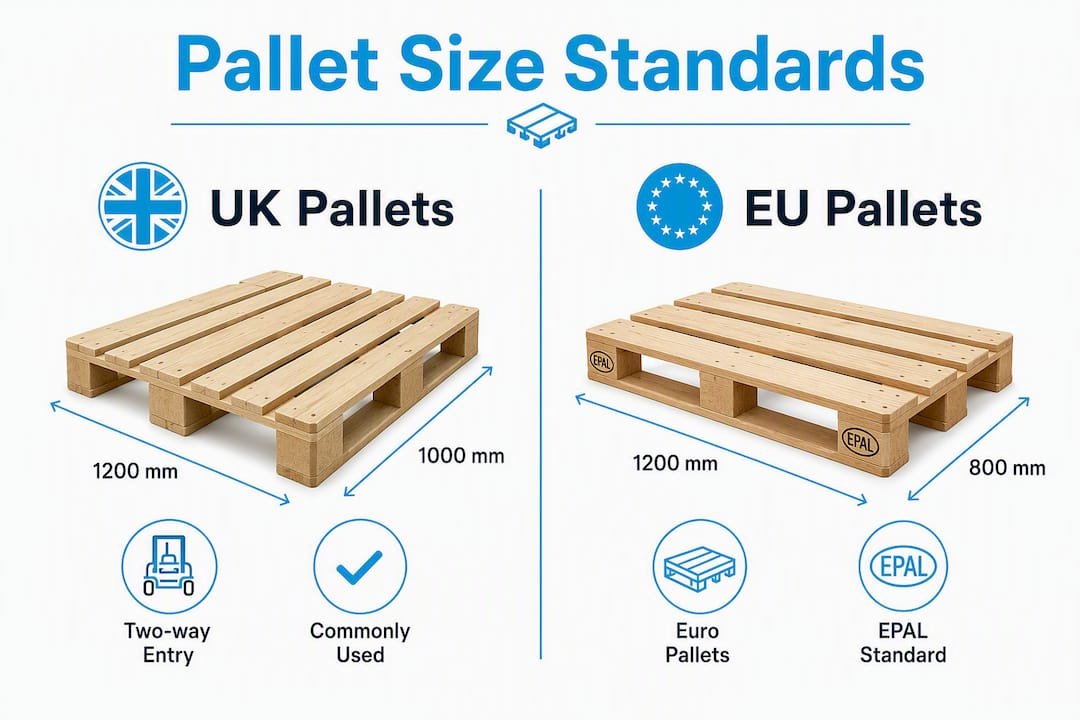
The two footprints you will encounter on almost every UK and European loading dock are 1200×1000 mm (the industrial or UK pallet) and 1200×800 mm (the Euro/EPAL pallet). Before you book transport, confirm the exact footprint in millimetres with the consignee or warehouse — not just “a standard pallet,” because that phrase means different things to different receivers.
Quick footprint reference:
- 1200×1000 mm (47.2×39.4 in) — UK/industrial, dominant in British manufacturing and distribution
- 1200×800 mm (47.2×31.5 in) — Euro/EPAL (EUR-1), the most common footprint across continental Europe
- 1219×1016 mm (48×40 in) — North American GMA, common in US supply chains, less compatible with European racking
- 1100×1100 mm (43.3×43.3 in) — widely used in Asia-Pacific
Confirm the receiver’s preferred footprint and check their racking or ASRS specification before booking. A mismatch at the delivery dock is expensive to fix after the lorry has left.
Table of Contents
- What are the standard pallet sizes used in the UK and Europe?
- How do full, half, and quarter pallets work, and how do you measure a consignment?
- What does ISO 6780 define, and why does it matter for cross-border shipments?
- Which pallet footprint should you use for common UK shipping scenarios?
- How does pallet classification affect courier and haulage quoting in the UK?
- Key takeaways
- A logistics operator’s note on pallet choices and common pitfalls
- Frphaulage: same-day pallet collection across the UK
- Useful standards and reference links
What are the standard pallet sizes used in the UK and Europe?
The table below covers the footprints you are most likely to quote or ship on. Load guidance figures reflect typical industry references; always verify with your pallet supplier for certified ratings.

| Footprint (mm) | Footprint (in) | Common name / standard | Typical industries | Typical max load guidance |
|---|---|---|---|---|
| 1200×800 | 47.2×31.5 | Euro pallet / EUR-1 / EPAL | Retail, grocery, FMCG, continental export | — |
| 1200×1000 | 47.2×39.4 | UK/Industrial / EUR-2 | Manufacturing, automotive, heavy goods, UK DC | — |
| 1219×1016 | 48×40 | GMA / North American standard | US domestic, transatlantic import/export | — |
| 1100×1100 | 43.3×43.3 | ISO 6780 / Asia-Pacific | Chemical, beverage, Asia-Pacific trade | — |
| 1140×1140 | 43.3×43.3 | Australian standard | Australia/NZ export, some mining | — |
The EPAL Euro pallet is commonly quoted at 1200×800×144 mm with a tare weight of around 25 kg. The 1200×1000 mm industrial pallet is taller in some constructions — CHEP’s wooden variant, for example, measures 1200×1000×162 mm.
Manufacturing tolerances are worth noting. Pallet deck dimensions can vary by ±3 mm in length and width under typical production tolerances, which matters when you are loading tight container configurations or fitting automated racking. Always measure the actual pallet rather than relying on the nominal size alone.
Quick mm-to-inch conversion for the most used footprints
| Size (mm) | Length (in) | Width (in) |
|---|---|---|
| 1200×800 | 47.2 | 31.5 |
| 1200×1000 | 47.2 | 39.4 |
| 1219×1016 | 48 | 40 |
| 1100×1100 | 43.3 | 43.3 |
How do full, half, and quarter pallets work, and how do you measure a consignment?
UK carriers classify pallet consignments primarily by footprint and total height. The height tiers below are typical across UK pallet networks, though individual carriers set their own thresholds — always check with your specific provider.
- Quarter pallet: 1200×800 mm or 1200×1000 mm footprint, up to approximately 500 mm tall (pallet plus load)
- Half pallet: same footprints, typically 500–1000 mm total height
- Full pallet: typically 1000–1800 mm total height
- Oversize: anything exceeding 1800 mm in total height, or a non-standard footprint, usually requiring a bespoke quote
Pallet deck height itself is typically 140–160 mm depending on whether the pallet is two-way or four-way entry construction. That baseline matters when you calculate total consignment height.
How to measure correctly

Measure the footprint as the top-deck length multiplied by width. Then measure total height from the floor to the highest point of the load, including any shrinkwrap, strapping, or corner boards. Overhang — where the load extends beyond the pallet deck edge — should be declared separately; most carriers will not accept more than 50 mm overhang without prior agreement.
Example 1: A 1200×1000 mm pallet carrying automotive parts, wrapped to 900 mm total height. Record as: 1200×1000 mm, 900 mm high, full pallet tier.
Example 2: A 1200×800 mm pallet with retail goods at 450 mm total height. Record as: 1200×800 mm, 450 mm high, quarter pallet tier.
Example 3: A 1200×1000 mm pallet stacked to 1,650 mm with boxed machinery. Record as: 1200×1000 mm, 1,650 mm high, full pallet (approaching oversize — confirm with carrier before booking).
Pro Tip: When measuring shrinkwrapped loads, press the tape against the outer film at the highest point, not the product beneath. Strapping and corner boards add real height. For nested or interlocked stacks, measure the assembled height as a single unit and declare it that way — carriers price on the total, not the theoretical single-layer height.
What does ISO 6780 define, and why does it matter for cross-border shipments?
ISO 6780:2003 is the international standard that specifies principal dimensions and tolerances for flat pallets used in intercontinental materials handling. It covers new single-deck and double-deck, reversible and non-reversible pallets of any material, defining the sizes, clearances, and construction features required for safe handling by pallet trucks, fork-lift trucks, and automatic handling systems.
The standard recognises six approved footprints:
- 1200×800 mm (Euro/EPAL)
- 1200×1000 mm (UK/industrial)
- 1219×1016 mm (North American GMA)
- 1067×1067 mm
- 1100×1100 mm (Asia-Pacific)
- 1140×1140 mm
The practical implication for cross-border shipments is significant. A GMA 48×40 in pallet (1219×1016 mm) is the dominant size in North American domestic circulation but is often incompatible with European racking systems and ASRS installations designed around 1200×800 mm or 1200×1000 mm footprints. Importing goods on GMA pallets into a UK or European DC may require manual re-palletising at the point of receipt, adding cost and handling time.
Container utilisation is the other consideration. ISO and industrial footprints often maximise space in standard ISO containers compared with narrower Euro pallets, so the right footprint choice depends on the primary transport leg, not just the destination warehouse.
Which pallet footprint should you use for common UK shipping scenarios?
The short answer: match the footprint to the destination’s handling equipment, not to what you happen to have in stock.
- Retail and distribution centre deliveries: Most UK supermarket and retail DCs specify either 1200×800 mm or 1200×1000 mm. Confirm the inbound pallet policy with the receiver before despatch. Supplier shipments on the wrong pallet size frequently trigger chargebacks at the recipient DC, so this check is worth a phone call.
- Manufacturing and heavy goods: The 1200×1000 mm footprint is the default for UK manufacturing, automotive, and engineering supply chains. Its larger deck area handles heavier, bulkier loads and fits most UK warehouse racking.
- Container export: For full-container-load (FCL) shipments, choose a footprint that maximises container utilisation. Industrial 1200×1000 mm footprints frequently give better utilisation in ISO containers than 1200×800 mm Euro pallets — though the receiver’s racking must also accommodate the size.
- Same-day and local courier collections: Footprint still matters. Declare the exact mm dimensions when booking; a same-day vehicle loaded for a tight multi-drop run cannot accommodate an undeclared oversize pallet without disrupting other collections.
Pro Tip: If the receiver’s warehouse runs a tight ASRS or narrow-aisle racking system, ask for their pallet specification sheet before you load. Transloading at origin onto the correct footprint costs far less than a refused delivery or a chargeback. The future of same-day delivery increasingly involves automated sortation at DCs, which makes footprint accuracy more critical, not less.
How does pallet classification affect courier and haulage quoting in the UK?
Carriers price pallet consignments on four variables: footprint, total height, gross weight, and condition. Get any one of those wrong on the booking form and you will face either a surcharge or a refused collection.
Here is how to prepare a pallet consignment for same-day collection:
- Measure the footprint in mm (length × width of the top deck). Note any overhang.
- Measure total height from floor to the highest point of the wrapped load, including all packaging materials.
- Weigh the consignment including the pallet tare. Declare gross weight, not net product weight.
- Photograph the pallet from two angles before the driver arrives — footprint visible, label readable, height evident. This speeds any claims and reduces dock-acceptance delays.
- Declare special items — hazardous goods, fragile loads, high-value cargo, or temperature-sensitive products — at the time of booking, not on collection.
- Book with the correct footprint and height tier. Selecting “full pallet” when the load is 450 mm tall wastes money; selecting “quarter pallet” for a 1,400 mm load will cause a surcharge or refusal.
Frphaulage collects pallet consignments across the UK with rapid collection typically within 60–120 minutes of your call, 24/7/365. Every shipment carries a signed Proof of Delivery, which gives you documentary evidence of safe arrival — useful when a DC queries receipt. When choosing a same-day courier for pallet work, confirm that the provider can handle your specific footprint and height tier before booking.
Pro Tip: Photograph the pallet label alongside a tape measure showing the height. That single image resolves the majority of dimension disputes before they become formal claims.
Key takeaways
The two footprints that cover the vast majority of UK and European pallet shipments are 1200×1000 mm and 1200×800 mm — confirm which one the receiver expects before you book.
| Point | Details |
|---|---|
| Confirm footprint in mm | Always state the exact mm dimensions (e.g. 1200×1000 mm) — “standard pallet” is ambiguous and can trigger chargebacks. |
| Measure total height with packaging | Include shrinkwrap, strapping, and corner boards; carriers price on total consignment height, not product height. |
| Check receiver pallet preference | Retail DCs, ASRS systems, and narrow-aisle racking each have specific footprint requirements — verify before loading. |
| ISO 6780 governs cross-border sizes | The standard defines six approved footprints; GMA 48×40 in pallets may need re-palletising for European DC entry. |
| Frphaulage for urgent UK collections | Frphaulage offers same-day pallet collection across the UK with signed Proof of Delivery and 24/7 availability. |
A logistics operator’s note on pallet choices and common pitfalls
The single most avoidable cost in UK pallet freight is the wrong footprint. Operators see it repeatedly: a shipper books a “standard pallet,” the driver arrives to find a 1200×1000 mm load destined for a DC that only accepts 1200×800 mm, and the consignment either bounces back or sits in a holding bay while someone arranges re-palletising. That delay on a same-day job is not recoverable.
The subtler version of the same problem is unreported height. A load declared as a half pallet that actually measures 1,100 mm tall will be reclassified on arrival, and the surcharge lands after the goods have moved. Photograph the pallet before collection, declare the actual height, and confirm the receiver’s inbound spec. Those three steps eliminate most of the friction I see in UK pallet movements. The footprint conversation with the consignee takes two minutes; the chargeback conversation takes two weeks.
Frphaulage: same-day pallet collection across the UK
When the dimensions are confirmed and the goods are ready, the next question is who picks them up. Frphaulage operates same-day pallet collection across the UK, with collection typically within 60–120 minutes of your call, around the clock, every day of the year.
Every pallet movement comes with a signed Proof of Delivery, so you have documentary evidence of safe arrival at the destination dock — particularly useful when shipping to retail DCs where inbound compliance is audited. The service covers urgent single-pallet collections, multi-drop pallet runs, and white-glove handling for high-value or fragile freight.
Specific services relevant to pallet shippers:
- Urgent same-day pallet collection (60–120 minute response)
- Signed Proof of Delivery on every shipment
- White-glove and high-value cargo handling
- Multi-drop pallet delivery across UK regions
- 24/7/365 availability, including bank holidays
To book a collection or get a quote for your next pallet shipment, visit Frphaulage’s services page or call the team directly.
Useful standards and reference links
- ISO 6780:2003 — Flat pallets for intercontinental materials handling: the primary international standard defining approved pallet footprints and tolerances.
- ISO 6780:2003 full specification (iTeh Standards): detailed scope, dimensions, and clearance requirements.
- Standard pallet sizes — Palguru: regional size comparison covering North America, Europe, Asia, and Australia.
- Standard pallet sizes — SizeMarker: EPAL Euro pallet dimensions and load guidance reference.
- Pallet size and dimensions — BRF Logistics: container utilisation and shipping guide.
- Pallet sizes dimensions chart — Florida Pallet Supply: GMA pallet dimensions and chargeback context.
- Standard pallet dimensions — DFH Freight: deck height and construction reference.