The RHA Conditions of Carriage cap a haulier’s liability for loss or damage, but only when they’re properly built into the contract before the job starts. Membership authorises you to use them; using them without membership risks a copyright dispute. Get the incorporation wrong and that cap disappears, leaving you exposed to the full replacement value of the goods under common law.
TL;DR:
- Proper incorporation of the RHA Conditions requires explicit reference, full-text attachment, and written acceptance before the contract is finalized.
- The £1,300 per tonne cap only applies if the Conditions are validly incorporated, or else liability can extend to full goods value plus damages.
- New clauses emphasize clear responsibilities on loading, welfare, and evidence collection to reduce disputes and improve operational compliance.
- Accurate documentation, including photographs, weight declarations, and site non-compliance logs, is critical for supporting claims and ensuring enforcement of the Conditions.
- The main risk lies in operational failure to follow procedural steps, not just the liability cap, making paper trail robustness essential for legal protection.
Table of Contents
- What are the headline changes in the 2024 RHA Conditions of Carriage?
- How do you incorporate the RHA Conditions into a haulage contract?
- What does the £1,300 per tonne liability cap actually cover?
- Who is responsible for loading, unloading and site safety?
- What are the time limits for making an RHA claim?
- A working checklist for logistics teams handling RHA-based contracts
- Where to find the RHA Conditions and related guidance
- Why most hauliers underestimate incorporation risk
- Sources
What are the headline changes in the 2024 RHA Conditions of Carriage?
The Road Haulage Association’s 2024 revision reshaped several clauses that matter day to day, not just in a dispute. If your contract templates still reference an older edition, you’re working from rules that no longer match what a court will expect.
- Condition 4 now sets out fuller customer obligations for loading and unloading, including suitable, well-maintained equipment and properly trained operators, plus stronger carrier inspection rights before goods move.
- Condition 5 adds detail on information duties, and introduces welfare access expectations, meaning customer sites should offer basic facilities to visiting drivers.
- Condition 6 clarifies proof of delivery rules and restricts customers from withholding carrier charges on flimsy pretexts.
- Condition 14 tightens evidence requirements and shortens the practical window for raising a claim, so slow paperwork now carries more risk.
Industry briefings from firms advising on the sector broadly agree the 2024 update reflects current operational risk rather than rewriting the Conditions from scratch. Treat it as a refresh of expectations already implicit in how good operators run sites, not a wholesale change of philosophy.
How do you incorporate the RHA Conditions into a haulage contract?
Incorporation is where most disputes actually get decided, long before anyone argues about the £1,300 figure. Legal commentary is blunt on this: courts expect clear evidence the customer agreed to the specific terms before the contract was formed, not after the van has left. A line on the back of an invoice, printed once the job is already done, generally won’t hold up.
- Reference the Conditions explicitly in the quote or booking confirmation, before the customer commits.
- Attach or link the full text of the Conditions to that same document, not a summary.
- Get written acceptance, whether that’s a signed order form, a ticked box, or an email reply confirming terms.
- Repeat the reference on the consignment note, so the paperwork on the day matches what was agreed at booking.
- Store the acceptance record somewhere retrievable, ideally against the job number in your transport management system.
Pro Tip: Quote the Conditions verbally during rate negotiations too, not just in writing. RHA guidance specifically recommends this, partly because it nudges customers toward arranging their own goods-in-transit cover for anything the standard cap wouldn’t cover.
Draft your standard wording once, get it checked by whoever handles your commercial contracts, and stop relying on individual sales staff to remember the phrasing on every call.
What does the £1,300 per tonne liability cap actually cover?
The cap applies per tonne of the consignment, and in practice it determines the extent of a haulier’s liability for claims. Without valid incorporation, that ceiling doesn’t exist at all: a carrier could be liable for full replacement value plus consequential losses, which is a materially worse outcome.
A haulier carrying 8 tonnes of goods under properly incorporated Conditions faces a maximum exposure of roughly £10,400 for that load, regardless of the goods’ actual market value, unless the parties have agreed a different figure.
The cap has real gaps. It doesn’t extend to consequential losses, such as a customer’s lost production time or a missed contract penalty, and it can leave a badly undervalued claim if the consignment is small but expensive. Two contrasting scenarios show why:
- A pallet of electronic components worth £40,000, weighing 200kg: the cap might apply at a fraction of a tonne, leaving the customer badly under-covered if damaged.
- A 20-tonne bulk load of low-value building aggregate: the cap sits comfortably above the goods’ actual value, so it rarely becomes the limiting factor.
For anything in the first category, agree a declared value in writing, or point the customer towards proper cargo insurance rather than relying on the Conditions to do a job they were never designed for. The Conditions regulate liability; they don’t provide insurance, and Hill Dickinson’s commentary makes that distinction explicit for both parties.
Who is responsible for loading, unloading and site safety?
Under the 2024 Conditions, the customer carries primary responsibility for loading and unloading unless the carrier has specifically agreed to take it on. That includes providing suitable, well-maintained equipment and staff who actually know how to use it, not just bodies on the yard.
Carriers retain the right to refuse an unsafe site outright. If a driver does step in to help load or unload, that assistance typically comes with an indemnity arrangement protecting the carrier for damage caused by the customer’s faulty equipment or untrained staff.
- Check access conditions and hardstanding before committing a vehicle, not after it’s stuck.
- Confirm welfare provision exists for drivers waiting on site, particularly for longer loading windows.
- Photograph any hazard, obstruction, or missing equipment the moment it’s spotted.
- Log a refused or delayed job in the transport management system with a timestamp and reason code, not just a note to the driver’s file.
Pro Tip: Train drivers to record site non-compliance on the proof of delivery itself, even for jobs that ultimately go ahead. A POD that simply says “site access poor, driver assisted loading” is worth more in a dispute than a verbal recollection six weeks later.
What are the time limits for making an RHA claim?
Condition 14’s tightened evidence requirements mean the first hour after suspected loss or damage matters more than it used to. Miss the early steps and a claim that should succeed can fail purely on paperwork.
- Isolate the affected goods immediately and photograph the damage before anything is moved or repackaged.
- Note the exact time, location, and condition on the proof of delivery, with the customer’s signature if possible.
- Notify your insurer promptly where the loss looks significant, rather than waiting to see if the customer complains.
- Expect the customer to raise formal notice within the deadline set by Condition 14. Late notification is one of the most common reasons claims collapse.
- Retain driver statements, weight declarations, and electronic tracking data rather than relying on memory weeks later.
- Escalate to a broker or solicitor once documentary evidence and financial exposure suggest the claim is heading towards dispute rather than routine settlement.
A working checklist for logistics teams handling RHA-based contracts
Getting the legal wording right means little if the people booking jobs and driving vehicles don’t follow through on the ground. Frphaulage builds incorporation checks and evidence capture into daily dispatch practice, because a contract clause is only as strong as the paperwork behind it.
- Before quoting, confirm the customer has received the current Conditions and reference them in writing.
- Have drivers photograph goods condition at collection and delivery as standard, not just when something looks wrong.
- Record weight declarations against each consignment note, since the per-tonne cap depends on an accurate figure.
- Log every site refusal or safety concern in the transport management system with time, location and reason.
- Set an internal escalation trigger, for example three days of silence after a customer flags damage, to move a file to broker or legal review automatically.
| Action | Owner | When |
|---|---|---|
| Send Conditions with quote | Sales/dispatch | Before booking confirmed |
| Photograph goods at collection/delivery | Driver | Every job |
| Log weight declaration | Dispatcher | At booking |
| Record site non-compliance | Driver/dispatcher | On occurrence |
| Escalate unresolved claim | Operations manager | After deadline lapses |
Building this into a proof of delivery process that customers can trust is worth doing properly. Frphaulage’s approach to documented chain of custody reflects exactly this discipline, applied to sensitive and high-value freight.
Where to find the RHA Conditions and related guidance
The current text and membership guidance sit on the RHA’s own Conditions of Carriage page, which also covers who may lawfully use the terms. Birketts’ legal update offers a clear breakdown of incorporation pitfalls that trip up otherwise well-run operators. Hauliers wanting a broader comparison point, such as how the Conditions sit alongside CMR or general industry model terms, can consult Logistics UK’s model conditions of carriage for a sector-wide reference.
Why most hauliers underestimate incorporation risk
The conventional advice on RHA Conditions focuses almost entirely on the £1,300 figure, as if the cap were the whole story. It isn’t. The real exposure sits earlier, in whether the Conditions were ever validly part of the contract in the first place. A haulier can quote the right number to a customer and still lose a dispute because the paperwork trail doesn’t show the customer had a genuine chance to see and accept the terms before the job began.
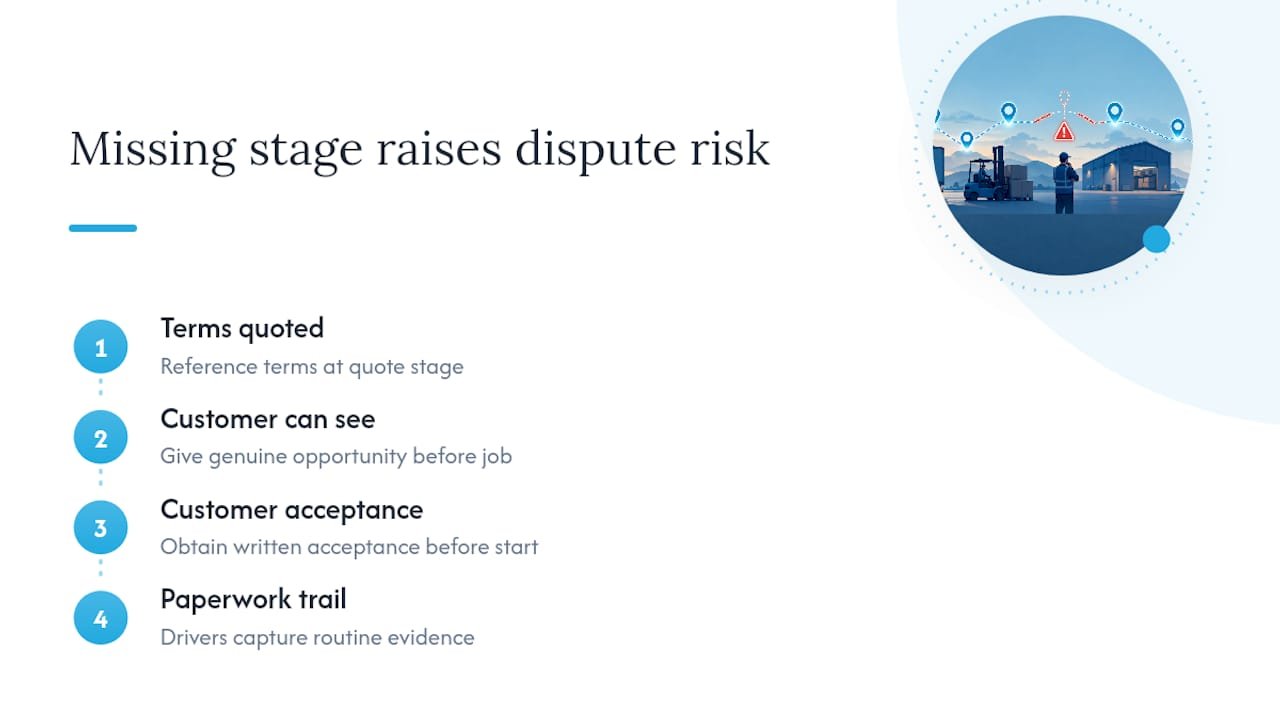
What gets overlooked is how operational the 2024 changes really are. Clauses on loading equipment, site welfare, and evidence timing aren’t abstract legal text. They’re a checklist for how a yard should run on an ordinary Tuesday, treating them as something the legal team deals with after a claim, rather than something dispatch enforces before every job, is the single most common mistake.
If there’s one priority, it’s this: fix the paper trail before worrying about the cap. Get the Conditions referenced at quote stage, get written acceptance, and train drivers to capture evidence as routine, not as a reaction to trouble. The cap only protects a haulier who can prove it applied in the first place.
— Catalin
Sources
- RHA Conditions of Carriage
- Incorporating RHA Conditions into haulage contracts
- RHA Conditions of Carriage 2024 Update | Hill Dickinson