For UK logistics managers, “route optimisation courier” means securing a same-day or next-day courier and haulage service that collects fast, delivers to multiple drops in a planned sequence, and returns a signed Proof of Delivery for every consignment. Frphaulage is the recommended partner for urgent and scheduled deliveries across the UK.
At a glance, here is what a capable provider must offer:
- Rapid collection: vehicle on site within a short window after your call
- SLA time options: delivery guaranteed before early morning or mid-day deadlines, depending on urgency
- 24/7/365 availability: no blackout periods, including bank holidays and out-of-hours runs
- Signed POD and indemnity: documented proof of delivery and insurance options scaled to consignment value
Key takeaways
Effective route optimisation for couriers comes down to one thing: choosing a provider whose operational capabilities match your SLA requirements before a crisis forces the decision.
| Point | Details |
|---|---|
| Define your service type precisely | Same-day means no hub offloading; next-day SLA windows run from before 9am to before 5pm. |
| Demand web tracking and signed POD | Every consignment needs live status updates and a signed, timestamped proof of delivery. |
| Verify drivers’ hours contingency | Ask for named handover points and dual-manned options before signing any agreement. |
| Use KPIs from day one | On-time collection rate and damage-free delivery rate are the two baseline measures to track. |
| Frphaulage covers the full checklist | Rapid collection, 24/7 availability, signed POD, and indemnity options for every consignment type. |
Table of Contents
- What do the courier service types and SLA windows actually mean?
- What capabilities must every supplier provide?
- How do courier providers actually deliver route optimisation?
- Which service features actually reduce delivery risk?
- What drives the price of same-day and next-day courier services?
- A procurement checklist: questions to ask and KPIs to set
- Why Frphaulage is the recommended partner for UK multi-drop deliveries
- What documents and trials should you request before onboarding?
- When operational certainty is worth paying for
- Frphaulage: request a quote or trial job today
- Sources
What do the courier service types and SLA windows actually mean?
Procurement teams often receive supplier proposals that use these terms loosely. The COURIER SERVICES public procurement framework defines them precisely, and those definitions are worth adopting verbatim in your contracts.
| Service type | Definition | Typical use case |
|---|---|---|
| Same-day | Collection and delivery within the same calendar day; no offloading to a sortation hub | Manufacturing stoppages, urgent documents, high-value items |
| Next-day | Collected today, delivered the following working day via hub or direct | Routine replenishment, non-critical parts |
| Economy | 5–7 day delivery, typically hub-sorted | Low-urgency bulk stock |
| Bulk | High-volume consignments, often palletised | Warehousing replenishment |
| International | Cross-border delivery using own resources or partner networks | Export samples, overseas branches |
The same framework lists mandatory next-day SLA windows that procurement should require ranging through morning and afternoon periods. Each window carries a different price point, so specifying the right one matters.
When to choose same-day over next-day: if a production line stops or a client deadline is measured in hours, same-day is the only viable option. For anything with a 24-hour tolerance, a timed next-day service (before 10:00 or before 12:00) usually costs less and carries comparable reliability. The Post Office’s guidance on courier selection confirms the general principle: faster services cost more, and some next-day options can guarantee delivery as early as 9am the following working day.
What capabilities must every supplier provide?
This is the non-negotiable list. Use it as a pass/fail filter before you read a single commercial proposal.
- Geographic coverage: collection and delivery across the whole of the UK, including Northern Ireland, and with European and international capability via own resources or vetted partners. The second procurement attachment requires this explicitly.
- Multi-drop delivery planning: pre-sequenced routes covering single pick-up, multiple delivery addresses, residential and business premises, and intra-site drops.
- 24/7/365 availability: no gaps for weekends, bank holidays, or nighttime runs where the contracting authority requires it.
- Vehicle variety: vans, lutons, curtainsiders, and specialist vehicles; dual-manned options for high-value or heavy consignments.
- Web-accessible tracking: live status from collection through to POD, with immediate notification of any route change and its impact on delivery time.
- Signed Proof of Delivery: every consignment, every time, with recipient name, timestamp, and GPS location as a minimum.
- Drivers’ hours compliance: documented contingency plans covering driver swaps, handovers at agreed points, and secure transfer to a second vehicle where hours would otherwise be breached.
- Insurance and indemnity: Goods in Transit cover with options to increase limits for high-value consignments.
- Route records and POD filing: daily saving of route sheets and POD records reduces administrative errors and supports invoicing and dispute resolution.
How do courier providers actually deliver route optimisation?
The operational reality behind “route optimisation” is less about software dashboards and more about disciplined planning and contingency discipline.
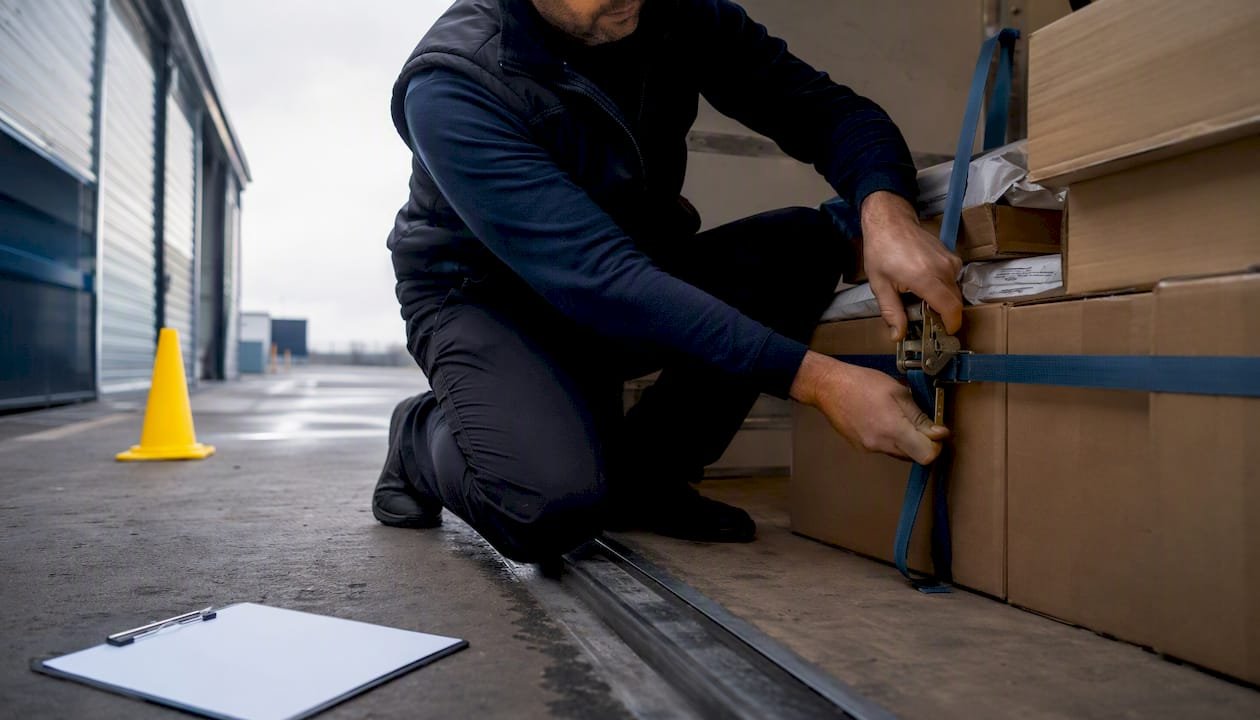
For same-day consignments, the best providers keep the goods on a single dedicated vehicle from collection to final drop. No hub offloading, no co-mingling with other clients’ freight. That single-vehicle approach, highlighted in B2B courier strategy guidance, materially reduces touchpoints and therefore risk for time-critical or high-value items.
For next-day and economy services, hub sortation is normal. The provider’s job is to sequence drops efficiently within a geographic zone so the driver completes the round without backtracking. Ask suppliers how they allocate consignments to routes and whether multi-drop sequences are pre-planned the night before or built dynamically on the day.
Driver handovers for long-distance same-day runs are a practical necessity under UK drivers’ hours rules. A credible provider will name the handover points in advance and confirm them in writing. For multi-leg consignments, the handover protocol should be part of the service agreement, not an ad hoc decision made on the day.
Pro Tip: Ask every supplier to describe their contingency process for a driver who approaches their hours limit mid-route. If they cannot name a specific handover point or a second driver on standby, that is a red flag worth acting on before you sign anything.
Which service features actually reduce delivery risk?
Tracking and documentation are where most delivery failures become visible, and where good providers separate themselves from average ones.
- Web tracking: live status updates accessible without calling the depot, covering every stage from collection to signed POD.
- Exception alerts: automatic notification when a route change occurs, with a revised ETA. The procurement framework requires this for same-day consignments specifically.
- POD detail: signed recipient name, full timestamp, GPS co-ordinate, and photo evidence where agreed. Specify these fields in your contract rather than accepting a generic “delivered” confirmation.
- White-glove handling: dedicated vehicle, secure seals, and trained handlers for fragile or high-value items.
- Indemnity levels: confirm the per-consignment limit in the base rate and the process for declaring higher values. For complex, multi-leg moves, tracking approaches for complex logistics can inform what visibility standards to demand.
What drives the price of same-day and next-day courier services?
Five variables account for most of the price difference between quotes:
- Speed: same-day carries a premium over next-day; the earlier the guaranteed delivery window, the higher the rate.
- Distance: longer runs cost more, particularly for dedicated vehicles.
- Vehicle type: a transit van costs less than a curtainsider or a dual-manned specialist vehicle.
- Number of stops: multi-drop routes add time and complexity; ask for a per-stop rate alongside the base rate.
- Out-of-hours and special handling: night collections, bank holiday runs, and white-glove requirements all attract surcharges.
For routine consignments with a 24-hour tolerance, a timed next-day service is almost always the better value choice. Reserve same-day for genuine urgency. When negotiating, request price bands by distance bracket, a multi-drop discount schedule, and trial pricing for new routes before committing to a contract.
A procurement checklist: questions to ask and KPIs to set
KPIs to require from day one
- On-time collection rate (target: 98%+)
- On-time delivery by SLA window (target: 95%+)
- Damage-free delivery rate
- Percentage of consignments with web-accessible tracking
- POD return time (signed POD available within agreed hours of delivery)
Ten questions to put to every supplier
- What is your guaranteed collection window after a booking is confirmed?
- Which next-day SLA windows (9am, 10am, 12pm, 1pm, 5pm) can you commit to contractually?
- How do you notify us of a route change, and within what timeframe?
- What is your documented process when a driver approaches their legal hours limit?
- What are your per-consignment GIT insurance limits, and how do we declare higher values?
- Can you provide a full vehicle fleet list, including specialist and dual-manned options?
- Do you cover Northern Ireland and international destinations using your own resources or partners?
- What does your web tracking portal show, and can we access it without calling your operations team?
- What POD fields do you capture as standard, and can we specify additional fields?
- Will you offer a paid trial job on a representative route before we sign a framework agreement?
Red flags: no web tracking portal, no signed POD practice, inability to confirm 24/7 availability, or a fleet limited to a single vehicle type.
Why Frphaulage is the recommended partner for UK multi-drop deliveries
Frphaulage meets every capability point on the checklist above.
- Collection within 60–120 minutes of your call, 24 hours a day, 365 days a year.
- Personal fleet plus a vetted partner network, so capacity does not disappear at peak times or on bank holidays.
- Signed POD for every shipment, with the detail levels procurement requires.
- Full SLA menu: timed deliveries before 9am, 10am, 12pm, 1pm, and 5pm.
- Driver-hours contingency: planned handover points and dual-manned options for long-distance same-day runs.
- Indemnity options scaled to consignment value, including high-value cargo.
Frphaulage’s professionalism and communication have been highlighted by clients as the factors that keep them returning for both urgent single drops and planned multi-drop schedules across the UK.
For a full picture of same-day courier service options, including vehicle types and coverage detail, the Frphaulage service pages carry the specifics procurement needs.
What documents and trials should you request before onboarding?
Before signing any framework agreement, request the following:
- Goods in Transit insurance certificate with per-consignment limits stated clearly.
- ADR licence if your consignments include hazardous materials.
- Drivers’ hours policy document describing the contingency process for long-distance runs.
- Vehicle fleet list with load capacities and specialist vehicle availability.
- Sample POD template showing every field captured as standard.
Then run a paid trial job. Choose a route that represents your typical consignment: single or multi-drop, the distance band you use most, and the SLA window you rely on. Agree the KPIs in writing before the trial starts, review performance against them at the end of the agreed window, and confirm that the web tracking and signed POD met the standard you specified. A short trial with agreed failure thresholds is far less costly than discovering gaps after a full contract is live.
When operational certainty is worth paying for
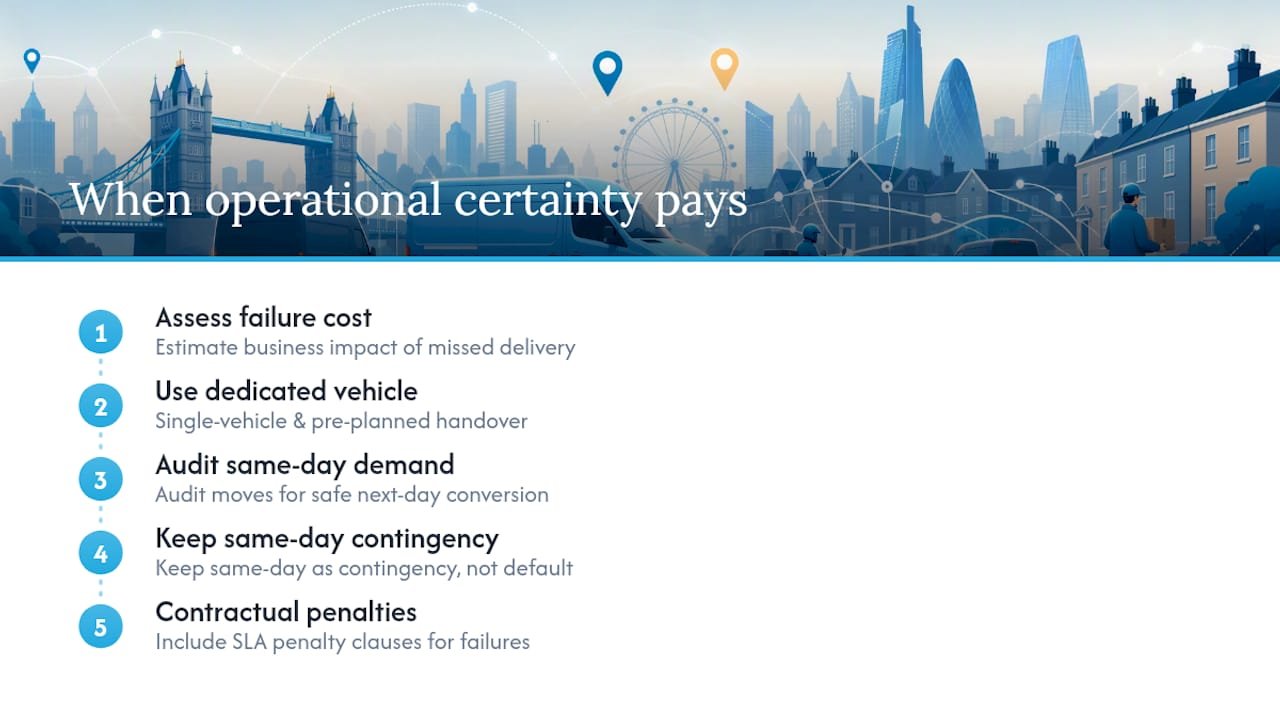
Price is the wrong starting point for same-day courier decisions. The right question is: what does a failed delivery actually cost?
For manufacturing operations, a missed component delivery can idle a production line for hours. For high-value consignments, a lost or damaged shipment triggers insurance claims, client relationship damage, and administrative time that dwarfs the courier premium. In those situations, the dedicated single-vehicle approach and the pre-planned driver handover are not luxuries; they are the only way to give the consignment a reliable chance of arriving on time and intact.
That said, same-day is a premium service, and procurement frameworks are right to push suppliers to help reduce same-day volumes over time through continuous improvement planning. The practical approach is to audit which same-day movements could be converted to timed next-day without operational risk, convert those, and keep same-day access as a genuine contingency rather than a default. Build SLA penalty clauses into the contract from the start so persistent failures carry a financial consequence.
Frphaulage: request a quote or trial job today
Frphaulage gives procurement teams something most courier contracts do not: a single point of contact, a personal fleet backed by a vetted partner network, and a signed POD on every consignment, available around the clock.
Whether you need an urgent single collection within the hour or a planned multi-drop schedule across UK regions, Frphaulage can confirm availability and pricing quickly. Visit the Frphaulage services page to review fleet options and coverage, or go straight to choosing a same-day courier service to start a conversation about a trial job or account set-up.