Confirm a compatible delivery time-slot and unloading method before anything leaves the supplier’s yard. That single action prevents the majority of construction site delivery failures. Everything else — paperwork, safety checks, post-delivery records — depends on that window being correct.
Before a vehicle moves, run through this checklist:
- Pre-book a named time-slot that matches gate opening hours and crane or forklift availability
- Confirm the exact unloading point, access route and any height or weight restrictions
- Verify that the driver has completed or is booked for site induction
- Confirm the POD method (signed docket, digital capture, photo)
- Record the vehicle registration on the booking and on the site manifest
Pro Tip: Add a named primary contact and an alternative contact to every booking. Put both numbers on the vehicle manifest. When a driver arrives early, late, or at the wrong gate, those two numbers resolve it in minutes rather than hours.
The Berkeley Group’s Code of Practice for construction logistics sets the benchmark many UK sites now follow, requiring pre-registered vehicles, timed slots and banksman-supervised unloading as standard. Frphaulage operates within the same parameters, providing vehicle registration in advance, signed Proof of Delivery and a confirmed escalation contact on every job.

Key takeaways
Effective construction site delivery depends on booking discipline, confirmed unloading arrangements and captured POD — every time, without exception.
| Point | Details |
|---|---|
| Book a compatible time-slot first | Confirm gate hours, vehicle type and crane availability before any supplier despatches. |
| Confirm induction and contacts | Every driver needs a site induction reference and two contact numbers on the manifest before arrival. |
| Capture POD with a photograph | Sign the docket only after checking the goods; annotate any damage or shortage before signing. |
| Use a delivery management platform | Systems with ANPR, time-slot booking and digital POD reduce gate congestion and create auditable records. |
| Frphaulage for urgent uplift | Frphaulage collects within 60–120 minutes across the UK, with signed POD and 24/7 availability for programme-critical deliveries. |
Table of Contents
- Why construction site deliveries are harder than standard freight
- How to manage a construction site delivery from booking to records
- What health, safety and the Code of Practice require for UK site deliveries
- How to manage vehicle access, unloading points and oversized loads
- Which features should a delivery management system have?
- When should you use same-day or urgent haulage for a construction site?
- What do construction deliveries cost and how long do they take?
- What to do when a delivery is refused, damaged or incomplete
- How Frphaulage handles urgent site deliveries in practice
- A ready-to-use delivery checklist for your site team
- What site teams consistently get wrong about delivery management
- Frphaulage supports urgent and scheduled site deliveries across the UK
- Sources
Why construction site deliveries are harder than standard freight
A standard parcel delivery tolerates a two-hour window and a safe place to leave the goods. A construction site delivery tolerates neither. The constraints are structural, and ignoring them is expensive.
Sites operate around fixed programme milestones: a concrete pour cannot wait for late rebar, a crane lift cannot be rescheduled at short notice without cost, and a structural steel delivery that arrives during a restricted traffic period simply cannot get in. Laydown areas are finite and often shared between trades. A flatbed that arrives unannounced with no banksman arranged blocks the access road for every other vehicle behind it.
The common failure modes cluster around a handful of causes:
- Missed booking windows: vehicle arrives outside the agreed slot and is turned away or queued for hours
- Incompatible vehicle type: a rigid lorry sent to a site that requires an articulated with a HIAB
- Incomplete paperwork: delivery docket missing a job number or purchase order reference, triggering a rejection
- No banksman arranged: unloading cannot proceed safely without a trained spotter, so the driver waits
- Theft and vandalism: materials left in an unsecured laydown area overnight disappear before the trade needs them
- Congestion at the gate: multiple suppliers arriving simultaneously with no booking system in place
Each of these cascades. A missed window on a structural steel delivery can push a crane booking by a day. That day costs money on the crane hire, on the operatives standing by, and on the knock-on programme delay. Construction logistics management software such as PLOT exists precisely because these cascades are predictable and preventable when procurement, delivery scheduling and site resource reservations are synchronised.
How to manage a construction site delivery from booking to records
A replicable workflow removes the dependency on individual memory and reduces handover failures. The sequence below applies to scheduled deliveries; the urgent variant is covered separately.
The booking-to-POD workflow
- Raise the delivery request against a job number and purchase order. Record supplier name, material description, quantity, weight and dimensions.
- Select a time-slot that aligns with gate hours, crane or forklift availability, and the relevant trade’s programme window. Confirm the slot with the site logistics coordinator.
- Confirm vehicle requirements: flatbed, HIAB, tail-lift, curtainsider, or abnormal load. Note any height, width or weight restrictions at the gate or on the access route.
- Issue the booking confirmation to the supplier and driver. Include: job number, site address, gate reference, time-slot, unloading point, contact name and number, alternative contact, PPE requirements, and banksman arrangement.
- Pre-arrival check (24 hours before): confirm the vehicle registration, recheck the time-slot against programme changes, and verify that induction is complete or booked.
- Arrival and access control: driver checks in at the gate, vehicle registration is verified against the manifest (manually or via ANPR), and the driver is directed to the correct unloading point.
- Supervised unloading: banksman or spotter in place for all reversing and crane-assisted lifts. PPE enforced. Materials checked against the delivery docket on arrival.
- POD capture: site representative signs the delivery docket. Note any shortages, damage or substitutions on the docket before signing. Photograph the delivered goods.
- Post-delivery reconciliation: match the signed POD against the purchase order in the procurement log. Raise a discrepancy note immediately if quantities or specifications differ.
Pro Tip: Integrate delivery windows with the master programme’s CPM milestones. Materials should arrive just in time for the trade that needs them — not a week early to sit in a laydown area and get damaged, and not the morning of the pour when there is no margin for error.
Every vehicle attending site should carry:
- Signed delivery docket with job number and purchase order reference
- Driver’s site induction confirmation or pre-registration number
- Risk assessment summary for the load (mandatory for abnormal or hazardous materials)
- Permit to travel for oversize or abnormal loads where required by the local traffic authority
For staging and haul-off considerations on bulk deliveries, construction material logistics guidance from specialists in that field is worth reviewing alongside your site-specific traffic management plan.
What health, safety and the Code of Practice require for UK site deliveries
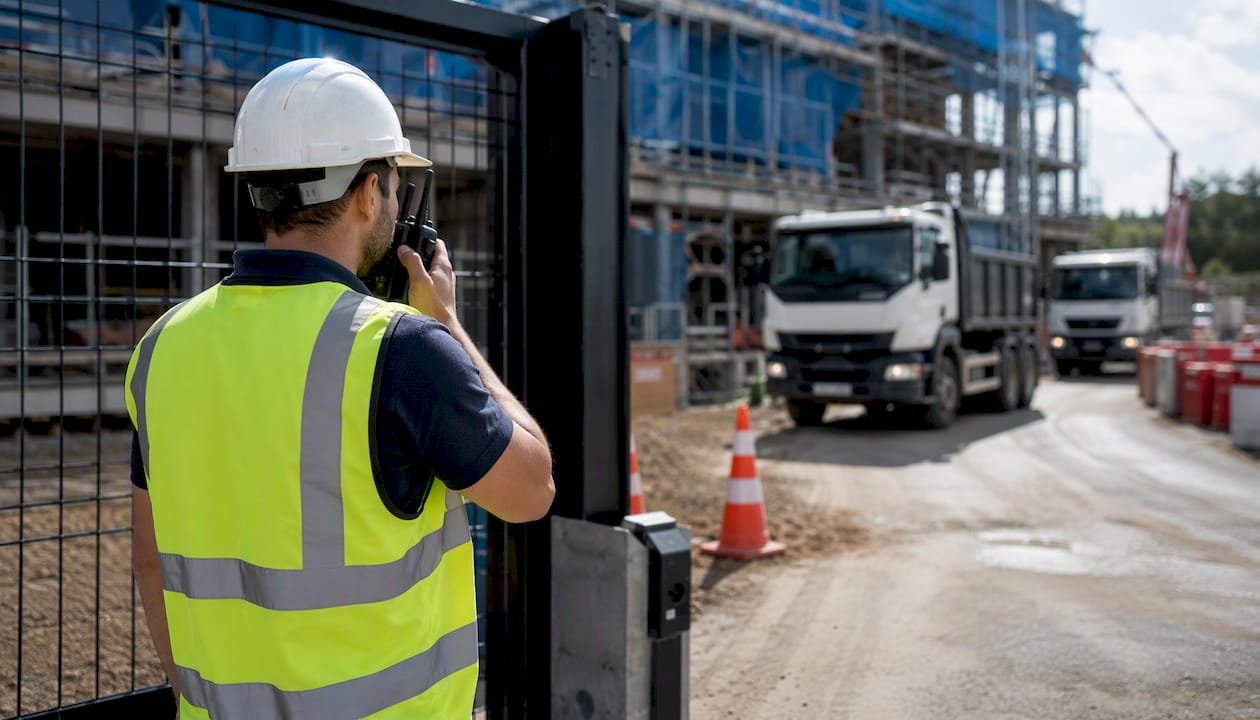
Follow site induction, vehicle segregation and banksman procedures. On a UK construction site, these are not optional courtesies — they are legal and contractual requirements, and a delivery that bypasses them will and should be refused.
The practical controls that flow from this guidance:
- Segregation: pedestrian routes and vehicle routes must never cross during active delivery operations. Barriers, signage and marshals enforce this.
- Exclusion zones: establish a minimum exclusion radius around crane lifts and HIAB operations. No pedestrian access during the lift.
- Banksman/spotter: mandatory for all reversing manoeuvres and crane-assisted unloading. The banksman must be visible to the driver at all times.
- PPE: hard hat, high-visibility vest and steel-toecap boots are the minimum for anyone in the delivery zone. Site rules may require additional PPE for specific materials.
- Vehicle checks: drivers should complete a pre-delivery vehicle check. Defective vehicles should not enter site.
- Reversing protocols: forward-in parking is preferred wherever the site layout allows. Where reversing is unavoidable, a banksman is required.
- Traffic management plan: every site above a certain scale should have a written traffic management plan that covers delivery routes, turning areas, parking and emergency access. Update it when the site layout changes.
Driver vetting and site induction reduce risk at the gate. The Security Industry Authority maintains accreditation and guidance for security contractors, relevant where sites require vetted personnel for high-value or sensitive deliveries. Pre-registration of drivers and vehicles before first attendance means the gate team is not making access decisions under time pressure.
Recordkeeping for compliance should include: signed PODs, delivery photographs, induction logs with dates and driver names, and a delivery incident log for any refusals, damage or near-misses. These records protect the site in the event of a dispute or HSE inspection.
How to manage vehicle access, unloading points and oversized loads
Gate control is where most delivery problems become visible, but the decisions that cause them were made days earlier. Publish your site’s access rules, unloading points and laydown areas to every supplier before they book — not on arrival.
A clear site access pack should include: gate location and opening hours, maximum vehicle dimensions, weight limits on the access road, designated unloading bays with reference numbers, laydown area allocations by trade or material type, and the booking contact’s name and number. Send it with every purchase order.
For abnormal and oversized loads, the checks are more involved:
- Confirm whether a Section 59 abnormal load notification or police escort is required under the Road Vehicles (Authorisation of Special Types) General Order 2003
- Book the crane or HIAB in advance and confirm the lift plan with the appointed person
- Arrange escort vehicles where required and notify the local highway authority
- Confirm the banksman requirement with the haulier before despatch
- Check overhead obstructions on the access route (power lines, bridges, gantries)
- Notify neighbours or adjacent businesses if the delivery will affect the public highway
Night deliveries and restricted-access locations need a separate brief. Map the drop-off route from the nearest trunk road to the unloading point and share it with the driver before departure. For deliveries outside normal hours, confirm that gate security is briefed, lighting is adequate in the unloading area, and that a site contact is reachable by phone throughout the operation.
Security for delivered goods matters as much as the delivery itself. Secure laydown areas with perimeter fencing, CCTV coverage and a sign-in/sign-out log for materials. High-value items — copper, stainless steel, power tools, plant — should be stored in a locked compound and recorded on a materials register.
Pro Tip: On larger sites during peak delivery phases, designate a permanent delivery coordinator whose sole job is managing the gate list, resolving conflicts between time-slots, and communicating changes to suppliers in real time. One person with authority to make decisions at the gate is worth more than the best booking system running unattended.
Which features should a delivery management system have?
Prioritise systems that enforce bookings, capture POD digitally and integrate with access control. A spreadsheet and a phone can manage a small site; anything above a handful of deliveries per day needs a platform.
The features that materially reduce site friction:
- Time-slot booking with approval workflow: suppliers request a slot; the site coordinator approves or redirects. No unannounced arrivals.
- ANPR integration: automatic number-plate recognition at the gate matches the arriving vehicle against the booking. Removes manual checking and creates an auditable access log.
- Role-based approvals: different users (site manager, logistics coordinator, procurement) have different permissions. Prevents unauthorised bookings.
- Digital POD capture: electronic signatures, timestamped photographs and delivery notes stored against the booking record.
- CO₂ and KPI reporting: track vehicle movements, delivery performance and environmental metrics. Increasingly required by clients and planning conditions.
- Multi-drop support: manage deliveries that cover multiple drop points within the same site or across a programme.
- Crane and gate booking integration: link delivery slots to crane availability so a HIAB delivery cannot be booked when the crane is committed elsewhere.
VIS Systems is an established example of a delivery management platform built specifically for construction sites, with ANPR, time-slot booking, POD capture and CO₂/KPI reporting as documented features. It is not the only option, but it illustrates what a purpose-built system should do.
PLOT takes the integration further by connecting procurement logs and CPM schedules directly to delivery bookings, so a material submittal approval automatically triggers a delivery window. For programmes with complex sequencing, that link between design approval and physical delivery is where most premature-delivery waste originates.
When evaluating any platform, check whether it integrates with your project scheduling tool, your procurement system and your workforce induction records. A system that sits in isolation from those three creates reconciliation work rather than removing it. Trends in delivery technology — including AI-assisted scheduling and real-time tracking — are covered in Frphaulage’s same-day delivery trends for 2026.
When should you use same-day or urgent haulage for a construction site?
Urgent uplift is justified when a delay has a direct, measurable programme cost that exceeds the premium for same-day service. That calculation is usually straightforward: a crane standing idle at £800 per day while waiting for a missing component costs more than an urgent courier run.
Common scenarios that warrant same-day or specialist haulage:
- A scheduled delivery was refused or failed to arrive and the trade needs the material today
- A late design change requires a substituted component before a pour or structural fix
- A critical spare is needed for a plant breakdown that is holding up the programme
- Documents or drawings need to reach site before a statutory inspection or sign-off
- A high-value or fragile item requires white-glove handling that a standard pallet network cannot provide
When briefing an urgent service, include:
- Exact drop point: gate reference, unloading bay number, contact name and mobile number
- Vehicle access constraints: maximum vehicle length, width, height and axle weight
- Load details: weight, dimensions, any handling requirements (HIAB, tail-lift, two-person carry)
- Banksman requirement: confirm whether the site will provide one or whether the driver needs to arrange it
- Alternative contact: a second mobile number in case the primary contact is unavailable
The differences between service types matter when briefing:
- Same-day/hotshot courier: collection within 60–120 minutes, direct point-to-point, suited to documents, small components and urgent parcels up to van capacity
- Same-day specialist haulage: larger vehicles, HIAB or tail-lift capability, suited to plant components, steel sections or equipment that a van cannot carry
- Next-day scheduled: lower cost, fixed collection and delivery windows, suited to non-critical replenishment where a 24-hour lead time is acceptable
When choosing an urgent provider, the criteria that matter most on a construction site are response time, POD capability, vehicle range and insurance cover. Frphaulage’s guide to choosing a same-day courier covers those selection points in detail.
Pro Tip: Always obtain a confirmed ETA and add the vehicle registration to the site manifest before the driver departs. A secure site that cannot verify the vehicle registration will not let the driver in, regardless of how urgent the delivery is.
What do construction deliveries cost and how long do they take?
Scheduled deliveries from a UK supplier typically take several working days depending on material type, fabrication lead time and distance. Next-day services are available from most national carriers for standard palletised goods. Same-day and urgent collections operate on a 60–120 minute collection window with delivery time determined by distance and route.
Site constraints extend effective lead times beyond the carrier’s quoted transit time. A 48-hour transit becomes a 72-hour effective lead time if the only available delivery slot is two days after the material is ready to despatch.
The main cost drivers for construction deliveries in the UK:
- Distance: the primary variable. Regional deliveries cost less than national trunking runs.
- Vehicle type: a standard curtainsider costs less than a HIAB-equipped flatbed. Tail-lift vehicles carry a premium over step-frame trailers.
- Abnormal load permits and escorts: Section 59 notifications, police escorts and pilot vehicles add cost and lead time. Budget for these on structural steel, precast concrete and large plant movements.
- Site access difficulty: restricted access, narrow roads, weight-limited bridges and timed entry windows increase driver time and may require a smaller vehicle with a transhipment.
- Waiting and crane time: a driver held at the gate or waiting for a crane adds demurrage charges. Minimise this by confirming the unloading arrangement before despatch.
- Out-of-hours and weekend delivery: night, weekend and bank holiday deliveries carry a premium, typically a percentage uplift on the base rate.
- Insurance and special handling: high-value cargo, fragile items and hazardous materials require additional cover and handling protocols.
| Cost driver | How it affects price |
|---|---|
| Distance | Longer haul increases fuel, driver time and overnight costs |
| Vehicle type | HIAB and tail-lift vehicles carry a day-rate premium |
| Abnormal load permits | Statutory fees plus escort and pilot vehicle costs |
| Site access difficulty | Extra driver time, possible transhipment to smaller vehicle |
| Waiting/crane time | Demurrage charged per hour beyond agreed free time |
| Out-of-hours delivery | Percentage uplift on base rate for nights, weekends, bank holidays |
| Special handling/insurance | Additional premium for high-value, fragile or hazardous loads |
To keep costs down: consolidate multi-drop runs where programme sequencing allows, use palletisation to reduce manual handling charges, and book scheduled runs for steady material flows rather than defaulting to same-day for convenience. Reserve urgent services for genuine programme-critical situations.
What to do when a delivery is refused, damaged or incomplete
Stop unloading immediately. Every action after that point is about preserving evidence and opening the claim correctly.
- Stop unloading as soon as damage or a discrepancy is identified. Do not move the goods further.
- Photograph everything before any goods are touched: the load on the vehicle, the packaging condition, any visible damage, and the delivery docket.
- Record a witness: note the name of the driver and any site operative who observed the condition on arrival.
- Annotate the POD: write the specific reason for refusal or the nature of the damage on the delivery docket before signing. “Received in good condition” is not acceptable if it is not true. Sign as “refused” or “received damaged” with a description.
- Retain a copy of the annotated POD: photograph it before the driver leaves.
- Notify the supplier and carrier within the timeframe specified in the contract or carrier’s terms. Most carriers require notification of damage within 24–72 hours of delivery.
- Open a formal claim with the carrier’s claims team, attaching the photographs, the annotated POD and the purchase order.
- Assign responsibility for follow-up to a named person on site. Claims that sit in a shared inbox get lost.
For part deliveries, accept the goods that are in good condition and record the outstanding items on the POD with quantities and descriptions. Raise a delivery discrepancy note against the purchase order immediately. Do not wait for the next delivery to reconcile — the window for a valid claim closes quickly.
Pro Tip: Keep a dedicated delivery incident log — a simple dated spreadsheet entry per incident with photographs attached. Timestamped evidence resolves supplier and insurer disputes faster than any amount of correspondence.
How Frphaulage handles urgent site deliveries in practice
When a construction programme hits a critical gap — a missed delivery, a plant breakdown, a last-minute design change — the response time of the haulier determines whether the programme recovers that day or loses it entirely.
Frphaulage operates a same-day and next-day courier and haulage service across the UK, with urgent collection available within 60–120 minutes of a call, 24 hours a day, 365 days a year. The operational process on a site delivery follows a consistent sequence: pre-call to confirm the exact drop point and vehicle access constraints, vehicle registration provided to the site contact before departure, driver briefed on site induction requirements, photo POD captured on delivery, and a signed delivery confirmation returned to the client.
The practical steps Frphaulage applies to construction site deliveries:
- Vehicle registration confirmed and added to the site manifest before the driver departs
- Driver briefed on site-specific access rules, PPE requirements and unloading point
- Signed and photographed POD captured at the point of delivery
- Delivery confirmation sent to the client contact immediately after handover
- Escalation contact available throughout the job for real-time updates
The service covers documents, small components, plant spares, high-value items and multi-drop runs across regions. For site managers who need to evaluate what to check when booking an urgent provider, Frphaulage’s same-day courier selection guide covers response time, POD, vehicle capability and insurance in practical terms.
A ready-to-use delivery checklist for your site team
Copy this into your booking form, delivery management tool or toolbox talk. It covers the five stages every delivery should pass through.
Pre-booking:
- Job number and purchase order reference confirmed
- Supplier name, material description, quantity, weight and dimensions recorded
- Time-slot booked and confirmed against gate hours and crane/forklift availability
- Vehicle type confirmed as compatible with site access and unloading method
- Primary and alternative contact names and numbers recorded on the booking
Confirmation (24 hours before):
- Vehicle registration confirmed and added to the site manifest
- Driver induction status checked (completed or pre-booked)
- Time-slot rechecked against any programme changes
- Banksman arranged if required for reversing or crane-assisted unloading
- Abnormal load permits confirmed if applicable
Arrival:
- Vehicle registration verified at the gate against the manifest
- Driver directed to the correct unloading point
- PPE checked before entry to the delivery zone
- Banksman in position before any reversing or lifting begins
Unloading and POD:
- Goods checked against the delivery docket on arrival
- Any damage, shortages or substitutions noted on the docket before signing
- POD signed and photographed
- Goods moved to the designated laydown area or secure compound
Post-delivery:
- Signed POD matched against the purchase order in the procurement log
- Discrepancy note raised immediately if quantities or specifications differ
- Delivery incident log updated if any refusal, damage or near-miss occurred
This checklist integrates directly into a delivery management platform such as VIS Systems or PLOT, or it can run as a tab in a shared spreadsheet for smaller sites. The key is that it is completed by a named person, not left as a general team responsibility.
What site teams consistently get wrong about delivery management
The biggest failures in construction delivery management are not technical. They are behavioural.
Booking discipline collapses under programme pressure. When a pour date moves forward by two days, the instinct is to chase the supplier and hope the delivery arrives in time. The better move is to treat the booking confirmation as a hard constraint: if the slot cannot be moved, the pour date needs to flex, not the safety and access controls around the delivery. Bypassing the booking process to accommodate a programme change is how vehicles end up arriving without a banksman, without a confirmed unloading point, and without anyone at the gate who knows they are coming.
The second consistent failure is POD discipline. Signing a delivery docket as “received in good condition” without checking the goods is a habit that costs money every time something is wrong. The signed docket is the evidence. Once it says the goods arrived undamaged, the claim window closes. Thirty seconds with a camera and an annotated docket is worth more than hours of correspondence with a carrier’s claims team.
Communication between the supplier, the haulier and the site team is where the gaps live. A supplier who does not know the site’s vehicle restrictions sends the wrong vehicle. A haulier who does not have the alternative contact number cannot reach anyone when the primary contact is in a meeting. These are not system failures. They are the result of not building the communication structure into the booking process from the start.
Frphaulage supports urgent and scheduled site deliveries across the UK
When a construction programme cannot afford to wait, the difference between a 60-minute collection and a next-morning service is a day of programme time. Frphaulage offers same-day and next-day courier and haulage across the UK, with urgent collection within 60–120 minutes, signed POD on every shipment, and 24/7/365 availability.
For construction sites specifically, Frphaulage handles tool and equipment delivery, replacement plant components, urgent structural documents, multi-drop runs across a programme, and high-value or fragile items requiring careful handling. Every job includes a vehicle registration confirmed before departure, a briefed driver, and a signed and photographed POD returned to the client.
When you need to evaluate whether a same-day provider is right for your site, Frphaulage’s complete guide to choosing a same-day courier covers the criteria that matter: response time, POD capability, vehicle range and insurance. For an immediate quote or to book an urgent uplift, contact Frphaulage directly.
Sources
- Construction site delivery management – VIS Systems
- PLOT: Construction logistics management software
- Olearydevelopmentgroup